New Claude Code Workflow: 9 Open-Source Skill Packs Take Over the Entire PR Lifecycle

Theo open-sources the TS-Tech skill pack, letting AI take over post-coding testing, PRs, and CI workflows.
Theo's open-source TS-Tech skill pack contains 9 instruction files for Claude Code and Codex, focused on post-coding tasks like testing, code review, PR submission, and fixing CI failures. Its main skill, "Big Number," does not rush to open a PR but first reproduces the defect or verifies the change, then sequentially invokes multi-model review, PR description generation, and Babysitter PR monitoring. The skills offer Full Speed and Full Stop modes, differing in whether they auto-merge. The "console" skill brings in Claude, GPT, and Gemini for cross-review. The article also notes that skills have dependencies, require extra multi-model access configuration, and recommends starting with low-risk changes, File PR, and Babysitter PR in stages.
When AI Starts Handling the "After the Code Is Written" Work
Most AI coding tools are competing on one thing: getting the model to write more elegant code. But a developer named Theo has open-sourced 9 AI agent skills that tackle the mess after the code is written—testing, code review, submitting PRs, fixing CI failures, and even taking over unfinished PRs. According to the introduction by Bilibili creator Better Stack, this skill pack, called TS-Tech, has already attracted considerable attention.
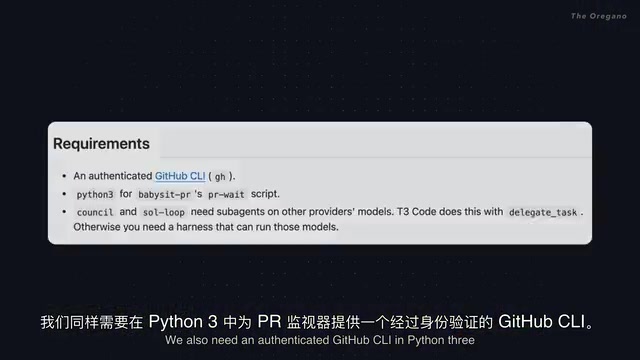
These skills are used in conjunction with Claude Code and Codex, and installation is not complicated: clone the repository and copy the skills into the corresponding skills directory. Some advanced features require additional environment preparation, such as providing an authenticated GitHub CLI for the PR monitor and access to models from other vendors.
The Main Skill "Big Number": Starting by Proving the Problem Exists
The most talked-about skill in this pack is the main skill "Big Number" (transliterated from the original). Its workflow has a counterintuitive starting point: instead of rushing to open a pull request, it first tries to prove that the change actually works—reproducing the original defect, running tests, or directly inspecting the application itself.
This design reflects an insight into a real pain point in AI coding. Better Stack puts it bluntly in the video: AI can indeed produce a fix, but the moment you run it, it crashes outright, and then you need another fix to patch the hole created by the first fix, sometimes even falling into a loop. Verifying first and submitting later amounts to distinguishing "seemingly fixed" from "actually fixed."
After verification, "Big Number" calls the other skills in sequence: Soul Loop brings in another AI model to review the code and address feedback item by item; File PR generates the description. You may not have noticed how PR descriptions are written—it does not list every file touched, but rather starts from the core problem at hand, explains the fix, and demonstrates the testing process, making the PR truly easy to understand.
Coding Agent in this type of workflow generally refers to an AI program capable of autonomously reading and writing files, running commands, and invoking external tools; Claude Code and Codex are two representative implementations today. Unlike ordinary code completion, an agent can plan multi-step operations according to task goals, which is why it can complete a chain spanning multiple tools such as "reproduce defect → run tests → submit PR." Understanding this helps clarify that the "skills" discussed in this article are not capabilities of the model itself, but a set of structured instructions for the agent, specifying what it should do at each stage, in what order, and when it should stop and wait for human decisions.
Babysitter PR and "Full Speed / Full Stop"
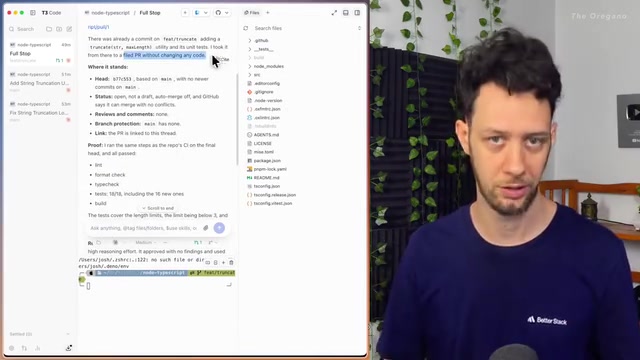
Most agents stop once the PR is submitted; what sets this skill pack apart is that it keeps going. The Babysitter PR skill specifically watches CI and review feedback. Once a failure or a reasonable review comment appears, it can investigate the issue, make small fixes, and verify again. But even so, "Big Number" will not merge the PR on its own—it hands the final decision back to a human.
Better Stack thus summarizes two modes: full speed and full stop. The former goes through the entire chain—proving the problem, Soul Loop review, File PR, Babysitter PR monitoring—and automatically merges once the necessary checks and reviews pass; the latter goes through the same process but does not merge. The difference lies in what work gets completed and who makes the final decision.
The value of this skill pack is not that it makes AI better at writing code, but that it handles the repetitive work that is usually thrown back to you after the code is written: no more switching back and forth between the terminal and GitHub—just review once the results are ready.
CI (Continuous Integration) refers to the set of checks automatically executed by a server after code is submitted, including compilation, unit tests, static analysis, etc., with results typically reported on the PR page as pass or fail. Branch protection is a repository-level rule specifying that merging into the main branch is prohibited when certain checks have not passed or without approval from designated people. Together, these two mechanisms form the external basis for "Babysitter PR" to automatically determine when to intervene and when to stop. Without reliable tests and branch protection, letting an agent auto-merge PRs is tantamount to removing the safety net—which is also why the original article emphasizes that this skill still requires genuinely effective tests and permission configurations.
Multi-Model Review and the Dependency Trap
Another noteworthy skill is console (transliterated from the original). If you have AI review its own code, you are relying on a single model's judgment and may easily go down a strange path—but this skill connects models from three different vendors: Claude, GPT, and Gemini, having each review the implementation and raise issues, going through additional rounds until consensus is reached or the workflow limit is hit.
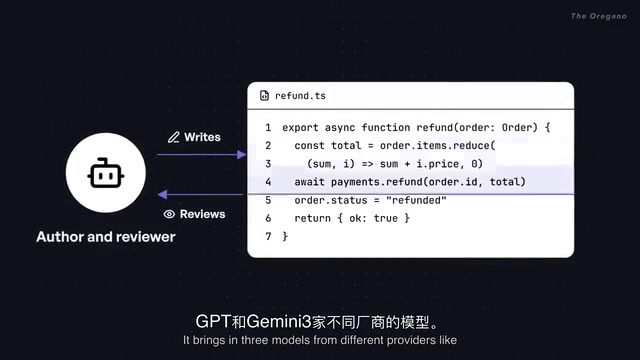
What needs to be viewed soberly is that three models reaching consensus does not automatically mean they are right, but different models can catch issues that a single model might miss—essentially a committee-style double check. There is also the takeover skill, used to take over a PR that another agent started but never finished, reading the existing work, identifying what is missing, and continuing from where it left off; and the modernize skill, used to determine whether a given change is still necessary.
These skills are not entirely plug-and-play. Advanced review workflows require additional model configuration; both Soul Loop and console depend on multi-model access, and the full workflow is not available under the basic configuration.
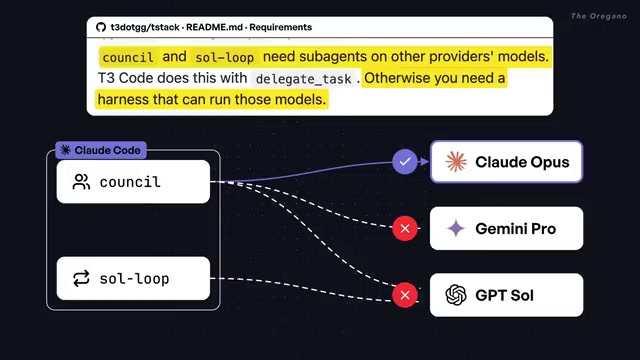
Multi-model cross-validation draws on the "diversity" principle from ensemble learning: models from different vendors differ in training data, alignment strategies, and decoding tendencies, so the same defect may not be ignored by all models simultaneously. Having Claude, GPT, and Gemini each review independently and then aggregating their disagreements can increase the probability of catching edge-case issues. But note that models may share common blind spots—for example, all tending to accept a seemingly reasonable interface design—in which case "unanimous agreement" can actually amplify errors. Therefore, this kind of committee-style review is suitable as a filter layer before human review, not as the final arbiter.
Who Should Use It, and How
The limitations of this skill pack are equally clear. The skills depend on one another—"Big Number" calls "Full Speed," which in turn calls other skills—so installing a single skill while missing dependencies will cause problems. It is essentially instructions for AI agents rather than a standalone system, and still requires appropriate permissions, genuinely effective tests, and branch protection. Nor is it necessarily the fastest or cheapest option for every change.
Better Stack's advice is to adopt it in stages: if you are already using Claude Code or Codex and submit multiple PRs every week, it is worth a try, but do not go full speed right away. Start by running your repository workflow through steps like File PR and Babysitter PR, and try Full Stop mode once the additional model configuration is ready; if you ultimately trust the process, then decide whether full rollout suits smaller, low-risk changes. Another piece of advice is that any skill should be customized to your own workflow rather than dropped in and trusted as-is.
What is interesting about this open-source skill pack is not that it makes AI better at writing code—it does not—but that it takes over the work after the code is written that is usually thrown back to people. If you are exploring the automation boundaries of AI coding workflows, this project provides a concrete reference sample.
Related articles

English Version of 'Thank You for Your Love' Gains Traction on Bilibili: A Cross-Cultural Rendition of a Classic Love Song
The English version of 'Thank You for Your Love,' titled 'I'll give you all my love,' trends on Bilibili with rewritten lyrics about giving all your love. This article analyzes its emotional expression, cross-cultural adaptation strategy, and differences from the Chinese original.

Claude Code vs Cursor vs GitHub Copilot: How to Choose Among the Three Major AI Coding Tools
A clear explanation of Claude Code, Cursor, and GitHub Copilot through the lens of 'degree of delegation': Copilot embeds in your editor for autocomplete, Cursor is an AI-first full editor with multi-file batch editing, and Claude Code executes tasks end-to-end in the terminal. Includes selection advice.

Behind the Viral Dynamic Comic Commentary: Deconstructing the Narrative of Family Finance and Emotional Conflict
Deconstructing a Bilibili dynamic comic episode on family financial conflict: how dense dialogue and emotional hooks retain viewers, and where AI script generation falls short in narrative coherence.