New Framework for Nonlinear Concept Erasure: Conditional Autoencoder Enables Precise Erasure and Steering
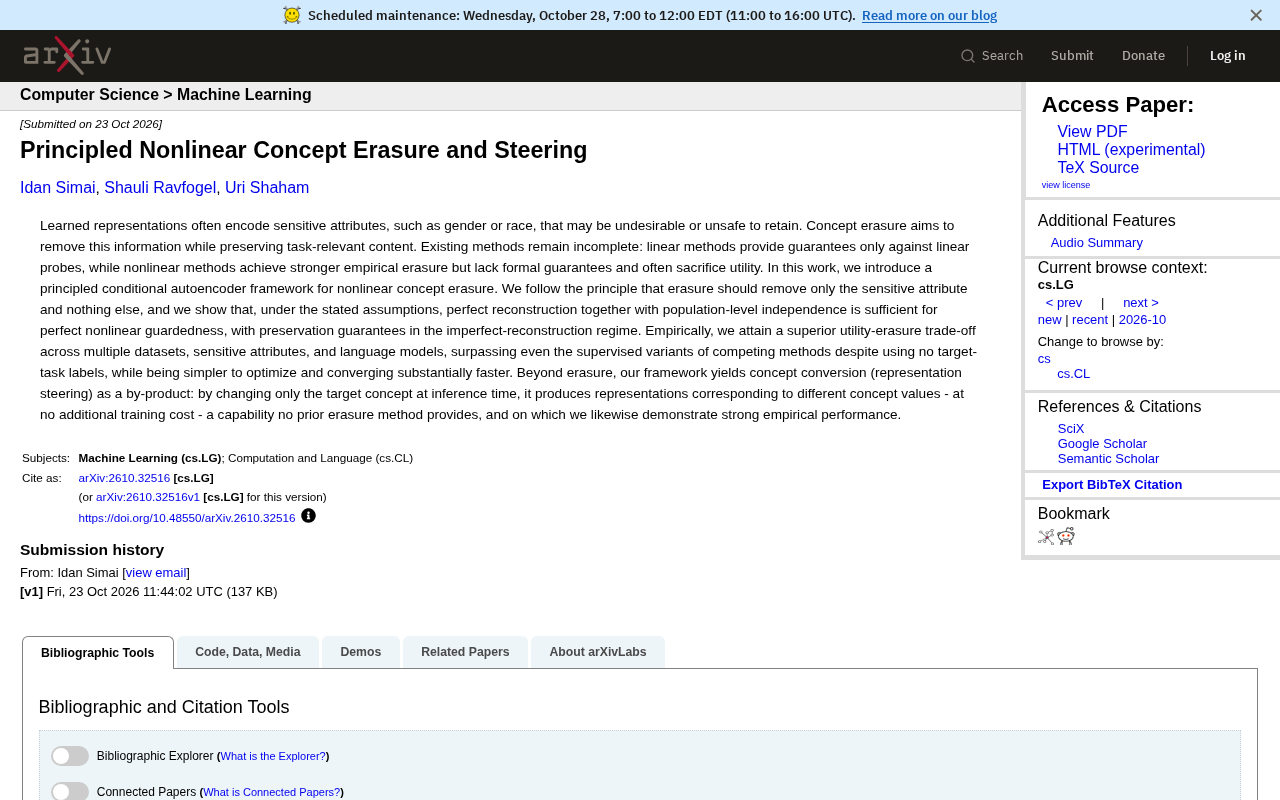
A conditional autoencoder framework provides the first formal guarantees for nonlinear concept erasure and unlocks representation steering for free.
This article introduces research on nonlinear concept erasure. Existing linear methods (such as LEACE) can only defend against linear probes, while nonlinear methods achieve more thorough erasure but lack formal guarantees and often sacrifice task utility. The new framework is based on a conditional autoencoder that simultaneously constrains reconstruction quality and marginal independence between sensitive attributes and representations, proving that perfect reconstruction plus independence achieves perfect nonlinear guardedness, with preservation guarantees even under imperfect reconstruction. Experiments show that the method achieves a better utility-erasure trade-off than supervised methods without target-task labels, with simpler optimization and faster convergence. Additionally, changing the target concept value at inference enables representation steering without additional training, a capability not offered by previous erasure methods. This work provides a verifiable, reusable theoretical framework for AI fairness and privacy governance.
Title
New Framework for Nonlinear Concept Erasure: Conditional Autoencoder Enables Precise Erasure and Steering
Meta Description
This paper proposes a conditional autoencoder framework that provides formal guarantees for nonlinear concept erasure, achieving a better utility-erasure trade-off without target-task labels and unlocking representation steering with faster convergence.
Article Content
AI models inevitably learn sensitive attributes such as gender and race during training. How to erase this information without sacrificing task utility has long been a challenge in representation learning. Existing methods either work only for linear probes or sacrifice utility. A recent paper proposes a framework based on conditional autoencoders that provides the first formal guarantees for nonlinear concept erasure and unexpectedly unlocks representation steering.
Limitations of Existing Methods: Linear Guarantees Are Too Weak, Nonlinear Methods Work but Lack Guarantees
The goal of concept erasure is to remove specific sensitive information from representations while preserving task-relevant content. Linear methods (such as LEACE) can guarantee that after erasure no linear classifier can predict the sensitive attribute, but this "lock" only defends against linear attacks—a simple MLP probe can still recover the erased information.
Nonlinear methods (such as those based on adversarial training or mutual information estimation) achieve more thorough erasure experimentally, but lack formal guarantees and often sacrifice downstream task accuracy, with unstable optimization. The authors point out: "Linear methods only guarantee against linear probes, while nonlinear methods have stronger empirical erasure effects but lack formal guarantees and often sacrifice utility." This dilemma motivated researchers to seek a middle path that balances guarantees and utility.
Linear Probes and MLP Probes: In concept erasure evaluation, a probe refers to a small classifier trained on top of representations to detect whether sensitive attributes can still be predicted. A linear probe contains only a linear layer (or logistic regression), whose decision boundary is a hyperplane in representation space; an MLP probe contains at least one hidden layer and a nonlinear activation function, capable of fitting more complex decision boundaries. Methods like LEACE ensure linear probe failure by projecting representations onto a subspace orthogonal to the sensitive attribute, but this orthogonalization cannot prevent MLP probes from exploiting residual nonlinear decodable information in the representation. Therefore, when evaluating erasure methods, reporting both linear and MLP probe accuracies is necessary to fully reflect the residual sensitive information.
Mutual Information Estimation and Adversarial Training: Mutual information measures the statistical dependence between two random variables. Ideally, erasing a sensitive attribute is equivalent to making the mutual information between the representation and the sensitive attribute zero. However, mutual information for high-dimensional continuous variables is difficult to compute exactly; in practice, neural estimators such as MINE and InfoNCE are used for lower-bound approximation, and estimation errors can lead to incomplete or excessive erasure. Adversarial training introduces a discriminator network that attempts to predict the sensitive attribute from the representation, while the main encoder is optimized simultaneously to fool the discriminator. Both methods rely on alternating optimization or additional networks, have complex training dynamics prone to oscillation, and lack provable bounds on the degree of erasure—this is precisely the source of "nonlinear methods work but lack guarantees" mentioned in the original text.
Core Principle: Erase Only the Sensitive Attribute, Not a Bit More
The new framework follows a simple but strict principle: the erasure operation should remove only the sensitive attribute and touch nothing else. To achieve this mathematically, the authors construct a conditional autoencoder whose objective simultaneously constrains two things: reconstruction quality (ensuring all task-relevant information is preserved) and marginal independence between the sensitive attribute and the representation (ensuring sensitive information is removed).
The paper proves that under given assumptions, perfect reconstruction plus marginal independence is sufficient to achieve perfect nonlinear guardedness. Even when reconstruction is imperfect, the framework provides preservation guarantees—meaning that erasure of sensitive attributes does not come at an unbounded cost to task utility. This formal result sets a theoretical benchmark for nonlinear erasure methods.
Conditional Autoencoder: An autoencoder consists of an encoder and a decoder, trained so that the decoder reconstructs the original input from the encoder's output. A conditional autoencoder introduces a conditioning variable: the encoder receives input x and condition c, and the decoder reconstructs x from representation z and condition c. In this framework, the conditioning variable is designed to be the sensitive attribute (e.g., gender). The key design is that the decoder must be able to reconstruct the input given condition c, but the representation z itself is statistically independent of c at the marginal level. Intuitively, if z still contains information about c, then given z, the predictability of c would be higher than its marginal distribution, violating the independence constraint; meanwhile, the reconstruction loss forces z to retain all information except c. Jointly optimizing both achieves the goal of "erasing only the sensitive attribute without touching other information."
Marginal Independence Constraint: Marginal independence means that the representation z and sensitive attribute c satisfy P(z,c)=P(z)P(c) in their joint distribution, equivalent to mutual information I(z;c)=0. Unlike conditional independence (independence given some variable), marginal independence does not depend on any additional conditioning variable and is a stronger constraint. Achieving exact marginal independence with finite samples is nearly impossible, so in practice batch-level statistics (such as HSIC, MMD, or correlation penalties) are used for approximate constraints. The paper's theoretical guarantees are also discussed within this approximate framework. Understanding this helps grasp the applicable boundaries of the proposition that "perfect reconstruction plus marginal independence is sufficient for perfect nonlinear guardedness."
Experimental Performance: Unsupervised Beats Supervised, Faster Convergence
The authors validated the framework on multiple datasets, sensitive attributes, and language models. The key finding: the framework achieves a better utility-erasure trade-off than existing methods, even surpassing supervised variants of competing methods—while using no target-task labels at all. In other words, it achieves better erasure and task preservation without knowing downstream task labels.
Optimization simplicity is another highlight. The paper emphasizes that the method is "easier to optimize and converges significantly faster." For practical deployment, this means lower tuning costs and shorter experiment cycles. From an engineering perspective, the combination of label-free operation, fast convergence, and strong guarantees makes the method highly attractive for privacy compliance scenarios.
Byproduct: Representation Steering Becomes a "Free" Capability
Another contribution of the framework is concept conversion, i.e., representation steering. Traditional erasure methods can only "delete information," but this framework can generate representations corresponding to different concept values by changing the target concept value at inference time within the same conditional autoencoder—without additional training cost.
The paper states: "This is a capability that no previous erasure method has provided." For example, if the model represents a "gender" concept, erasure removes it, while steering can adjust the representation from the "male" direction to the "female" direction, or to any specified concept value. This provides a new tool for controllable generation, fairness interventions, and counterfactual data augmentation. The authors also demonstrate strong performance of this capability in experiments.
Representation Steering: Representation steering refers to moving a sample's representation along a specific concept direction in the model's internal representation space, thereby changing the concept attribute reflected in the model's output without retraining the model. This differs from prompt engineering at the output layer or editing in pixel space; steering directly acts on hidden vectors in intermediate layers. Common implementations include adding a concept direction vector (e.g., a "gender direction") to the representation, or specifying a target concept value at inference time via a conditional generative model. The uniqueness of this framework lies in: erasure requires the representation to be independent of the sensitive attribute, while steering requires the representation to vary controllably according to a specified concept value. These seem contradictory, but the conditional autoencoder unifies both operations by taking the concept value as a conditioning input and replacing that conditioning value at inference—constraining independence during training for erasure, and injecting the target conditioning value at inference for steering, sharing the same set of parameters.
Industry Implications: The Intersection of Privacy Protection and Model Controllability
This work advances concept erasure from "empirical patching" to "principled design." For teams concerned with AI fairness and privacy, the conditional autoencoder framework provides a verifiable technical route: use reconstruction loss to preserve utility, independence constraints to ensure erasure, and theoretical proofs to guarantee the baseline. More notably, erasure and steering share the same set of parameters, meaning model governance tools can simultaneously serve the roles of "deleting sensitive information" and "adjusting concept directions."
Of course, the framework's guarantees depend on the assumptions given in the paper (such as the realizability of the marginal independence constraint), and approximation errors on real large-scale models still need further examination. But methodologically, it establishes a reusable theoretical framework for nonlinear concept erasure and provides new ideas for model control at the representation level.
Paper title: Principled Nonlinear Concept Erasure and Steering
(This article is based on a paper abstract from an RSS source and does not include full experimental details.)
One-line Summary
A conditional autoencoder framework provides the first formal guarantees for nonlinear concept erasure and unlocks representation steering for free.
Paragraph Summary
This article introduces research on nonlinear concept erasure. Existing linear methods (such as LEACE) can only defend against linear probes, while nonlinear methods achieve more thorough erasure but lack formal guarantees and often sacrifice task utility. The new framework is based on a conditional autoencoder that simultaneously constrains reconstruction quality and marginal independence between sensitive attributes and representations, proving that perfect reconstruction plus independence achieves perfect nonlinear guardedness, with preservation guarantees even under imperfect reconstruction. Experiments show that the method achieves a better utility-erasure trade-off than supervised methods without target-task labels, with simpler optimization and faster convergence. Additionally, changing the target concept value at inference enables representation steering without additional training, a capability not offered by previous erasure methods. This work provides a verifiable, reusable theoretical framework for AI fairness and privacy governance.
Related articles

What Is MCP? The Open Standard That Connects AI to Every Tool
MCP (Model Context Protocol) is the open standard that lets AI apps connect to tools uniformly. This article explains MCP's Host, Server, and Client roles, the Tools, Resources, and Prompts building blocks, the full path of a tool call, plus two-way use in n8n and security risks.
MCP Explained: How AI Agents Connect t…
MCP Explained: How AI Agents Connect to Your Apps
Using an e-commerce support bot scenario, this visual guide explains how MCP solves the M×N AI-tool integration problem, why raw REST calls fall short, the Tools/Resources/Prompts primitives, and Host-Client-Server security.

Industrial Intelligence: The Next Growth Engine for Manufacturing
Industrial intelligence is becoming the next growth opportunity for manufacturing. This article analyzes the core connotation of industrial intelligence, explores three key implementation scenarios—changeover assistance, knowledge transfer, and anomaly tracing—and examines practical challenges such as data silos and knowledge modeling costs, providing decision-making reference for manufacturing enterprises.