New Google Maps Feature: AI-Crafted Travel Itineraries
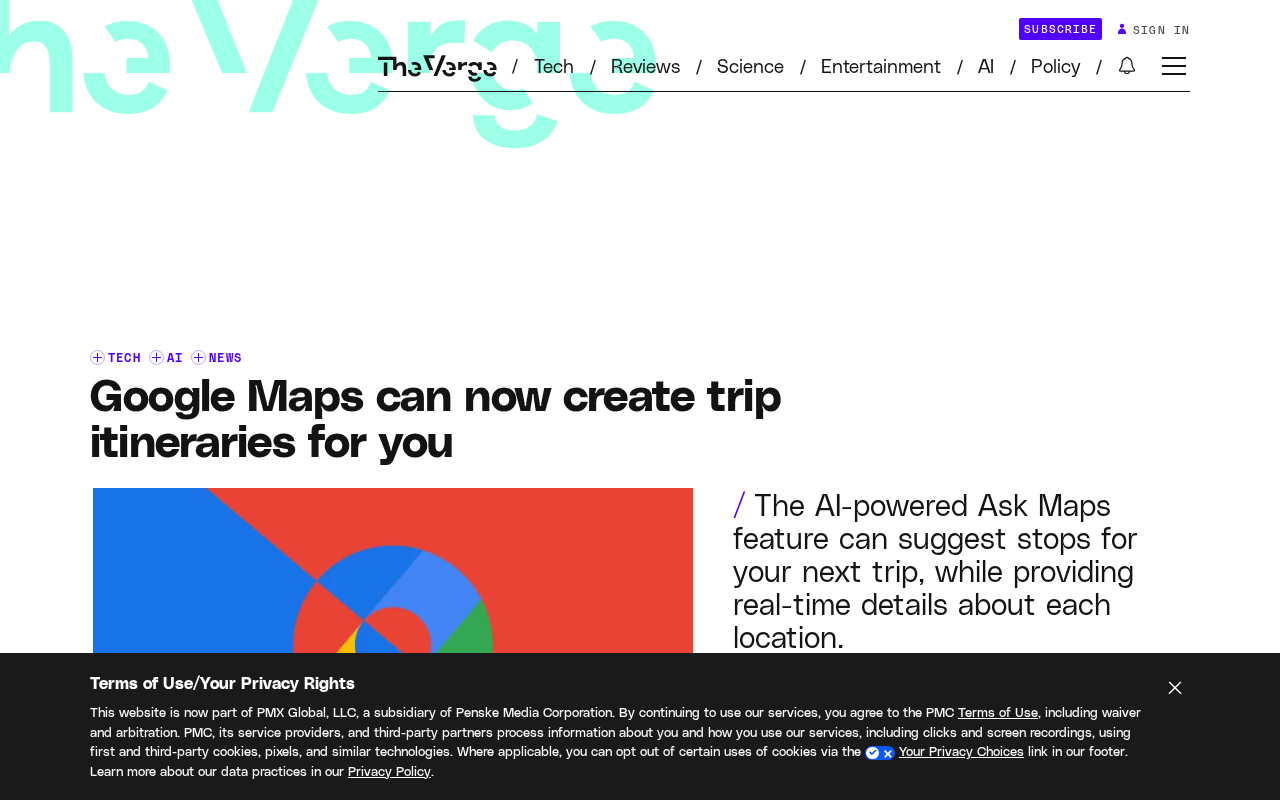
Google Maps tests Gemini-powered AI itinerary planning, supporting one- or multi-day trips with real-time details.
Google Maps is rolling out an AI itinerary planning feature to its Gemini-powered Ask Maps chatbot. Users can describe their needs in natural language, and the AI generates single- or multi-day itineraries with multiple stops, providing real-time details like business status and travel time for each stop. The gradual rollout marks Google Maps' shift from a navigation tool to an intelligent travel assistant. The article covers the feature, Gemini's technical underpinnings, and the intensifying competition in AI travel planning, noting Google's data advantage while the actual experience and coverage remain to be seen.
Google Maps is testing a new AI itinerary planning feature that lets the app create custom travel routes for you, complete with real-time details for each stop. The update is rolling out to the Gemini-powered Ask Maps chatbot within the app and supports planning both single-day and multi-day trips.

Feature Overview: From Chat to Itinerary
According to Google's announcement, the feature is integrated into the Ask Maps chatbot, where users can describe their needs in natural language and the AI generates an itinerary with multiple stops. Each stop includes not only place information but also real-time details such as operating status and travel time.
The feature is currently rolling out gradually and supports both day-trip and multi-day travel planning. This signals Google Maps' shift from a simple navigation tool to an intelligent travel assistant, using Gemini's generative capabilities to understand user intent and organize complex multi-step tasks.
Technical Background: Gemini-Powered Ask Maps
Ask Maps is the conversational assistant embedded in Google Maps, powered by the Gemini model. Users can ask questions in natural language—for example, "Help me plan a day visiting museums and restaurants"—and the AI parses the request and generates a structured itinerary.
Unlike traditional route planning, AI itinerary planning must account for multiple constraints such as scheduling, the order of places, and opening hours. This update from Google shows that Gemini's role in Maps is expanding from simple Q&A to more complex task automation.
Gemini is a family of multimodal large language models developed by Google DeepMind, capable of understanding and generating text, images, audio, and other inputs, with an emphasis on long-context reasoning and tool calling. Within Google's product ecosystem, Gemini exists not only as a standalone chat assistant but is also embedded into Search, Workspace, Maps, and other applications through APIs and on-device/cloud integrations. Unlike earlier single-task models, Gemini's reasoning ability lets it break down multi-constraint problems—for example, simultaneously weighing opening hours, geographic distance, and user preferences during itinerary planning. This is precisely the technical foundation that enables Ask Maps to move from Q&A toward task automation.
Itinerary planning is essentially a constrained combinatorial optimization problem: arranging multiple places within a limited time while satisfying conditions such as business hours, travel time, and meal times, traditionally relying on rule engines or specialized algorithms. Large language models do not directly solve for the optimal solution; instead, they use natural language understanding to convert user intent into structured queries, then combine that with map data (place coordinates, traffic conditions, business status) for candidate generation and ranking. This hybrid architecture of "language model + structured data + real-time information" is the prevailing paradigm for AI assistants handling real-world tasks today, and it also explains why real-time details need to be fetched separately from model inference.
Industry Impact: Competition in AI Travel Planning Heats Up
This Google Maps feature is not an isolated development. In recent years, AI travel planning has become a competitive hotspot among tech companies, with many exploring how large models can enhance the travel experience, from itinerary generation to real-time recommendations.
Google's advantage lies in its vast map data and user behavior data; combined with Gemini's reasoning capabilities, it is well positioned to deliver more accurate real-time information. However, the feature is still in a rolling rollout phase, and the actual experience and coverage remain to be seen.
What Users Can Expect
For ordinary users, the most immediate change is the ability to complete the entire process—from inspiration to a finalized itinerary—within Google Maps. When planning a day trip, the AI can recommend attractions and arrange their order; multi-day itineraries involve coordinating accommodation and transportation.
Real-time details are another highlight: each stop in the itinerary can display its current status, helping users respond to unexpected changes. As the feature rolls out progressively, travel planning efficiency is expected to improve significantly.
One-line Summary
Google Maps is testing Gemini-powered AI itinerary planning, supporting single- or multi-day trips with real-time details.
Paragraph Summary
Google Maps is rolling out an AI itinerary planning feature to its Gemini-powered Ask Maps chatbot. Users can describe their needs in natural language, and the AI generates single-day or multi-day itineraries with multiple stops, providing real-time details such as business status and travel time for each stop. The feature is being rolled out gradually, marking Google Maps' shift from a navigation tool to an intelligent travel assistant. The article covers the feature's form, Gemini's technical underpinnings, and the industry context of intensifying competition in AI travel planning, noting that Google has an edge thanks to its map data and user behavior data, though the actual experience and coverage remain to be seen.
Related articles
OpenAI Doubles Down on Healthcare: Cha…
OpenAI Doubles Down on Healthcare: ChatGPT Healthcare Adds Computer-Use Agents and Clinical Plugins
OpenAI updates ChatGPT for Healthcare with computer-use agents, improved clinical answers, and cross-software plugins—moving AI from answering questions to completing real clinical workflows.

How Could a Single Router Failure Cripple US Air Traffic Control?
A single router failure caused a nationwide FAA communications outage, exposing the fragility of air traffic control redundancy. We analyze the failure chain, aging systems, and what resilience really means.
Google Maps New Feature: Real-Time Itinerary Generation Turns Navigation into a Travel Assistant
Google Maps launches Ask Maps, which auto-generates multi-day itineraries from natural-language descriptions with real-time info for each stop. This article analyzes the shift from navigation to itinerary planning and its impact on travel planning products.