New Nature Study: Machine Learning Breakthrough for 2–6 Week Subseasonal Weather Forecasting

A new Nature study uses machine learning to improve 2–6 week subseasonal forecasts and stresses that intelligent validation systems matter more than bigger models.
A new Nature study uses machine learning to improve 2–6 week subseasonal weather forecasting, filling the gap between traditional numerical prediction (~2 weeks) and climate prediction (months+). This window is historically hard to predict due to decaying initial-condition constraints and unstable statistical signals, yet is valuable for extreme weather response, water management, and agriculture. The research learns predictability signals of slow-varying processes from historical data rather than relying solely on physical equation integration, enabling fast, low-cost inference. The team further argues that future progress may depend not just on stronger models but on intelligent validation systems that learn systematic errors, reason causally, and continuously calibrate—an idea relevant to high-risk AI in healthcare, finance, and autonomous driving.
Weather forecast accuracy has improved steadily over the past few decades, but one time window has remained stubbornly difficult: subseasonal forecasting at 2 to 6 weeks. This period falls beyond the effective range of traditional weather forecasts (about two weeks) yet short of the timescale of climate prediction (months to years), leaving it long in a scientific gray zone. A new study published this week in Nature demonstrates a path to tackling this challenge with machine learning.
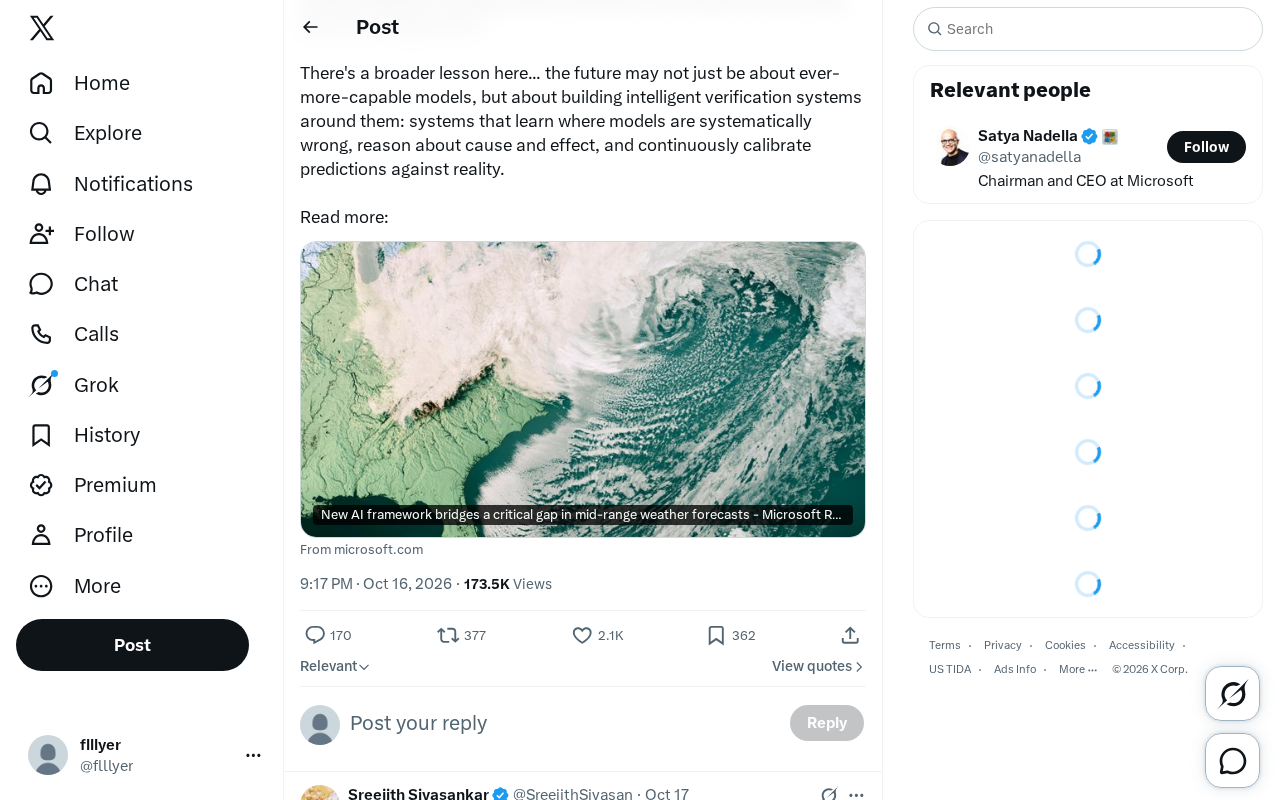
Why 2–6 Weeks Is the "No Man's Land" of Weather Forecasting
Traditional numerical weather prediction relies on physical equations to simulate atmospheric motion. Even a tiny error in initial conditions amplifies exponentially over time, causing forecasts to lose their reference value after about two weeks. Climate prediction, by contrast, focuses on the statistical patterns of slow-varying signals such as sea surface temperatures and circulation, typically on timescales of a month or more. The 2–6 week window sits right between the two: there are neither sufficiently strong initial-condition constraints nor stable statistical signals.
The research team noted on social media that this time window "has historically been very difficult to predict." As a result, subseasonal forecasting has long lacked reliable operational products—even though agriculture planning, water resource management, and extreme weather emergency response are precisely the scenarios that most need information at this timescale.
Subseasonal Forecasting is the timescale between medium-range weather forecasts (within about two weeks) and seasonal climate prediction (more than a month); the international academic community typically defines it as the coming 2 weeks to 2 months. It is treated as a distinct category because the dominant sources of predictability in this window are neither initial values nor boundary forcing: synoptic-scale baroclinic waves have already lost their memory here, while slow-varying signals such as sea surface temperatures and ENSO have not yet sufficiently constrained the atmosphere. The World Meteorological Organization's (WMO) Subseasonal to Seasonal (S2S) project was established precisely to systematically study this timescale, and its database collects hindcast experiments from operational centers in multiple countries for diagnosing the predictability of factors such as the MJO, soil moisture, and the stratospheric polar vortex.
Predictability refers to the upper time limit before forecast error grows to a given threshold. It can be divided into two types: the first arises from initial conditions, with error growing approximately exponentially with lead time and limited by chaotic dynamics; the second arises from externally forced boundary conditions (such as sea surface temperature, soil moisture, and greenhouse gases), whose signals can persist over longer timescales. The difficulty of the subseasonal window is that both types of predictability are weak, so "windows of predictability" must be mined from historical data—for example, the phase evolution of the MJO and the persistence of modes such as the North Atlantic Oscillation. These are precisely the targets that machine learning models attempt to capture.
How Machine Learning Approaches Subseasonal Forecasting
According to public explanations from the research team, the core idea of this work is to use machine learning models to learn predictability signals from historical data rather than relying entirely on forward integration of physical equations. Specifically, the models need to capture slow-varying processes that still have predictive value at the 2–6 week scale—such as soil moisture, sea surface temperature anomalies, and large-scale circulation modes.
The advantage of this approach is that machine learning can automatically extract relationships from massive historical samples that human forecasters find difficult to model explicitly, and its inference is fast with computational costs far lower than traditional ensemble forecasting. The team demonstrated improved forecast skill at the subseasonal scale in the Nature paper, but the specific technical details and performance metrics require consulting the original paper for a complete assessment.
For extreme weather preparedness, natural resource management, and agricultural decision-making, even a modest improvement in forecast skill could bring significant economic and social value.
Ensemble Forecasting is the standard approach in numerical weather prediction for addressing chaotic uncertainty: a set of forecast members is generated by perturbing initial conditions or model physics, and the spread among members is used to estimate forecast uncertainty. Traditional ensemble forecasting at the subseasonal scale requires dozens of members, consumes substantial supercomputing resources per run, and the members often fail to cover the true error distribution. If machine learning models can produce probabilistic or deterministic forecasts with a single forward inference, computational costs could be reduced by several orders of magnitude—this is the technical background behind the paper's emphasis that "inference is fast and computational costs are far lower than traditional ensemble forecasting."
Slow-varying processes and precursor signals are the physical basis of subseasonal predictability. Soil moisture anomalies can persist for weeks through land–atmosphere flux feedbacks, affecting subsequent temperature and precipitation; sea surface temperature anomalies (especially in the tropical Indian Ocean and North Atlantic) can modulate mid-latitude circulation through teleconnections; and the MJO, as a tropical intraseasonal oscillation, has a phase evolution with an 8–10 day period that is one of the most important sources of predictability for 2–4 week forecasts. What machine learning models learn from reanalysis data (such as ERA5) is precisely the nonlinear statistical mapping between these variables and future weather, rather than explicitly solving the equations of atmospheric motion.
A Deeper Insight: Intelligent Validation Systems Matter More Than Bigger Models
The most interesting part of this study may not be the weather forecasting itself, but the methodological perspective the team distilled from it. They wrote on Twitter: "The future may not just be about increasingly capable models, but about building intelligent validation systems around models: systems that learn where models systematically err, reason about causality, and continuously calibrate predictions against reality."
This judgment deserves serious attention. The dominant narrative in AI today is scaling—bigger models, more data, more compute. But weather forecasting is precisely a counterexample: no matter how powerful a model is, if it cannot identify the conditions under which it is systematically biased, forecast reliability is impossible to establish. The so-called "intelligent validation system" is essentially a layer of meta-cognition built outside the model: it does not make predictions directly, but learns the error structure of predictions, performs causal reasoning, and continuously calibrates with new observations.
This idea has broad significance for AI deployment. In high-risk domains such as healthcare, finance, and autonomous driving, pursuing model capability while neglecting validation and calibration is often the root cause of accidents. Elevating "validation" from a passive post-processing step to an active learning system may be a key direction for the next stage of AI engineering.
General Lessons from Weather Forecasting to AI Engineering
This study provides a concrete case showing that the role of machine learning in scientific discovery is changing: it is not merely a tool to replace traditional methods but is also pushing us to rethink "forecasting" itself—a forecast is not just a number but also includes knowing when that number can be trusted.
Of course, there is still a distance from paper publication to operational application. Evaluation of subseasonal forecasting requires years of rolling validation, and the model's robustness across different seasons and regions remains to be tested. But the direction is clear: machine learning is filling the gaps left by traditional methods, and validation and calibration systems built around models may be just as important as the models themselves.
For practitioners focused on deploying AI, this study reminds us: while chasing more powerful models, don't forget to equip them with a validation mechanism that can learn, reflect, and self-calibrate. This may be the key step toward making AI truly trustworthy.
One-line Summary
A new Nature study uses machine learning to improve 2–6 week subseasonal forecasting and emphasizes that intelligent validation systems are more critical than bigger models.
Paragraph Summary
A new study published in Nature uses machine learning to improve 2–6 week subseasonal weather forecasting, filling the gap between traditional numerical prediction (about two weeks) and climate prediction (months or more). This time window has historically been extremely difficult to predict because initial-condition constraints decay and statistical signals are not yet stable, yet it is highly valuable for extreme weather response, water resource management, and agricultural decision-making. The core of the research is to learn predictability signals of slow-varying processes from historical data rather than relying entirely on integrating physical equations, enabling fast inference at lower cost than traditional ensemble forecasting. The team further proposes a methodological view: the future focus may not just be more powerful models, but building intelligent validation systems that can learn systematic errors, reason about causality, and continuously calibrate against reality—an idea with broad relevance for high-risk AI applications such as healthcare, finance, and autonomous driving.
Related articles

Chain of Thought Isn't Just for AI: How Humans Can Use CoT to Improve Thinking Quality
Chain of Thought isn't just a prompt trick for large models. Starting from a Hacker News discussion, this article analyzes why CoT works for human thinking too, breaks down actionable ways to transfer it, and highlights the key differences between human CoT and machine CoT.
Cloudflare Teams Up with OpenAI: Closi…
Cloudflare Teams Up with OpenAI: Closing the Loop from Vulnerability Discovery to Defense with AI
Cloudflare uses OpenAI Daybreak to investigate security vulnerabilities and generate reviewable remediation plans, while developers use Codex to boost coding efficiency and quality.

Orca Multi-Agent Orchestration in Practice: A Guide to Parallel Collaboration with Claude and Codex
Orca is Stable AI's free open-source agent workbench supporting 34 agents like Claude Code and Codex in parallel. Learn its Git worktree isolation, multi-model orchestration, and mobile management.