New Open-Source Digital Human Solution: Build Your Own Anime-Style Real-Time Conversation Companion

Open-source project "Big Fat Fish" enables low-cost real-time digital human conversation and motion via modular architecture.
The open-source "Big Fat Fish" project offers a reusable real-time digital human framework with four decoupled modules: listen, think, speak, and facial expression. It uses Qwen audio models, local/cloud LLMs, TTS voice cloning, and vision-language-driven video generation, with a 4-step draft plus 12-step refinement pipeline, targeting sub-3-second response latency and hybrid local-cloud deployment.
In an era where virtual streamers and AI assistants are increasingly common, how can you build a true "personal" real-time digital human at low cost? A Bilibili creator shared an open-source project called "Big Fat Fish" (大肥鱼) that, through modular design and clever engineering trade-offs, enables an anime-style character to naturally answer phone calls, hold real-time conversations, and even make body movements that fit the context.

The Core of Real-Time Conversation: Breaking Down "Listen, Think, Speak, Move"
The development team drew on the open-source real-time conversation project Vox and split the digital human's capabilities into four independent modules: Listen (speech recognition), Think (conversation model), Speak (speech synthesis), and Facial Expression (motion generation). This decoupled design allows each component to be independently optimized and replaced.
For example, speech recognition uses Qwen's audio model, the conversation component supports either local Qwen 2.5 or DeepSeekAd's cloud API, and speech synthesis uses an open-source TTS model that can clone a character's voice from just one reference recording. Motion generation relies on a vision-language model to parse reference images and motion descriptions, then uses a video generation model to produce short clips.
The benefits of this architecture are obvious: if you only want to upgrade the conversational intelligence, you can simply swap the LLM interface; if you're unhappy with the voice, just switch to a different TTS model—no need to rebuild the entire system.
Vox is an open-source real-time conversation system project whose core design philosophy is to decouple speech recognition, language model inference, and speech synthesis into independent service modules, reducing end-to-end latency through streaming processing. Unlike the traditional serial pipeline of "record → recognize → generate → synthesize," Vox emphasizes asynchronous collaboration and incremental output between modules, allowing the conversation system to begin preparing a response before the user has finished speaking. This architecture is especially critical for digital human scenarios, because the digital human not only needs text replies but must also synchronously drive facial movements and voice output—any blocking in a single link would destroy the sense of real-time interaction.
TTS voice cloning refers to the technology that lets a speech synthesis model learn and imitate a target speaker's timbre, intonation, and pronunciation habits from just a few seconds to tens of seconds of reference recording. It typically relies on a speaker encoder to extract timbre embedding vectors, which are then decoupled from text content and fed into an acoustic model. The quality of voice cloning depends heavily on the clarity of the reference audio and the range of phonemes it covers, so the project recommends using clean, multi-syllable recordings as references. The reason common lines need to be re-synthesized after changing the reference voice is precisely because the timbre embedding has changed.
Motion Generation: Fine Control from "Waving" to "Nodding"
The naturalness of a digital human depends largely on the timeliness and appropriateness of its movements. The project uses an efficient video generation pipeline: first, use accelerated weights to generate a motion draft in 4 steps, checking whether the fingers, window frames, and camera position are reasonable; after passing, refine with 12 steps, and finally the video decoder restores the frames.
Even more clever is the logic for transitioning between motions. The team designed a "head frame" and "tail frame" (i.e., starting and ending poses) for each motion, and based on the same character sheet, let the model learn the connection points between motions. During a live stream, the character can "lean forward slightly" to indicate listening, "nod once" to indicate understanding, or even start speaking before a motion completes—the player will finish the current motion before recording the next segment, avoiding mechanical looping.
It's worth noting that the team once tried temporarily swapping the character's mouth shape but found that drawing the corners of the mouth slightly wider would make it "a different person." They ultimately chose to keep the original artwork's expression, sacrificing word-by-word lip sync. This is a typical engineering trade-off: between real-time performance and visual stability, prioritize character consistency.
Diffusion model steps refer to the number of iterations performed during the denoising sampling process. More steps generally produce finer, more detailed results, but the time cost increases proportionally. The project's "4-step draft" uses accelerated weights (such as distillation or consistency models) to quickly produce a recognizable low-quality video in very few steps, used for manual or automated checks of structural errors like finger distortion, background glitches, and camera offset; once confirmed, 12 steps are used for refinement, trading acceptable time cost for improved image quality. This "coarse-then-fine" strategy is very common in video generation, because the spatiotemporal dimensions of video are far higher than a single image—if a direct high-step generation fails, the wasted compute is considerable.
Head frame and tail frame are terms used in animation and video generation to describe the starting and ending frames of a motion. When teaching the model motion transitions, the team uses each motion's starting and ending poses as constraints, visually aligning the tail frame of the previous motion with the head frame of the next. This way, what the model learns is not isolated motion clips but the transition distribution between motions. During a live stream, the player executes motions in a queue; if a speech command arrives before the current motion completes, it is recorded and triggered later, preventing motions from being hard-cut or the character's pose from jumping.
Conversation and Voice: Low-Latency Engineering Practices
The biggest challenge in real-time conversation is latency. The project made targeted optimizations in both speech recognition and synthesis.
For speech recognition, the browser converts sound to mono audio and sends it to the Qwen 3 recognition model. If the system decides the speaker has finished after just two "hello"s, the character might mistakenly respond to a greeting and miss the real question. Therefore, the system needs more robust endpoint detection.
For speech synthesis, early versions "handed it to the player after just two or three characters," resulting in a fast first sound but frequent subsequent pauses. Now it first assembles "semantically complete short sentences" that can be understood; while the first segment is playing on the phone, the cloud is already preparing the next segment. Meanwhile, the browser handles speaker echo, stopping playback only when it confirms the caller is speaking; the next round includes the already-played portion so the model understands the follow-up context.
According to the creator's testing, the goal is to keep the time from when the caller finishes speaking to when the browser plays the first sound at under three seconds. The opening phone call sounds natural precisely because both voices were re-recorded in post-production; the actual system latency must be evaluated by looking at two moments within the same round.

Endpoint detection (VAD, Voice Activity Detection) is used to determine whether the user has started or finished speaking. Simple energy thresholds or fixed silence durations are prone to misjudgment in real calls: background noise, breathing sounds, and verbal pauses can all be mistaken for the end of speech, while silence after two "hello"s can be mistaken for the end of a question. A more robust approach combines a voice activity detection model with semantic completeness judgment—for example, waiting for a semantically complete short sentence to end or setting a dynamic timeout. The project emphasizes that "if the system decides the speaker has finished after just two hello's, the character might mistakenly respond to a greeting and miss the real question," which precisely points out that endpoint detection strategy directly affects the correctness of conversation turns.
Echo cancellation (AEC, Acoustic Echo Cancellation) is essential in browser speaker scenarios. When the digital human's voice plays from the phone speaker, the microphone also picks up that sound; without processing, the system would mistake its own output for user input, causing self-conversation or interruption. Browsers typically provide echo cancellation, but the project adds an extra confirmation that "playback stops only when the caller is speaking"—that is, a layer of semantic judgment on top of acoustic cancellation, ensuring only real user speech can trigger an interruption. Carrying the already-played content into the next conversation round lets the language model understand the follow-up context, avoiding repetition or irrelevant answers.
Deployment Guide: Building Your Digital Human from Scratch
The project provides a complete standalone repository with a clear deployment path:
- Basic environment: Download the code, install the image library and video tools, and first run a little robot that waves to verify whether motion transitions are natural.
- Voice and conversation: Connecting real voice requires a cloud server (the reference environment is a virtual GPU with 48G VRAM). Put models, motions, and cache on a mounted data disk for easy migration.
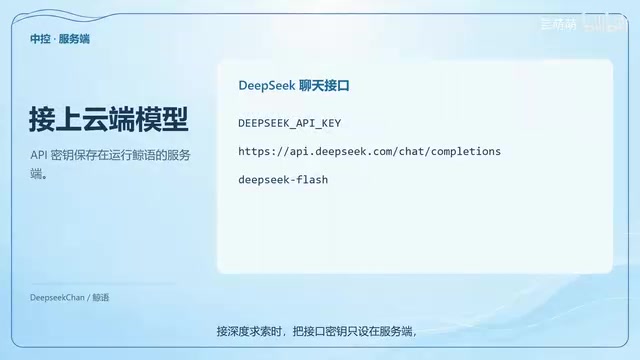
- Model configuration: Split speech recognition and synthesis into two environments, each with compatible dependencies. The DeepSeek API key is set only on the server side; the phone communicates only with the local service.
- Offline operation: You can optionally use a local Qwen model, but you need to complete Chinese and English text normalization rules and include reference recordings you have the right to use.
- Phone service: The browser requires a secure URL (HTTPS) to use the microphone. Write the URL into the configuration, proxy it to the server port, enable bidirectional connection upgrade forwarding, and use an invitation code to open the page and dial into a call seat.
- Character customization: Write the account number into the character configuration, import the front-facing image and 9 same-camera-angle motions, and modify the line library and motion selection rules.
HTTPS and microphone permissions are basic requirements of the browser security model. For privacy protection, Web standards stipulate that pages can only call getUserMedia to access the microphone in a secure context (HTTPS or localhost). The project's statement that "the browser requires a secure URL to use the microphone" stems from this. In actual deployment, a reverse proxy (such as Nginx or Caddy) typically handles TLS termination and then forwards requests to the local service port.
Bidirectional connection upgrade forwarding means the reverse proxy must support WebSocket or HTTP/2 protocol upgrades and maintain a bidirectional data stream long connection between the client and server. Real-time voice conversation relies on continuous audio stream transmission; ordinary HTTP request-response patterns cannot meet low-latency requirements. When configuring the proxy, you must explicitly set Upgrade and Connection header forwarding, otherwise the connection will be rejected by the proxy during the handshake phase. Setting cloud API keys such as DeepSeek only on the server side is to prevent keys from leaking with the front-end page; the phone communicates only with the local service, and the server calls external APIs on its behalf.
Testing and Iteration: How to Judge Whether the Digital Human "Feels Right"
The creator suggests testing with a phone call: first use a very short sentence to hear how it responds, then ask a question whose answer you know. You can observe separately whether it understands, whether the voice is smooth, and whether the content is accurate.
If you want to create your own motions, the repository includes a two-pass workflow: run the first pass to verify the cache, then run the second pass for refinement. After changing the reference voice, remember to re-synthesize common lines.

This project's value lies in providing a reusable engineering framework rather than pursuing extreme realism. It candidly reveals the trade-offs: unsynchronized lip movements, motion intervals, and the limitations of offline models. For enthusiasts looking to get started with digital human development, this is a clear starting line.
One-line Summary
Open-source project "Big Fat Fish" achieves low-cost real-time digital human conversation and motion generation through modular architecture and engineering trade-offs.
Paragraph Summary
The open-source project "Big Fat Fish" shared by a Bilibili creator provides a reusable real-time digital human engineering framework. It splits capabilities into four independent modules—listen, think, speak, and facial expression—using Qwen's audio model, local or cloud LLMs, open-source TTS voice cloning, and a vision-language-model-driven video generation pipeline, respectively. Motion generation uses a two-pass workflow of 4-step drafting plus 12-step refinement, with head/tail frames for motion transitions. Speech synthesis prioritizes semantically complete short sentences, with the cloud pre-synthesizing the next segment, targeting response latency under three seconds. Deployment supports hybrid local-cloud setups, with API keys stored only on the server and phones connecting via a secure HTTPS URL. The team chose character consistency over lip sync, candidly demonstrating the engineering trade-offs of real-time systems and providing a clear starting line for digital human development enthusiasts.
Related articles

Prompt Engineering for Beginners: From Writing Prompts to Engineering Thinking
Starting from the essence and four functions of prompts, this article systematically explains the six-step process, four success criteria, learning value, and practical limitations of prompt engineering to help you build a complete understanding.

Anthropic Launches Nasdaq IPO: AI Giant's Listing and Risk Disclosures
Anthropic officially launches its Nasdaq IPO under ticker ANT, with market valuation expected to potentially exceed SpaceX's record. The prospectus devotes nearly 100 pages to AI risks, while first-half revenue grew over 14x but net losses widened sharply, reigniting the AI bubble debate.

Rust cURL Clone Uses 4,832 unsafe Blocks—Is the Memory Safety Myth Broken?
A Rust cURL clone uses 4,832 unsafe keywords, challenging Rust's memory safety narrative. We analyze what unsafe really means, compare Fil-C, and examine rewrite motives.