New Research on Multi-Objective Alignment: Predicting Goal Conflicts and Navigating Trade-offs

MODPO enables flexible balancing across value objectives, but AI annotation biases undermine multi-goal conflict prediction.
This paper investigates "steerable pluralistic alignment": since human values are diverse and conflicting, a single aligned model cannot be universal. The researchers propose using MODPO (Multi-Objective DPO) to build a continuous trade-off spectrum across competing objectives. Key findings: pre-training metrics can predict synergy vs. conflict between goals, but only for human-annotated data — AI annotations are corrupted by length and repetition biases. Model selection and parameter merging can expand trade-off coverage at low cost, but neither consistently matches directly trained models. RLAIF practitioners should beware of systematic biases that distort multi-objective analysis.
Why a Single Aligned Model Can't Satisfy Everyone
People hold diverse and often conflicting values, which means no single aligned AI model can satisfy everyone. A user who prioritizes "absolute honesty" and one who values "friendly, tactful responses" will have vastly different standards for evaluating the same reply. This fundamental divergence is one of the core challenges in current LLM alignment research.
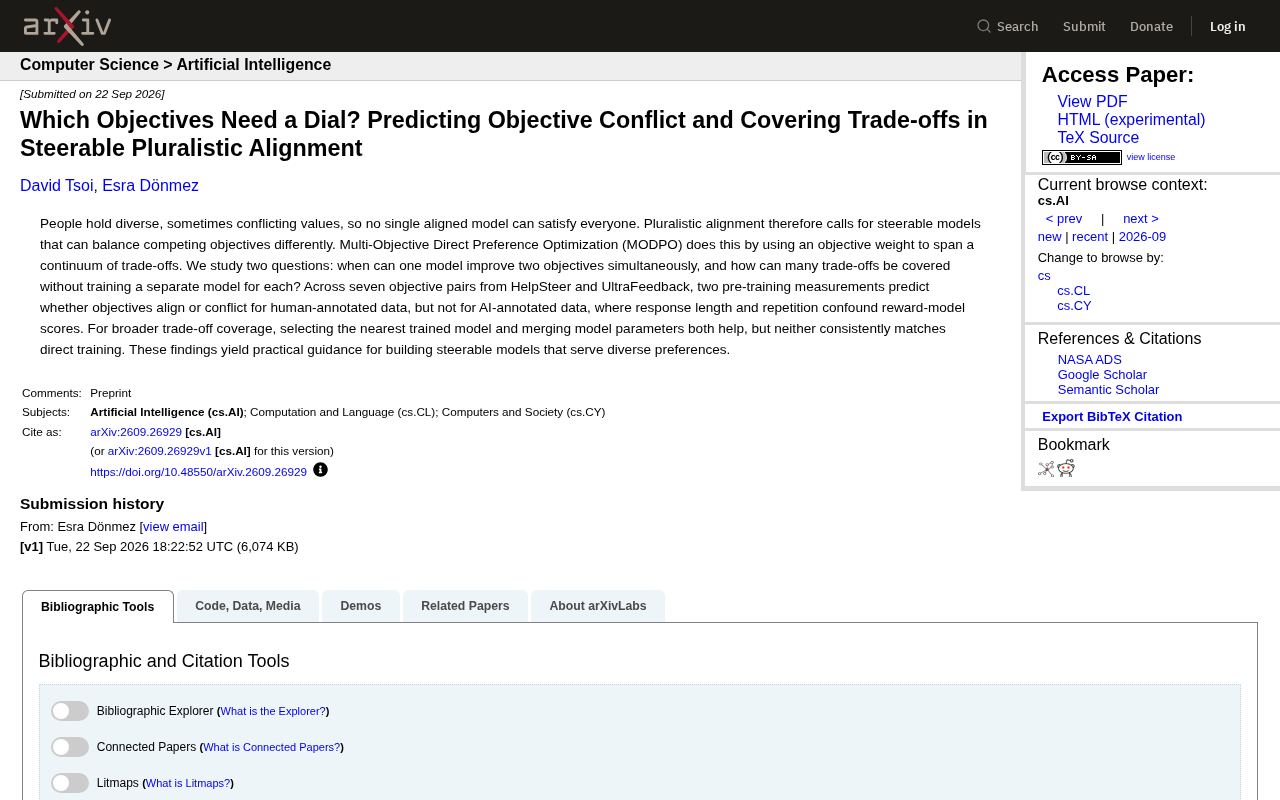
This latest paper from arXiv (arXiv:2609.26929) focuses on "Steerable Pluralistic Alignment." The central idea: rather than training one model that tries to please everyone, build models capable of flexibly switching between and balancing different objectives. Think of it as giving each objective an adjustable "dial" that lets the model move across multiple value dimensions on demand.
MODPO: Spanning the Continuous Spectrum of Trade-offs with Weights
The technical foundation of this research is Multi-Objective Direct Preference Optimization (MODPO). Unlike traditional single-objective DPO, MODPO introduces an "objective weight" parameter. By adjusting this weight, the model can form a continuous trade-off spectrum across multiple competing objectives.
For example, if one end represents "maximize helpfulness" and the other "maximize safety," MODPO lets you choose any balance point between them rather than being forced to pick one. This provides theoretical flexibility for serving diverse user preferences.
Two Key Questions
The researchers posed and attempted to answer two specific questions:
- When can both objectives be improved simultaneously? In other words, are two objectives synergistic (a rising tide lifts all boats) or conflicting (a zero-sum trade-off)?
- How can we cover as many trade-off combinations as possible without training a separate model for each? Training a dedicated model for every possible preference combination is prohibitively expensive.
Direct Preference Optimization (DPO) is one of the mainstream methods for aligning large language models. It trains models directly from human-annotated "preference pairs" (two responses to the same prompt, one labeled as better), optimizing model parameters without the complex step of explicitly training a reward model as in reinforcement learning. Traditional DPO optimizes for a single objective (e.g., "helpfulness") and cannot simultaneously balance multiple competing goals. MODPO builds on this by introducing an objective weight vector, enabling the same training framework to smoothly transition between different objectives by adjusting weights. Geometrically, this "trade-off spectrum" approximates the Pareto Frontier in multi-objective optimization theory — the boundary set where you cannot improve one objective further without degrading another.
Synergy or Conflict? What the Prediction Methods Found
The study conducted systematic experiments across seven objective pairs on two datasets, HelpSteer and UltraFeedback. A key finding: two metrics measured during the pre-training phase can predict whether objectives are synergistic or conflicting — but this holds only for human-annotated data.
For AI-annotated data, things get more complicated. The study found that response length and repetition interfere with reward model scoring, acting as confounding factors. In other words, within AI-annotated preference data, models may assign higher scores to responses that are longer or repetitive — not because they genuinely meet the objective — but simply due to these surface features. This finding raises a warning for alignment practices that heavily rely on AI feedback (RLAIF): systematic biases in AI-annotated data can invalidate predictions of goal conflict.
Reinforcement Learning from AI Feedback (RLAIF) replaces human annotators with AI models (typically more powerful language models) to generate preference data, aiming to reduce the high cost and scalability bottleneck of human annotation. However, AI annotators carry systematic biases: research widely shows that many reward models score longer responses higher (even when quality isn't actually better), and tend to rate fluent but repetitive responses favorably. These "shortcut biases" cause RLAIF-trained models to learn to "write longer" or "repeat content" to inflate rewards, rather than genuinely optimizing the intended objective. This paper's findings further show that such biases undermine the predictability of inter-objective conflict relationships, making multi-objective analysis conclusions based on AI-annotated data unreliable.
Covering More Trade-offs: Model Selection and Parameter Merging
To address the question of how to cover a broader range of trade-off combinations, the study compared several approaches:
Select the Nearest Trained Model
The first approach: when a specific trade-off point is needed, simply use the already-trained model whose parameters are closest to that point as an approximation. This has some effectiveness and can avoid retraining to a certain extent.
Merge Model Parameters
The second approach involves merging the parameters of multiple trained models to generate new trade-off combinations. This was also found to be helpful.
However, the study delivers an honest conclusion: neither selecting the nearest model nor merging parameters can consistently match the performance of directly training for the target objective. In other words, these "shortcuts" can reduce costs and expand coverage, but a performance gap compared to direct training remains.
Model Merging is a technique that generates new models by performing arithmetic operations directly on the weights of multiple models — no retraining required. The simplest approach is linear interpolation: take two models fine-tuned from the same base model on different objectives, and compute a weighted average of their parameters to produce a "blended" model. Intuitively, if Model A is optimized for objective X and Model B for objective Y, merging their parameters at a 0.5:0.5 ratio should theoretically yield an intermediate model with reasonable performance on both objectives — without needing to train a dedicated MODPO model at weight 0.5. The appeal lies in its extremely low computational cost, but the limitation is clear: linear interpolation in parameter space doesn't necessarily correspond to linear interpolation in objective performance, and model capabilities can degrade nonlinearly after merging.
Practical Implications for Building Steerable Models
The value of this research lies not in presenting a perfect solution, but in offering pragmatic guidance for building steerable models that serve diverse preferences:
- When using pre-training metrics to predict goal conflicts, be wary of data provenance. Human-annotated and AI-annotated data may yield different conclusions, and length and repetition biases in AI-annotated data especially need to be controlled.
- For low-cost coverage of more trade-off points, model selection and parameter merging are viable compromises — but accept the performance gap relative to direct training.
- The essence of pluralistic alignment is acknowledging that value diversity cannot be resolved by a single model, and that "steerability" deserves serious attention at the engineering level.
As large language models become increasingly involved in people's decision-making and expression, enabling AI systems to respect and serve diverse — even conflicting — values will remain a critical direction in alignment research. This paper adds a valuable, empirically grounded piece to that puzzle.
Related articles

Chain of Thought Isn't Just for AI: How Humans Can Use CoT to Improve Thinking Quality
Chain of Thought isn't just a prompt trick for large models. Starting from a Hacker News discussion, this article analyzes why CoT works for human thinking too, breaks down actionable ways to transfer it, and highlights the key differences between human CoT and machine CoT.
Cloudflare Teams Up with OpenAI: Closi…
Cloudflare Teams Up with OpenAI: Closing the Loop from Vulnerability Discovery to Defense with AI
Cloudflare uses OpenAI Daybreak to investigate security vulnerabilities and generate reviewable remediation plans, while developers use Codex to boost coding efficiency and quality.

Orca Multi-Agent Orchestration in Practice: A Guide to Parallel Collaboration with Claude and Codex
Orca is Stable AI's free open-source agent workbench supporting 34 agents like Claude Code and Codex in parallel. Learn its Git worktree isolation, multi-model orchestration, and mobile management.