New York's Loneliest Peptide Party: The Verge Reporter Experiences the Supplement Craze Firsthand
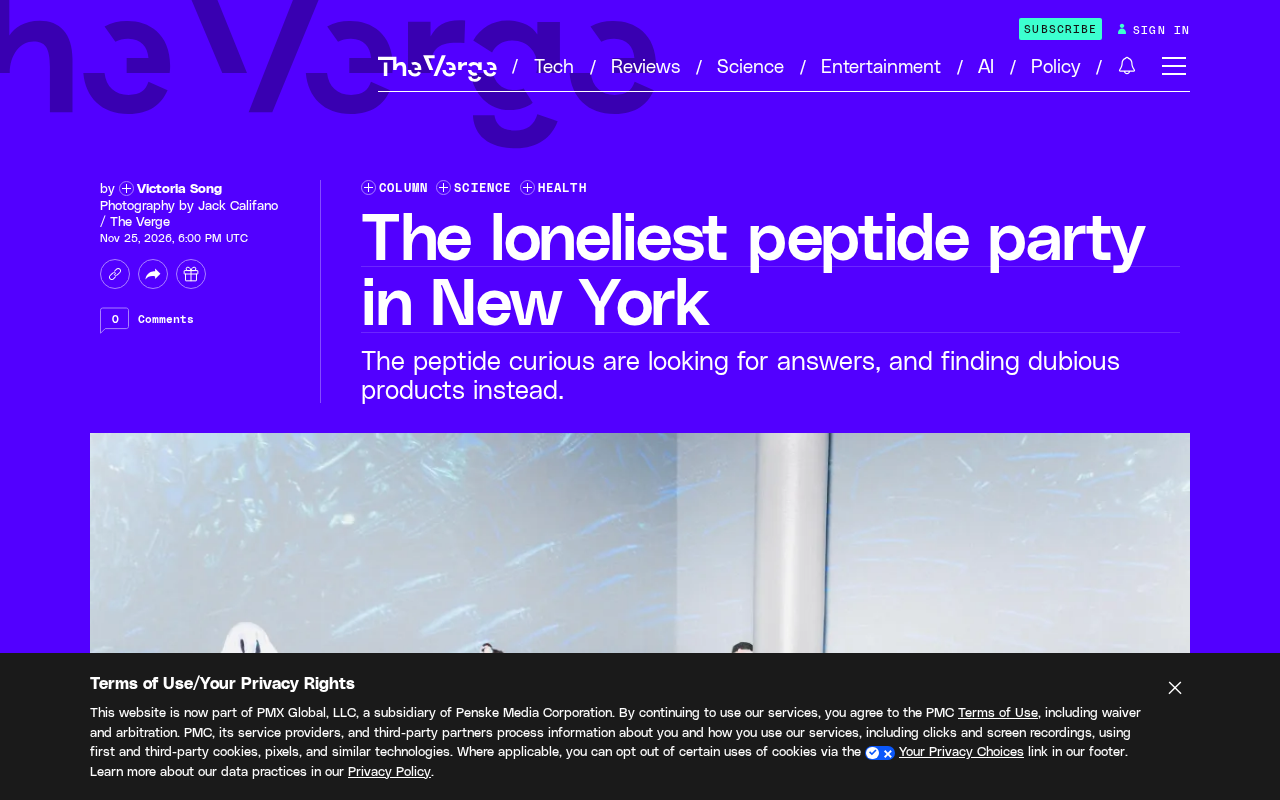
A Verge reporter attends a New York peptide party, where the sparse turnout reveals the gap between marketing buzz and real participation.
The Verge senior reviewer Victoria Song documents a peptide product party at Chelsea Market in her Optimizer column, where few people queued and the atmosphere fell far short of a "party." The article uses this to explore the peptide supplement craze: these products are often packaged as miracle ingredients for anti-aging, repair, and body sculpting, but Song's column consistently dismantles "life-changing" promises from a critical perspective. The deserted scene suggests consumers' enthusiasm may be driven more by marketing rhetoric than real demand. The report offers no product recommendations, but reveals the gap between marketing events and actual experience through frontline observation.
The Verge senior reviewer Victoria Song, in her weekly column Optimizer, documented a peptide product party held at an experimental art space in Chelsea Market. On a drizzly autumn evening, a small queue at the entrance suggested the event was not entirely unattended—but inside, the atmosphere was far removed from the word "party."
A Party That Wasn't Really a Party
According to Victoria Song's account, the event took place at an experimental art venue inside Chelsea Market, and there were indeed a few people queuing outside. However, the article's title—"New York's Loneliest Peptide Party"—already sets the tone: the crowd and enthusiasm on site fell far short of what the organizers might have hoped for.
This was not a lively product launch or social gathering. From the narrative voice of the original piece, it reads more like an on-site record written from an observational distance—as a columnist who specializes in reviewing gadgets and potions that "claim to change your life," Song already maintains a scrutinizing stance toward this kind of supplement marketing.
Cold Reflection Behind the Peptide Craze
In recent years, peptide products have appeared frequently in the health and beauty space, often packaged as "miracle ingredients" with anti-aging, repair, and body-sculpting benefits. Victoria Song's column is positioned precisely to dismantle such promises: how much substance is there really in products that claim to change your life?
The sparse turnout at this party may be a signal in itself. When marketing volume contrasts with actual participation, the question worth asking is: is consumers' enthusiasm for peptide products genuine demand, or fleeting curiosity generated by rhetoric? The original article offers no answer, but the deserted scene itself constitutes a kind of answer.
Peptides are short-chain molecules formed by two or more amino acids linked through peptide bonds, and are intermediate products of protein hydrolysis. Many functional peptides exist naturally in the human body, such as insulin and glutathione, participating in physiological processes like hormone regulation and immune defense. In the supplement and beauty market, commonly promoted peptides include collagen peptides and copper peptides (GHK-Cu). Theoretically, small-molecule peptides are more easily absorbed than intact proteins, and some in vitro studies suggest they may stimulate collagen synthesis or possess antioxidant activity. However, orally ingested peptides are further broken down into amino acids in the gastrointestinal tract, and whether they can reach the skin or target tissues in intact form to deliver the marketed "anti-aging, repair, body-sculpting" effects lacks support from high-quality human clinical trials. The U.S. FDA regulates most peptide products as dietary supplements, without requiring pre-market proof of efficacy, which leaves room for exaggerated claims. Understanding this background helps assess the consumer awareness behind the lonely peptide party: when scientific evidence remains insufficient, the contrast between marketing buzz and actual participation is itself a market signal worth noting.
The Media Perspective on Supplement Reviews
The Verge's Optimizer column consistently covers consumer health-tech products, and Victoria Song's review style leans toward firsthand experience and critical observation. This report on the peptide party continues that stance—not readily endorsing "life-changing" promises, but presenting the real on-site experience to readers.
For readers interested in health consumption trends, the value of this kind of frontline record lies in this: it offers no product recommendations, but reveals the gap between marketing events and actual experience. When a product needs a party to generate buzz, the party's own emptiness becomes the most honest footnote.
The Verge's Optimizer column is written by senior reviewer Victoria Song and focuses on consumer health-tech products, covering wearables, sleep aids, nutritional supplements, and other categories that "claim to change your life." Its review methodology emphasizes long-term firsthand use rather than short-term unboxing, and habitually examines products within the broader context of consumer culture, questioning the distance between marketing rhetoric and real utility. This critical stance aligns with industry trends in tech media: as the health-tech market expands, the media's role shifts from simple recommendation to consumer education, helping readers identify pseudoscientific claims. The column does not offer list-style buying advice, but instead presents experiential gaps through narrative on-site records, giving it a unique watchdog value in health consumption reporting—the deserted party scene is a typical example of this methodology.
One-line Summary
A Verge reporter experiences a New York peptide party, where the sparse turnout reveals the gap between marketing buzz and real participation.
Paragraph Summary
In her Optimizer column, The Verge senior reviewer Victoria Song documents a peptide product party at Chelsea Market, where few people queued and the atmosphere was far from what a "party" would suggest. The article uses this as an entry point into the peptide supplement craze: such products are often packaged as miracle ingredients for anti-aging, repair, and body sculpting, yet Song's column consistently dismantles "life-changing" promises from a critical perspective. The deserted party scene suggests that consumers' enthusiasm for peptide products may be driven more by marketing rhetoric than genuine demand. The report offers no product recommendations, but reveals the gap between marketing events and actual experience through frontline observation, providing an honest footnote for readers following health consumption trends.
Related articles
Has the AI Bubble Burst? A 45-Day, $6 Trillion Loss Post-Mortem
US stocks shed $6 trillion in 45 days—averaging $225B daily for 31 sessions. Has the AI bubble burst? A deep-dive post-mortem of six converging headwinds and what's already priced in.

AI Historical Comic Drama Goes Viral: Why the Zhu Yuanzhang Theme Outperforms Real Actors
An AI-generated historical comic drama went viral on Bilibili, with viewers saying its acting beats real people. We analyze its tech pipeline, narrative logic, and industry impact.

Bin's Live Stream Highlights: Hilarious Interactions from "You Came at the Right Time" to "I'll Support You From Now On"
Bin's hilarious live stream highlights: from "You came at the right time" to "I'll support you from now on," featuring Championship skins, wigs, and other game memes that showcase Bilibili's unique streaming culture.