Nexus AI: A Local AI Agent Prototype for Automated Security Vulnerability Detection and Patching

Nexus AI is a local AI agent prototype using FastAPI and Groq to auto-patch security vulnerabilities without breaking existing code.
Nexus AI is an open-source prototype by developer mohitambaldhage, built on FastAPI and the Groq LPU inference backend as a locally-running AI agent. Its core goal is to automatically patch application security vulnerabilities while avoiding regression bugs. It runs locally to sidestep compliance risks of uploading source code to the cloud, and leverages Groq's low-latency inference to support the full read-understand-patch workflow. The author explicitly positions it as a prototype rather than a production product — supported language coverage, vulnerability types, and patch accuracy metrics are not yet publicly documented. The project aligns with the industry trends of DevSecOps "shift left" and AI-driven vulnerability remediation, and is best suited as a research and experimentation target at this stage, with human review still required before merging any auto-generated patches.
An AI Prototype Targeting AppSec Automation
Application security (AppSec) has long suffered from a persistent pain point: vulnerabilities are discovered far faster than they can be fixed. Security scanning tools can surface hundreds or even thousands of issues within minutes, but actually remediating them demands significant developer effort — and patches frequently end up breaking existing business logic in the process. An open-source project called Nexus AI, shared by a developer on Reddit, aims to tackle this exact problem.
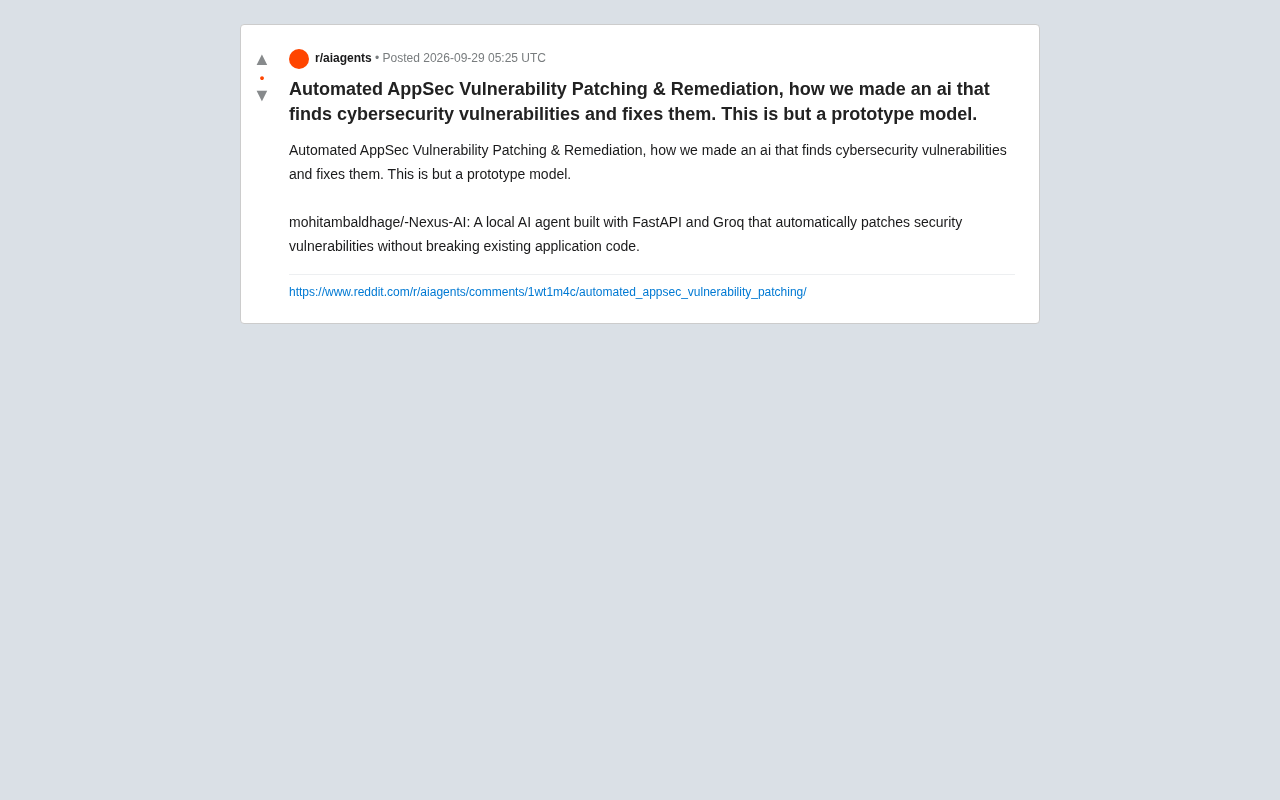
According to the project's author (GitHub user mohitambaldhage), Nexus AI is a local AI agent built on FastAPI and Groq, designed to automatically patch security vulnerabilities without breaking existing application code. The author is upfront that this is currently a prototype — not a production-ready product.
Technology Stack Breakdown: Why FastAPI + Groq
Looking at the publicly available technical choices, the architectural thinking behind Nexus AI is fairly coherent.
Local Deployment First
The project emphasizes being a "local AI agent" — one that runs entirely on your own machine. In a security context, this matters enormously. Codebases and vulnerability details are among an organization's most sensitive assets, and uploading source code to a third-party cloud for analysis carries real compliance and data-leakage risks. Running locally helps mitigate those concerns and aligns far better with how security teams actually want to deploy tooling.
FastAPI as the Service Layer
FastAPI is a high-performance Python web framework well-suited for rapidly building API services and agent orchestration interfaces. Its async capabilities and automatic documentation features make it a lightweight choice for tools that need to call models frequently and process large amounts of code text.
Groq for Inference Acceleration
The choice of Groq as the inference backend is one of the more noteworthy aspects of this project. Groq is known for the exceptionally high inference throughput delivered by its LPU (Language Processing Unit), which significantly reduces large model response latency. For an automated workflow that must read code, understand context, and generate patches, inference speed directly determines overall usability and iteration efficiency.
A note on LPU architecture: The LPU (Language Processing Unit) is Groq's proprietary chip architecture. Unlike the parallel computing paradigm of GPUs, the LPU uses a deterministic, sequential dataflow design specifically optimized to address the memory bandwidth bottleneck in Transformer model inference. GPUs offer extremely high throughput for matrix operations, but when running large model inference, they're constrained by VRAM bandwidth and KV Cache read/write overhead, making latency difficult to compress. The LPU dramatically reduces data movement through on-chip SRAM, achieving per-token generation latency improvements of several times — sometimes over ten times — compared to GPU-based solutions. For patch generation tasks where input context tends to be long (requiring full functions or even entire files), both latency and throughput requirements are high — precisely the scenario where Groq is most competitive against traditional cloud GPU inference services. Groq currently offers services via the GroqCloud API, supporting mainstream open-source models like LLaMA and Mixtral. Developers can integrate it using an interface nearly identical to the OpenAI API, keeping migration costs low.
The Core Proposition: Fix Without Breaking
The most valuable design goal of Nexus AI is captured in the phrase "automatically patches security vulnerabilities without breaking existing application code."
This is, in fact, the central hard problem facing every automated remediation tool. Detecting vulnerabilities is relatively straightforward — static analysis and rule matching can handle that. But generating a patch that closes the vulnerability, doesn't introduce regression bugs, and passes the existing test suite is where the real technical difficulty lies. The value of AI here is semantic understanding of code and context, not simple string replacement or template application.
This is also why the author repeatedly emphasizes "prototype." Going from a proof-of-concept demo to reliably guaranteeing patch quality across complex, real-world codebases requires substantial additional engineering and validation work. Does the auto-generated patch introduce new logical errors? Does it cover all trigger paths for the vulnerability? Can it pass a full regression test suite? All of these questions demand rigorous verification mechanisms.
On regression safety in automated patching: "Not breaking existing code" maps to the engineering problem of regression safety — a dedicated research area within automated patching. What looks like a simple security fix — say, adding parameterized queries to defend against SQL injection — can simultaneously touch ORM configuration, database driver version compatibility, and downstream assumptions about return data formats. Breaking any hidden dependency in this chain could cause a production outage. Existing research in Automated Program Repair (APR) shows that even test-suite-guided patch generation commonly falls into the trap of "overfitting to test cases" — the patch passes all existing tests but introduces new errors on paths the tests don't cover. AI-driven patch generation adds semantic understanding on top of traditional APR, but it faces the same incomplete verification loop problem. This is why human review remains a non-skippable step at this stage.
Where This Fits in the Industry Landscape
Zooming out, "AI-driven vulnerability discovery and remediation" is rapidly becoming one of the hottest directions in security. From DevSecOps to the recent wave of AI coding assistants, the industry is broadly moving toward "shifting left" and "automating" — catching security issues early in development and closing the loop automatically.
The long-term vision for tools like this is compelling: stringing together vulnerability scanning, prioritization, patch generation, and validation testing into a single automated pipeline — freeing security engineers from repetitive remediation work so they can focus on architectural-level risk governance. Open-source prototypes like Nexus AI represent individual developers and small teams exploring this direction, while also lowering the barrier for community participation and validation.
On "Shift Left" security: Shift Left Security is the core philosophy of DevSecOps — moving security checks from traditional pre-launch audits into earlier stages like code writing, code review, and CI/CD pipelines. The underlying logic is that remediation costs grow exponentially as development progresses. Fixing a vulnerability at the coding stage costs far less than fixing it during testing, and vastly less than responding to an exploit in production. Tools like Snyk, GitHub Advanced Security, and Semgrep already implement vulnerability scanning and some automated fix suggestions at the CI layer — but there remains a significant engineering gap between "providing suggestions" and "automatically generating a merge-ready patch." The direction Nexus AI is exploring aims to bridge exactly that gap, extending the pipeline's endpoint from "discovering problems" to "closing the loop on fixes."
Rationally Assessing the Prototype's Limitations
It's worth being objective: as an early-stage prototype shared on Reddit, Nexus AI's publicly available information is still quite limited. Which programming languages it supports, what types of vulnerabilities it can detect (full OWASP Top 10 coverage or a specific subset), what its patch accuracy rate is, and whether it has built-in automated regression validation — none of these critical metrics have publicly available data to back them up.
For security practitioners, tools like this are best treated as objects of experimentation and research at this stage, rather than something to plug directly into production workflows. Any automatically generated security patch should go through human review and comprehensive testing before being merged. The value of open source lies precisely in transparency — the community can inspect the implementation logic directly, propose improvements, and collectively push these kinds of solutions toward maturity.
Conclusion
Nexus AI is an early attempt that points in the right direction with clear thinking: using a local AI agent, combining FastAPI's engineering capabilities with Groq's inference speed, to take on the genuinely hard problem of "auto-patching without breaking code." It may not solve the problem today, but the automated AppSec proposition it points toward is an unavoidable part of the security industry's future. Developers who are interested should keep an eye on its GitHub repository and consider getting involved in this exploration of security automation.
Related articles

Chain of Thought Isn't Just for AI: How Humans Can Use CoT to Improve Thinking Quality
Chain of Thought isn't just a prompt trick for large models. Starting from a Hacker News discussion, this article analyzes why CoT works for human thinking too, breaks down actionable ways to transfer it, and highlights the key differences between human CoT and machine CoT.
Cloudflare Teams Up with OpenAI: Closi…
Cloudflare Teams Up with OpenAI: Closing the Loop from Vulnerability Discovery to Defense with AI
Cloudflare uses OpenAI Daybreak to investigate security vulnerabilities and generate reviewable remediation plans, while developers use Codex to boost coding efficiency and quality.

Orca Multi-Agent Orchestration in Practice: A Guide to Parallel Collaboration with Claude and Codex
Orca is Stable AI's free open-source agent workbench supporting 34 agents like Claude Code and Codex in parallel. Learn its Git worktree isolation, multi-model orchestration, and mobile management.