NHTSA Investigates Tesla Robotaxi Speeding Allegations in School Zones

NHTSA is evaluating allegations that about 1,000 Tesla Robotaxis sped in school zones, making child safety a shared industry test.
The National Highway Traffic Safety Administration (NHTSA) is evaluating an allegation against Tesla that approximately 1,000 Robotaxis sped during active school zone hours. It remains at the "evaluation" stage and has not escalated to a formal investigation. School zone speed limits rely on dynamic signals such as time windows and flashing lights, making them a classic long-tail, highly sensitive scenario for autonomous driving with an extremely low tolerance for error. Notably, Waymo has also previously received similar regulatory inquiries, indicating this is not a problem unique to any one technological route but a common industry challenge. The signal value exceeds the individual case: as autonomous driving moves from pilot programs to scaled operations, stable performance in sensitive scenarios such as child safety will become a key focus of regulatory and public scrutiny, potentially driving more detailed operating requirements.
The National Highway Traffic Safety Administration (NHTSA) is evaluating an allegation against Tesla's autonomous taxis: approximately 1,000 Robotaxis equipped with its self-driving system are accused of "speeding during active school zone hours." The news was confirmed by NHTSA and remains at the "evaluation stage," not yet escalated to a formal investigation.
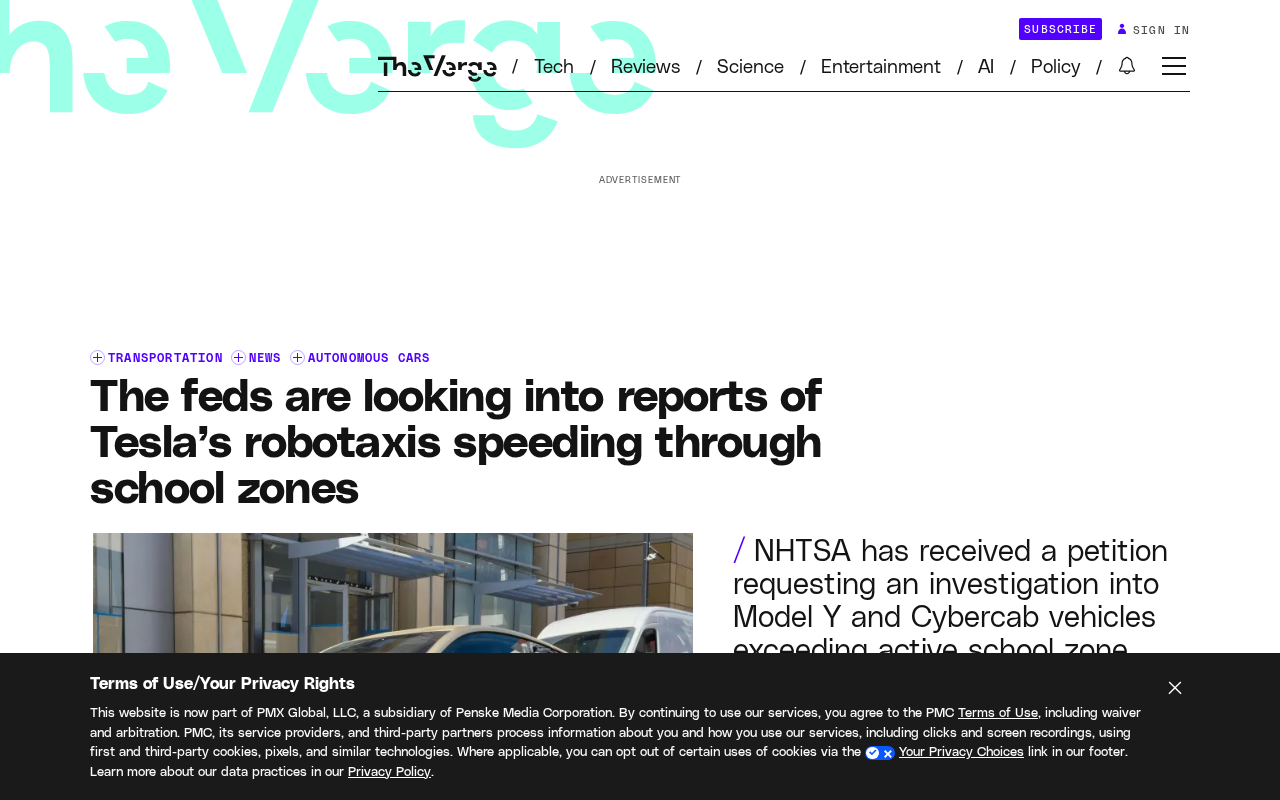
The Incident: 1,000 Robotaxis Accused of Speeding in School Zones
NHTSA's wording is notably cautious—it says it is "evaluating" the allegations rather than announcing a formal investigation. In U.S. regulatory parlance, "evaluating allegations" typically means the agency has received a complaint or tip and is determining whether further action is warranted.
The scale involved is approximately 1,000 Robotaxis. That number is worth noting: it is not an individual owner's case but points to an operating fleet. If the allegations hold, the problem is not "a single vehicle's sensors occasionally failing" but a systemic flaw in the speed control strategy under specific scenarios.
School zones are a highly sensitive category under U.S. traffic law. Speed limits are typically significantly lower than on regular roads and strictly enforced, because children's behavior is unpredictable—they may suddenly dart into the roadway. For autonomous driving systems, this is a classic "long-tail scenario": infrequent but with an extremely low tolerance for error.
What is a Robotaxi?
A Robotaxi (autonomous taxi) refers to a vehicle that operates without a human driver, relying entirely on its autonomous driving system to complete passenger-carrying operations. It is fundamentally different from driver-assistance features on ordinary passenger cars: driver assistance (such as Tesla's Autopilot or supervised FSD) still requires the driver to take over at any time, whereas a Robotaxi must independently assume all dynamic driving tasks within its operational domain and is subject to operating permits from the relevant regional regulator. Tesla's Robotaxi service centers on a pure vision approach, eliminating LiDAR and radar in an attempt to replicate human perception and decision-making using cameras plus neural networks. Precisely because of this, once its speed control strategy is alleged to have systemic problems in special scenarios like school zones, the entire fleet is affected—not just a single user's case.
Why School Zones Are Especially Tricky for Autonomous Driving
The difficulty with school zone speed limits is that they are not static rules. The speed limit often applies only during specific hours (drop-off and pick-up times) and relies on flashing lights, temporary signs, or even on-site traffic officer direction to convey the signal.
This means the autonomous driving system must process multiple layers of information simultaneously: recognizing school zone signs, determining whether the current time falls within active hours, reading dynamically changing speed limits, and then adjusting vehicle speed. An error in any one link could lead to speeding.
For human drivers, this set of rules is equally easy to violate—school zone speeding is a common traffic infraction. But the public holds autonomous driving to a higher standard: if human drivers make mistakes, machines "should" do better, not replicate human negligence.
What is a long-tail scenario?
"Long-tail scenario" is a core term in the autonomous driving industry, referring to extreme or edge situations with extremely low probability of occurrence but nearly infinite variety—such as temporary traffic direction, road construction detours, or children suddenly darting into the roadway. The opposite is "common scenarios," i.e., high-frequency situations like normal car-following, lane changes, and traffic light compliance. Autonomous driving systems are often already quite reliable in common scenarios, but the true safety bottleneck is concentrated in the long tail—because these scenarios lack sufficient real-world road test data and are difficult to cover through large-scale training. School zone speeding falls precisely into this range: it is not encountered every day, but once mishandled, the consequences may involve children's lives, with near-zero tolerance for error. This is also why regulators and the public are particularly sensitive to autonomous driving performance in such scenarios.
Waymo Also Faces Similar Scrutiny
This is not the first time the autonomous driving industry has encountered regulatory attention over school zone scenarios. Waymo's Robotaxis have also previously received similar inquiries, involving issues such as illegally passing school buses and striking a child near an elementary school in California.
Placing the two incidents together reveals what is actually the same industry-wide problem: Can autonomous driving systems achieve the level of reliability the public and regulators expect in scenarios involving child safety?
Waymo and Tesla pursue different technological approaches—the former relies on high-definition maps and a sensor suite primarily based on LiDAR, while the latter insists on a pure vision approach. But both have stumbled, or are suspected of stumbling, in school zone scenarios, suggesting this may not be a problem unique to any one technological route but rather a common challenge in autonomous driving's handling of edge scenarios.
Tesla's pure vision approach may face additional scrutiny in school zone scenarios: reading speed limit signs, determining time windows, and recognizing flashing lights all depend heavily on camera recognition capability. If the vision system misjudges under complex lighting or occlusion conditions, speed control will be directly affected.
The difference between pure vision and multi-sensor approaches
Tesla adheres to a "camera-only" approach, arguing that humans can drive with just their eyes, so cameras plus neural networks are sufficient; Waymo adopts a fusion approach primarily based on LiDAR, millimeter-wave radar, and high-definition maps. LiDAR can directly output precise 3D distance point clouds, offering advantages in ranging and under harsh conditions such as nighttime or backlighting; high-definition maps pre-store static information such as lane lines, speed limits, and school zone locations. The pure vision approach has lower cost and scales faster, but depends heavily on camera recognition accuracy under complex lighting, occlusion, and reflective signs—precisely the links where dynamic signals like school zone flashing lights and temporary speed limit signs are prone to problems. Each approach has its trade-offs, which also explains why they expose different types of risk in school zone scenarios.
Regulatory Signals and Industry Impact
NHTSA is currently only "evaluating," but the signal value of this matter exceeds the individual case itself.
Autonomous taxis are at a critical stage of moving from pilot programs to scaled operations. Any allegation involving public safety—especially child safety—will amplify regulatory scrutiny. NHTSA has previously conducted multiple rounds of inquiries into Tesla's Autopilot and FSD systems. If the school zone speeding allegations are substantiated, they could push for stricter operating restrictions.
For Tesla, Robotaxi is an important part of its valuation narrative. Although the school zone speeding allegations are currently limited in scale, they touch the public's most sensitive safety nerve. If mishandled, they could affect the pace at which Tesla rolls out operations in different cities.
For the broader industry, the fact that Waymo and Tesla have successively been questioned over school zone scenarios means regulators may introduce more detailed autonomous driving operating requirements for such highly sensitive areas—such as mandatory school zone speed limit verification, speed caps during specific hours, or requiring operators to submit test data for school zone scenarios.
The matter is still at the evaluation stage, and whether the allegations hold remains undetermined. But what is certain is that the commercialization of autonomous driving is entering a phase where proving technical capability is no longer enough—stable performance in every highly sensitive scenario will become the object of regulatory and public scrutiny.
One-line Summary
NHTSA is evaluating allegations that approximately 1,000 Tesla Robotaxis sped in school zones, making child safety scenarios a shared industry test.
Paragraph Summary
The National Highway Traffic Safety Administration (NHTSA) is evaluating an allegation against Tesla: approximately 1,000 Robotaxis are accused of speeding during active school zone hours. It remains at the "evaluation" stage and has not escalated to a formal investigation. School zone speed limits rely on dynamic signals such as time windows and flashing lights, making them a classic long-tail, highly sensitive scenario for autonomous driving with an extremely low tolerance for error. Notably, Waymo has also previously received similar regulatory inquiries over illegally passing school buses and striking a child near an elementary school, indicating this is not a problem unique to any one technological route but a common industry challenge. The signal value of this matter exceeds the individual case: as autonomous driving moves from pilot programs to scaled operations, stable performance in sensitive scenarios such as child safety will become a key focus of regulatory and public scrutiny, potentially driving more detailed operating requirements.
Related articles

Cursor Can Now Control Your Computer: AI Agents Can Drive Desktop Apps for Testing
Cursor adds desktop control: AI agents can drive desktop apps like the iOS Simulator to test their own features. We analyze the impact on dev workflows, possible technical approaches, and reliability concerns.

Vibecoding a Custom Inference Engine: High Hopes, Harsh Reality
A Reddit developer shares the real experience of vibecoding a custom inference engine: running GGUF Q4 models in the browser with WebGL2 and GLSL, only to fall into tokenizer debugging hell. This article analyzes the engineering challenges of browser-side LLM inference and why cloning llama.cpp is the more rational choice.

How High Are Anthropic's Early Investor Paper Returns Ahead of IPO?
Anthropic's early investor paper returns draw attention ahead of IPO. This article analyzes sources of book gains, capital structure, pre-IPO games and risks, and implications for the AI startup ecosystem.