Nilay Patel Slams the AI Industry: High Costs, Poor Products, Rampant Corruption

Nilay Patel criticizes AI products for costing far more than they're worth, saying the only way out is to build genuinely better products.
The Vergecast host Nilay Patel delivered a scathing critique of the AI industry, which spread widely after being quoted by Simon Willison. He argues that AI products' value doesn't justify their costs—data center noise and energy burdens, privacy risks, and capital expenditure far exceeding revenue. He questions whether AI agents have truly landed and cites a hack of blood-storage refrigerators in Europe as a security concern. He also ties the industry's economic problems to political lobbying, calling executives' relationship with the White House "obvious crypto corruption." His only solution: build products so good they need no persuasion and make users feel their lives have improved.
The Vergecast host Nilay Patel delivered a scathing critique of the current AI industry on his show, which was widely circulated after being quoted by Simon Willison's blog. His core judgment is straightforward: the value of AI products doesn't justify the costs they impose, and the industry's only way out is to build genuinely better products.
A Severe Imbalance Between Cost and Benefit
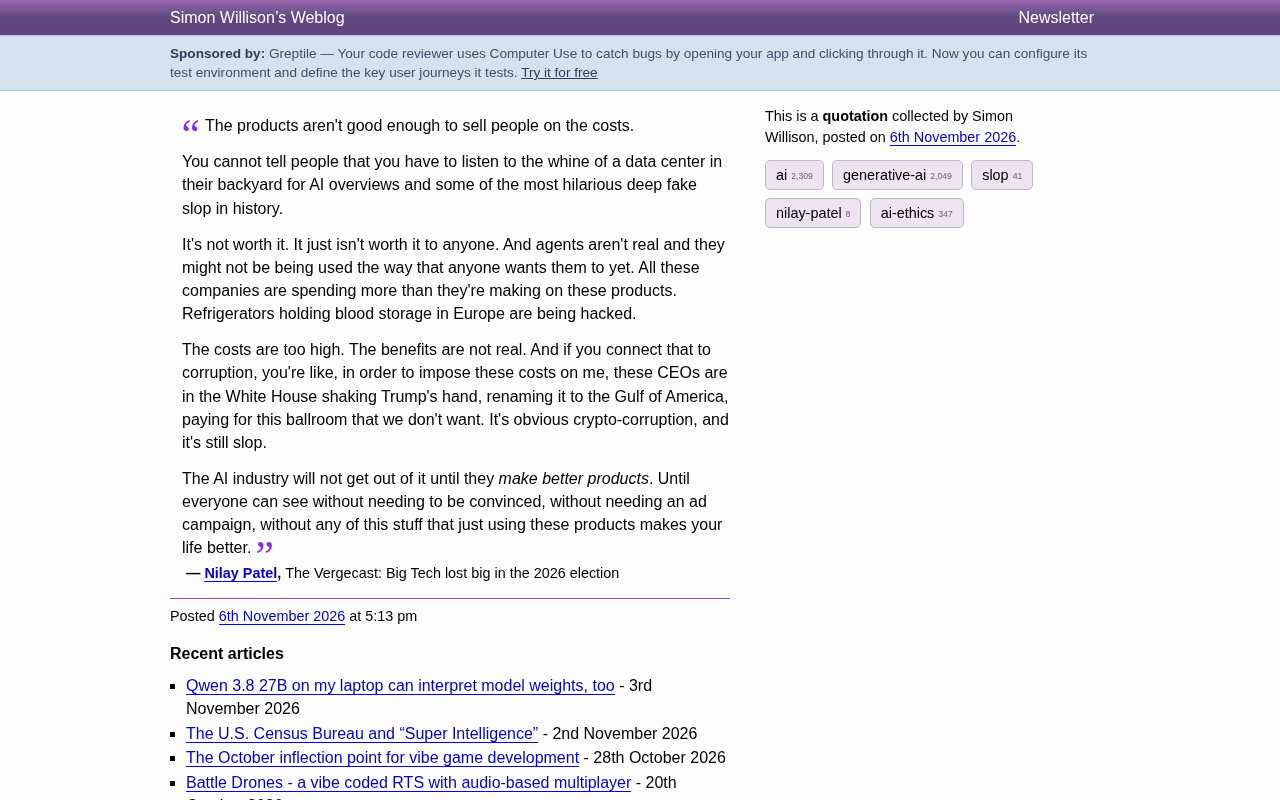
Patel's criticism begins with a single judgment: "The products aren't good enough to convince people to accept these costs."
Specifically, these costs include the noise and energy burden of data centers, privacy risks, and the enormous sums companies are pouring into AI. He points out that every company involved is spending more on these products than it earns from them. This observation points to a common concern: capital expenditure on AI infrastructure is expanding far faster than commercial returns, while the benefits users actually experience are disproportionate.
What makes the critique sharp is the comparison he draws—it's hard to tell ordinary users that, for AI overviews and "the funniest deepfake garbage ever," they must endure the constant hum of a data center in their backyard.
Agents Have Yet to Deliver on Their Promise
Patel is equally blunt about AI agents: "Agents aren't real yet, and they may not be used in the way anyone expects."
This judgment touches on the most heated controversy in the current AI application layer. Vendors universally describe agents as the core form of the next stage, but in practice most products remain in demos and limited scenarios. Patel doesn't deny the direction of the technology; what he questions is the gap between product maturity and market hype.
Interestingly, he also mentions a specific security incident: refrigerators used for blood storage in Europe are being hacked. The existence of such infrastructure security problems makes the question of whether AI's conveniences are worth it even more complicated.
The Corruption Narrative and a Crisis of Industry Trust
Patel extends the technical issues to the political and ethical level. His formulation: if you connect these costs with corruption, the picture becomes clear—CEOs appearing at the White House shaking hands with Trump, renaming the Gulf of Mexico, paying for a ballroom nobody wanted.
He describes this relationship as "obvious crypto corruption," and emphasizes that even so, what's produced is still "slop." The force of this critique lies in packaging the industry's economic problems, product problems, and political lobbying problems into a single narrative: the executive class passes costs onto the public while securing policy favors in return.
This is no longer just product criticism—it's a public questioning of the industry's legitimacy.
"Crypto corruption" is a term that has emerged in recent years in American political discourse, usually referring to the crypto industry trading political donations, lobbying, and personnel ties for looser regulation or favorable policy. Patel borrows the term to describe the AI industry: a government-business relationship leveraged by enormous capital and rewarded with policy convenience. It stings because it reframes a technical business issue as a matter of public trust—when industry executives appear both at product launches and in White House photos, the public can no longer view these companies purely through the lens of "technological progress." This also explains why his criticism resonates on social platforms: people feel not only that the products are hard to use, but also a sense of imbalance—costs passed on, and voice bought out.
There's Only One Way Out: Build Better Products
Patel's solution isn't complicated, but it sets a high bar: the AI industry must build better products to get out of the predicament.
His standard: good enough that no one needs to be convinced, no ad campaign is needed, no additional explanation is required—just use it and feel that life has improved. This is an extremely high threshold, and it happens to be the common trait of every successful product in consumer technology history—self-evident value.
From an industry analysis perspective, the value of this critique isn't whether it's comprehensive, but that it represents a spreading user sentiment: fatigue with the AI narrative. When investment keeps expanding while the experience improves only marginally, market patience drains quickly. For AI companies, the core of the next phase of competition may no longer be model parameters or funding scale, but whether they can deliver a product that users spontaneously endorse.
One-line Summary
Nilay Patel criticizes AI products for costing far more than they're worth, and says the only way out is to build genuinely better products.
Paragraph Summary
The Vergecast host Nilay Patel delivered a scathing critique of the AI industry, which spread widely after being quoted by Simon Willison. He argues that the value of AI products doesn't justify the costs they impose, including data center noise and energy burdens, privacy risks, and capital expenditure far exceeding revenue. He questions whether AI agents have truly landed, noting the gap between hype and product maturity, and cites a security incident in which blood-storage refrigerators in Europe were hacked to illustrate technological risk. He also links the industry's economic problems to political lobbying, describing executives' relationship with the White House as "obvious crypto corruption" and noting that the output is still low-quality content. His only solution is to build products so good that they need no persuasion, no advertising, and make users feel their lives have improved the moment they use them.
Related articles
 Tech Frontiers
Coldframe: A Honeypot Disguised as a Supermarket Freezer Controller
Coldframe is a honeypot disguised as Danfoss AK-SM 800A and Dixell XWEB freezer controllers, built as a single Python file that detects CVE-2025-41450 attempts and is identified as real devices on Shodan.
 Tech Frontiers
GRFNet: A Lightweight PyTorch Model Designed for Multichannel Time-Series Classification
GRFNet is a lightweight PyTorch model for multichannel time-series classification, originating from EEG decoding research. With only 3,847 parameters, it is based on the ROCKET architecture, combining random convolution kernels with learnable spatial filters, supports arbitrary input lengths, and will soon be evaluated on the PhysioNet dataset.
 Tech Frontiers
CUDA-Accelerated Rocket League Simulator: A Player-Made Hardcore Experiment
A Reddit post shows a "100% Accurate" Rocket League simulator accelerated with CUDA. We analyze its technical context, CUDA's value in game physics simulation, and the significance and limitations of such community projects.