Nilekani Steps Back as GP, Fundamentum Launches $200M Fund III Targeting AI and Fintech

Nilekani exits Fundamentum GP role as the firm launches a $200M Fund III focused on AI and fintech.
Infosys co-founder Nandan Nilekani has stepped down as General Partner at Fundamentum while remaining an anchor investor. Coinciding with the launch of a $200M Fund III targeting Indian AI and fintech startups, the move signals Fundamentum's shift toward an institutionalized, team-driven model — and reflects the broader maturation of India's venture capital industry.
A Major Shift in India's Venture Capital Landscape
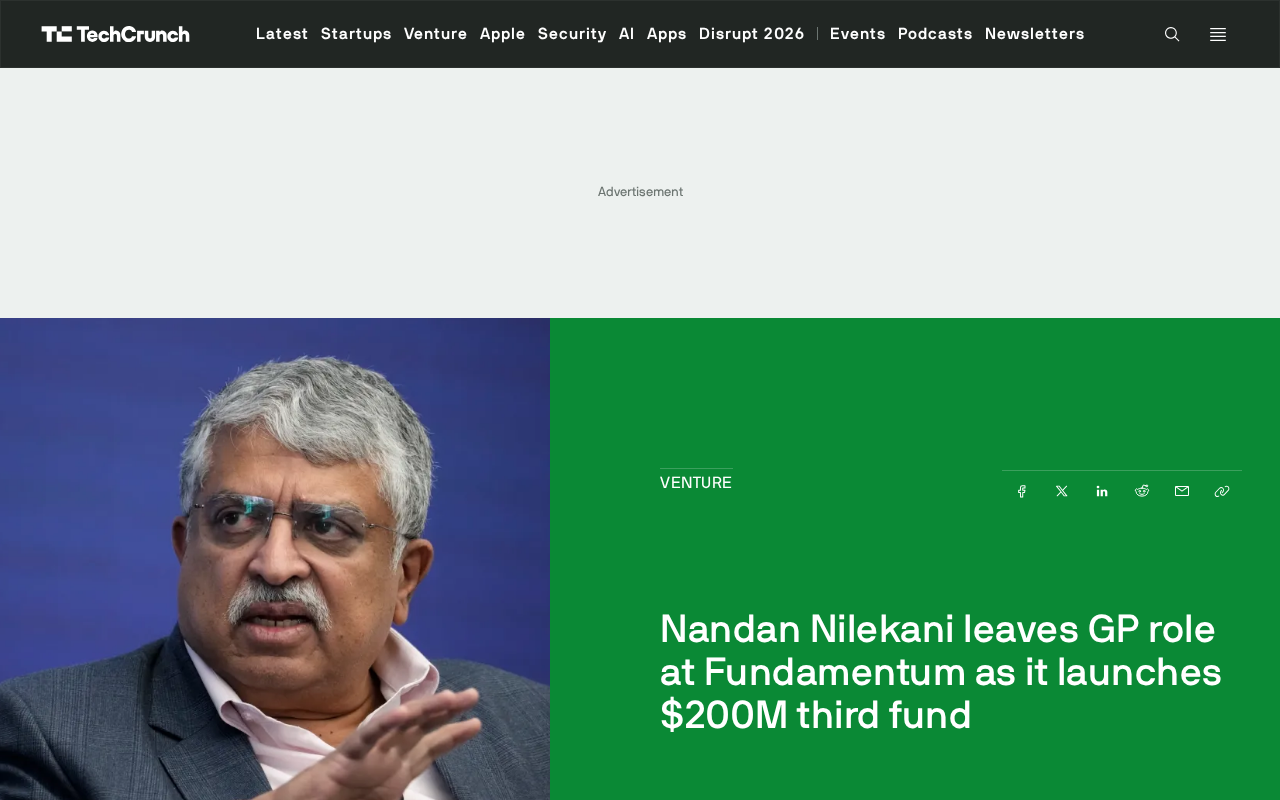
Nandan Nilekani, co-founder of Infosys and one of India's most prominent tech entrepreneurs, has announced his departure as General Partner (GP) of venture capital firm Fundamentum. The move comes as the firm launches its $200 million Fund III, drawing significant attention across India's startup investment community.
What's worth noting is that while Nilekani is stepping back from his day-to-day GP role, he will continue to be deeply involved as a core anchor investor. To understand this distinction, it helps to know how VC fund structures work: a General Partner (GP) is responsible for all operational aspects of a fund — investment decisions, portfolio management, and daily execution — while also bearing unlimited liability. They are, in essence, the ones running the show. An anchor investor, by contrast, commits a large amount of capital early in the fundraising process, providing credibility that helps attract other LPs. It's more of a strategic endorsement role — lending capital and reputation without being involved in day-to-day decisions. In other words, Nilekani's relationship with Fundamentum hasn't ended; it has shifted from active management to long-term capital support — from "playing the game" to "betting from the sidelines."
From Operations to Capital: The Logic Behind the Transition
For a tech leader juggling multiple high-stakes responsibilities, this move from Nilekani is hardly surprising. He is not only co-founder of Infosys but also the key architect behind India's digital identity system, Aadhaar — a role that has long commanded a significant share of his attention.
Aadhaar is India's national biometric digital identity system, launched in 2009. Nilekani served as the inaugural Chairman of the Unique Identification Authority of India (UIDAI), overseeing its design and rollout. The system collects citizens' iris, fingerprint, and facial data to assign each resident a unique 12-digit identification number, and has now reached over 1.3 billion Indians. Aadhaar fundamentally transformed how public services are delivered in India, becoming the foundational infrastructure for the UPI digital payments network, Direct Benefit Transfers (DBT), and financial inclusion initiatives. This gives Nilekani a rare, systems-level understanding of India's digital economy — and a policy network to match — which has been a key competitive advantage for Fundamentum's deep focus on fintech. Handing off the day-to-day GP responsibilities to a dedicated team while retaining his anchor investor role is a pragmatic way to preserve his influence without overextending his bandwidth.
Moving Toward an Institutional, Team-Based Model
Alongside launching the new fund, Fundamentum is actively expanding its leadership team — a clear signal that the firm is deliberately transitioning from a founder-driven model to a more institutionalized, team-based investment platform.
Venture capital has a well-known structural tension: top firms' brands are often tightly associated with a handful of star partners, and when key figures step back, fundraising ability and portfolio company confidence can both take a hit. The world's leading VC firms — Sequoia, Andreessen Horowitz (a16z) — have all gone through the evolution from founder-driven to collective partnership decision-making. The hallmarks of this institutional transition include standardized investment review processes, shared portfolio networks across partners, and the ability to attract great deals through brand and culture rather than individual charisma. Fundamentum's current moves — building out the leadership team, retaining Nilekani's capital backing while freeing him from management duties — are a local Indian expression of this broader industry pattern. For any VC firm with long-term ambitions, reducing reliance on a single star individual and building a sustainable decision-making structure is an unavoidable step toward maturity.
Betting on AI and Fintech: A Bellwether for Indian Venture Capital
Fund III has a clear mandate: artificial intelligence (AI) and fintech, with a focus on Indian startups. This strategy aligns squarely with the dominant trends in Indian and global tech investing.
India's Opportunity in the AI Wave
With the explosion of generative AI, India — backed by a vast engineering talent base and a rapidly expanding digital economy — is emerging as a significant hub for AI entrepreneurship. India holds several unique structural advantages in the global AI startup landscape. First, engineering talent density: India produces over 1.5 million engineering graduates annually, making it one of the world's largest sources of technical talent, at salary costs significantly below those in the US or Europe. Second, linguistic and contextual diversity: with 22 official languages and hundreds of dialects, there is an enormous localization opportunity in LLM fine-tuning, speech recognition, and multilingual NLP applications for Indian languages. Third, enterprise AI export potential: India's IT services industry has long served Western enterprises, building deep client relationships and delivery capabilities that give it a natural edge in AI-driven enterprise services. The generative AI wave is accelerating India's evolution from a traditional "code factory" into an exporter of AI solutions. Fundamentum's allocation to this space reflects strong conviction in the growth potential of India's AI ecosystem.
Deepening the Fintech Bet
Fintech has historically been one of India's most vibrant investment verticals. At the heart of it is UPI (Unified Payments Interface) — a real-time payment system launched by the National Payments Corporation of India (NPCI) in 2016, which allows users to make instant interbank transfers via mobile number or virtual payment address. UPI operates on an open, interoperable protocol that any licensed financial institution can access, dismantling payment market monopolies and enabling an ecosystem of players including PhonePe, Google Pay, and Paytm. As of 2024, UPI processes over 13 billion transactions per month, making it one of the largest real-time payment systems in the world. For Indian fintech founders, UPI is essentially a free public highway — national infrastructure laid by the government, letting startups focus on use-case innovation and user value creation across digital payments, financial inclusion, and credit tech. Given that Nilekani himself was one of the key architects of India's digital infrastructure, Fundamentum's heavy fintech focus is a natural expression of the team's deep domain expertise.
A Continuation of Influence, Not an End
Nilekani's departure from the GP role may look like a personnel change on the surface, but it reflects something deeper: India's venture capital industry maturing as a whole. By expanding its team and scaling up its fund, Fundamentum is building a more resilient and sustainable investment platform. Nilekani's continued involvement as anchor investor ensures that his market insight and network remain an asset to the firm.
For those tracking India's tech ecosystem, this $200 million AI- and fintech-focused fund is poised to be an important indicator of where Indian early-stage investing is headed over the next several years. Against a backdrop of broad global caution toward emerging markets, Fundamentum's move signals strong and enduring confidence in India's innovation story.
Key Takeaways
Related articles

Workbuddy for Absolute Beginners: How a Desktop AI Agent Fits Into Real Workflows
A beginner's guide to the Workbuddy desktop AI agent: installation, claiming credits, file management, and building automated workflows—compared with CodeX for fit and cost, helping professionals shift from AI question-askers to AI managers.

OpenAI's New Agent Stack: Computer Use, Decisions API, and Ultra-Fast Workflows
OpenAI Dev Day unveiled a new agent stack: Computer Use outperforms humans, Decisions API delivers ultra-low-latency classification via Luna, Agents API opens the same Computer Use capabilities, and GPT-6.1 Sol costs only one-seventh of Astra. Core updates, benchmark data, and developer insights.

Liang Wenfeng Open-Sources DeepInfo Inference Framework, Takes On U.S. Ban
DeepSeek open-sources its DeepInfo inference framework after its models, featuring GPU/CPU cross-pipelining, small-model prediction with large-model verification, and full Huawei Ascend and NVIDIA chip support—facing the U.S. federal ban head-on. This article analyzes its significance for AI deployment and open-source strategy.