Nintendo Officially Announces Pikmin Day: Switch 2 Title and Mobile Updates Unveiled

Nintendo establishes Pikmin Day and announces a Switch 2 title, mobile update, and shorts series.
Nintendo announced four Pikmin-related items at its mini Direct: an annual "Pikmin Day" on November 1, revealed by Shigeru Miyamoto himself; new information on Pikmin 4 for Switch 2, though specific gameplay changes remain undisclosed; a content update for mobile game Pikmin Bloom continuing its location-based gameplay; and a Hello! Pikmin short film series extending the IP beyond games. The article argues these moves collectively point to Pikmin's shift from a standalone series to a systematic structure of "new console title + long-term mobile operations + transmedia content," but whether it can reach top-tier IP status depends on the Switch 2 version's actual performance.
Nintendo dropped a string of announcements during its mini Direct on the eve of November 1: the establishment of an annual "Pikmin Day," new information on Pikmin 4 for Switch 2, an update for the mobile game Pikmin Bloom, and a Hello! Pikmin short film series. This short presentation packed a dense amount of information, and each item is worth unpacking.
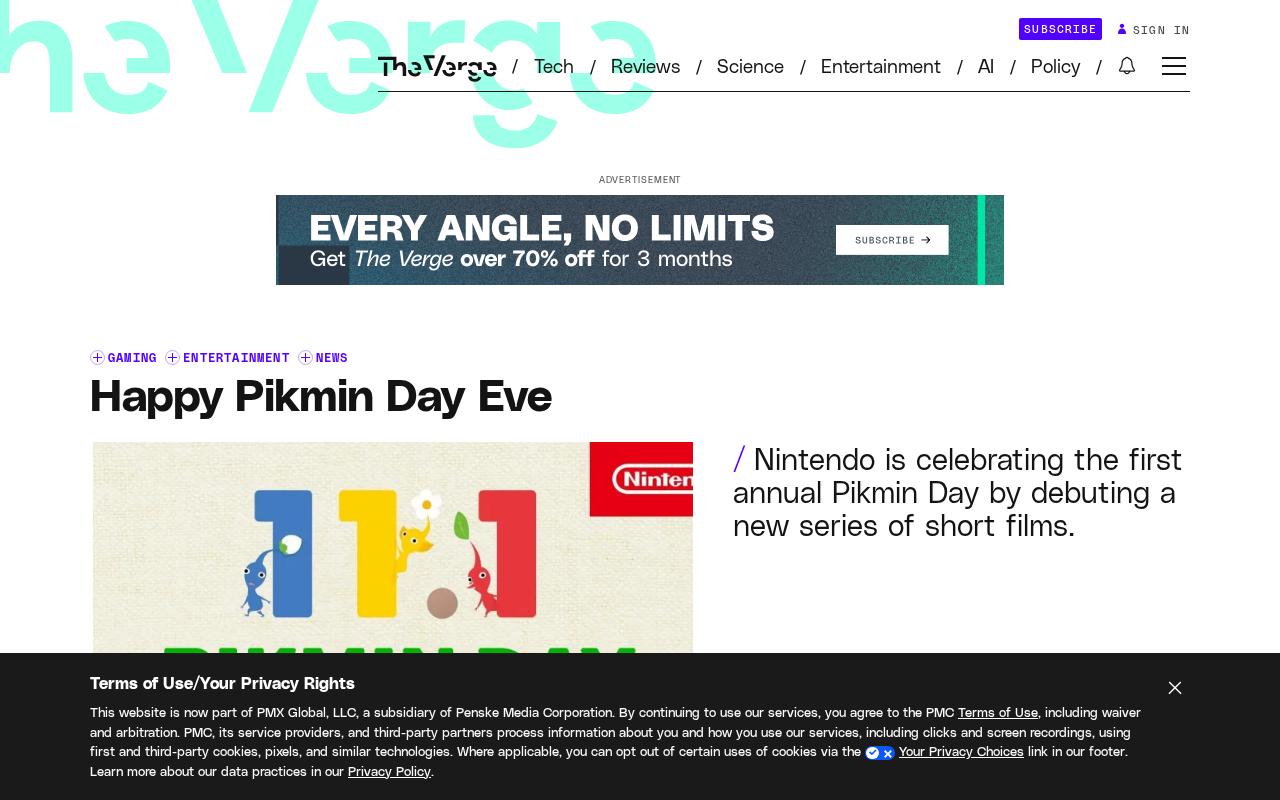
The IP Strategy Behind a Commemorative Day
Shigeru Miyamoto himself took the stage to announce that November 1 will become the first annual "Pikmin Day." Nintendo isn't the first to designate a fixed day as an IP anniversary, but for Pikmin—a series that has long sat in the second tier—this is a clear signal: it is no longer just an experimental pet project of Miyamoto's, but a brand asset brought into systematic management.
The value of a commemorative day isn't the day itself, but the stable marketing touchpoint it provides. Every year at this time, new title announcements, merchandise collaborations, and community events can be released in a concentrated burst, creating user expectations. For players, it's essentially an additional fixed "Pikmin information window."
Pikmin 4 on Switch 2: The Significance of Platform Migration
During the Direct, Miyamoto shared new information about Pikmin 4 on Switch 2. The original Pikmin 4 already launched on Switch; landing on new hardware technically means more ample computational resources to support more complex scenes and crowd AI behavior—the core gameplay of the Pikmin series relies on real-time scheduling of large numbers of individual units, and hardware performance directly determines how many Pikmin can appear on screen simultaneously and how detailed their behavioral logic can be.
However, the source material says little about specific gameplay changes in the new version, and it remains unclear whether this is an enhanced port or a version with added content. This point will need to be confirmed through official follow-up disclosures.
Crowd AI (Flocking / Crowd AI) is the underlying technical pillar of the Pikmin series' gameplay. It typically consists of three basic rules—separation (avoiding individual overlap), alignment (maintaining the same direction as nearby individuals), and cohesion (moving toward the group center)—layered with pathfinding and obstacle avoidance logic, allowing dozens to hundreds of units to exhibit "lifelike" collective behavior without individual manual commands. The overhead of such systems grows non-linearly with the number of units, because each individual must periodically query its neighbors and recalculate its movement vector. Therefore, hardware performance directly determines the on-screen unit cap and the granularity of behavior: the more ample the computational resources, the more units can be supported, the larger the neighbor perception radius, and the more complex the priority decisions—bringing the visuals closer to a "real insect swarm."
Continued Updates for Mobile Game Pikmin Bloom
Pikmin Bloom received a content update. This location-based mobile game combines Pikmin planting and collection mechanics with walking data, following a lightweight daily companionship approach. What it contributes to the series is reach—allowing users without console hardware to engage with the IP, while translating the act of "walking" into game progress, consistent with the Pikmin series' emphasis on nature and exploration.
The specific details of the update were not elaborated in the original source material, but from an operational rhythm perspective, such continuous updates are standard practice for maintaining mobile game retention.
Location-based service (LBS) mobile games refer to a genre that uses GPS and other positioning data as core input, with Pokémon GO as the representative example. The basic loop is: the player's real-world movement is converted into in-game displacement, triggering collection, planting, or combat actions on the map. The key design challenge for such products is translating real-world behavior (walking distance, routes, weather, time of day) into meaningful progress feedback while managing battery consumption and positioning accuracy. Since gameplay is tied to the real geographic environment, content updates tend to focus on seasonal events, limited-time quests, and regional collaborations to maintain long-term retention—this is the standard operational paradigm to which Pikmin Bloom's update cadence belongs.
Hello! Pikmin Shorts: Extending Beyond the Game
Nintendo also announced the Hello! Pikmin short film series. Bringing game characters into short film format is a common path for IP transmedia expansion—relatively controllable in cost while reaching non-player audiences. For an IP like Pikmin, with distinctive character designs and a light narrative burden, short films are a highly suitable vehicle.
Transmedia expansion refers to dispersing the content of the same IP across animation, shorts, comics, film and television, and other vehicles beyond games, with each vehicle serving as an entry point rather than a simple adaptation. A common strategy is to prioritize low-cost, short-cycle, flexibly distributed short-form content to test character appeal, reach non-player audiences, and accumulate data for larger-scale adaptations later. For IPs with high character recognition but a light worldbuilding narrative burden, short films can expand brand awareness without bearing the narrative risk of feature-length productions—making them a high-ROI first step.
What This Direct Tells Us
The three announcements point in the same direction: Nintendo is pushing Pikmin from a standalone series toward a combined structure of "new console title + long-term mobile operations + transmedia content." The commemorative day provides rhythm, the Switch 2 title provides the technical ceiling, the mobile game provides user breadth, and the shorts provide brand diffusion. Whether this combination can elevate Pikmin into the top-tier IP ranks remains to be seen based on the actual performance of the Switch 2 version.
Information currently available remains at the announcement level; key details such as gameplay specifics and release windows are yet to be supplemented.
Related articles

Anthropic's IPO Crisis: Why $16.8B in Revenue Can't Buy a High Valuation
Anthropic posted $16.8B in Q3 revenue with 85% gross margin yet faces a cut to its IPO valuation. A deep dive into halved growth, the token price war, circular financing, and the clash between safety ideals and capital reality.

Anthropic Races Toward the Largest IPO in History: Can a $100 Billion Raise Ignite the AI Investment Boom?
Anthropic may file its prospectus as early as October 23, aiming to raise up to $100 billion at a valuation of up to $2 trillion, potentially the largest IPO ever. Q3 revenue hit $16.8 billion, up nearly 50% quarter over quarter, with adjusted profitability, but slowing growth has led some investors to cut valuation to $1.5 trillion. The IPO is a key test of whether the AI investment boom can continue.

Bessemer Partner on Anthropic IPO: The Public's First Direct Investment in AI Software
Bessemer partner Byron Theta on the Anthropic IPO: why it's called the moment everyone's been waiting for, the $650M four-round investment, the LP liquidity bind, and expectations of a 2027 IPO wave—plus open-source model pricing pressure, existential risk disclosures, and what the founders' 50.1% voting structure means for ordinary investors.