NirnaY: An AI-Powered Emergency Decision Support System That Turns Chaotic Disaster Data into Clear Decisions
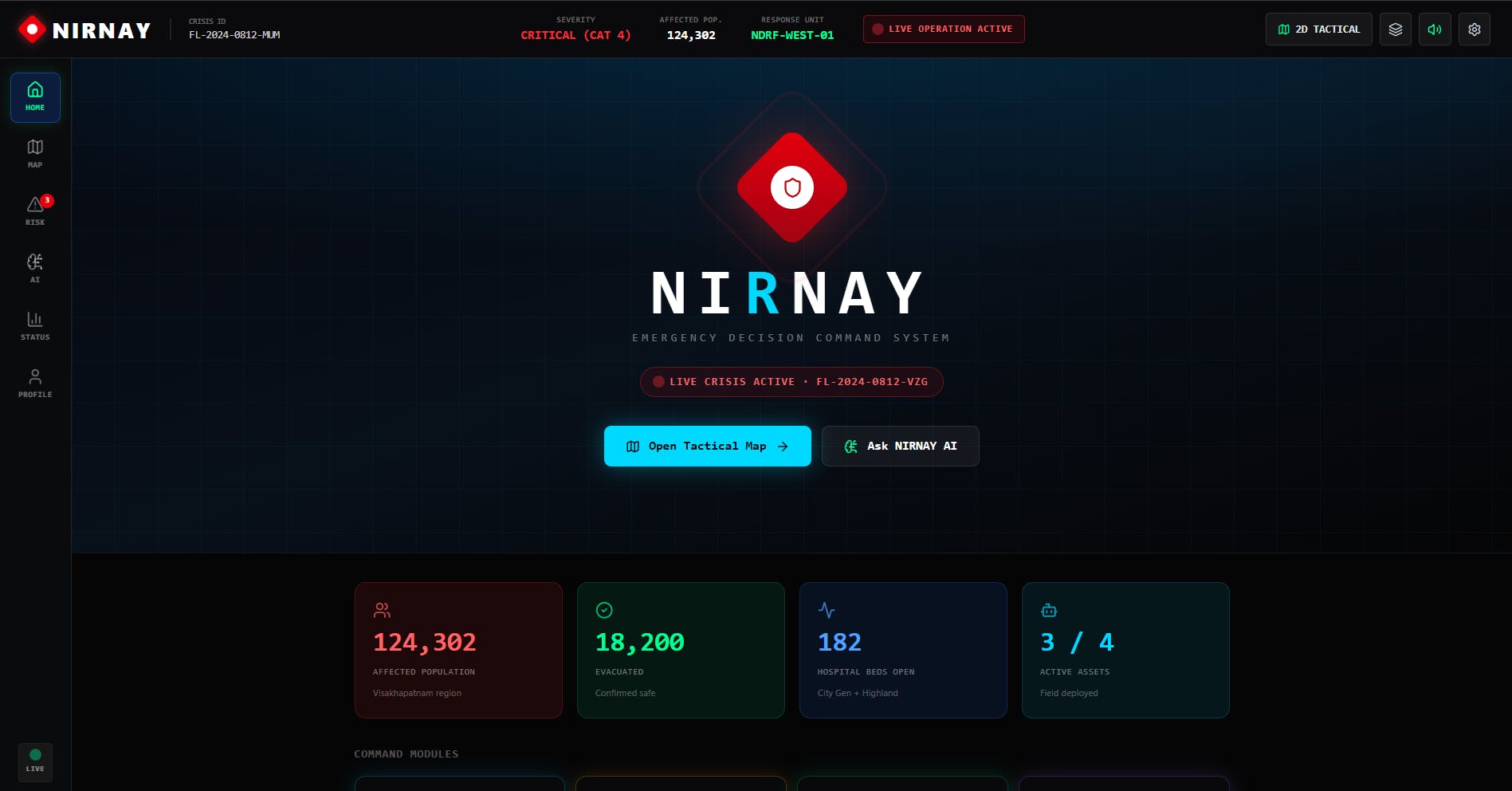
NirnaY uses AI to turn chaotic disaster data into clear, explainable emergency decisions.
NirnaY is an AI-powered emergency decision support system that transforms fragmented, contradictory disaster data into actionable decisions. Its core capabilities include real-time risk maps, confidence scores for uncertainty quantification, emergency routing, what-if scenario simulation, and explainable AI reasoning — all while keeping humans in control of final decisions.
The Core Dilemma at Disaster Sites: Information Is Never Complete
When earthquakes, floods, or wildfires strike, emergency responders typically don't face a shortage of information — they face information chaos. Data is fragmented, contradictory, and changing every second. Which roads are still passable? Which areas pose the highest risk? Where should rescue teams be dispatched first? In life-or-death moments, commanders must make decisions amid overwhelming uncertainty.
NirnaY, which recently launched on Product Hunt (ranking #20 on launch day with 12 upvotes and 4 comments), targets exactly this pain point. It positions itself as an "AI-powered emergency decision support system" with a concise and powerful tagline: Turn uncertain disaster data into clear decisions.
NirnaY's Five Core Capabilities: From Data Chaos to Decision Clarity
According to its official description, NirnaY is not a single-function tool but a complete capability stack built around "decision support." It transforms incomplete, contradictory, and constantly evolving disaster information into clear, explainable action plans.
Real-Time Risk Maps: Intuitive Situational Awareness
NirnaY dynamically aggregates multi-source disaster data and displays real-time risk levels across different areas on a map. This gives commanders an intuitive situational awareness interface — compared to a pile of isolated spreadsheets, a real-time risk map lets you grasp the spatial distribution of danger at a glance. This also explains why the product is categorized under Maps on Product Hunt.
Confidence Scores: Quantifying Uncertainty
This is the key design feature that sets NirnaY apart from ordinary mapping tools. Data from disaster sites is often unreliable, so NirnaY attaches a confidence score to every piece of information, explicitly telling decision-makers "how reliable is this assessment." This explicit quantification of uncertainty is precisely the element most easily overlooked yet most critically important in emergency command.
Emergency Routing: Dynamic Safe Path Planning
When roads are blocked and bridges destroyed, how do you plan the optimal route for rescue teams? NirnaY's emergency routing feature combines real-time risk data to dynamically calculate feasible and safe travel plans, preventing rescue forces from running into secondary disasters.
What-If Scenario Simulation: From Reactive Response to Proactive Prevention
"What if the floodwaters rise another two meters?" "What if this main road is also cut off?" NirnaY provides hypothetical scenario simulations, allowing commanders to rehearse different possibilities before making decisions, enabling them to pre-deploy resources and mitigate risks. This forward-looking simulation capability is the key to upgrading from reactive response to proactive prevention.
Explainable AI Reasoning: Making People Confident Enough to Act on Recommendations
The system doesn't just provide recommendations — it also explains "why it recommends this." In high-risk, high-accountability emergency scenarios, black-box AI outputs struggle to earn trust. Only an explainable chain of reasoning can give human commanders the confidence to truly act on AI's decision recommendations.
Human in the Loop: AI Assists Rather Than Replaces Human Decision-Making
One statement in NirnaY's product philosophy is particularly noteworthy — keeping humans in control.
This positioning stands out as remarkably measured and pragmatic among current AI product narratives. In high-stakes domains like disaster rescue, any wrong decision could cost lives. NirnaY doesn't promise "AI-automated rescue command." Instead, it explicitly positions itself as a decision support system: AI handles the massive, chaotic, and contradictory data, distilling it into clear options with confidence scores and explanations; the final call always rests with experienced human responders.
This "human-AI collaboration" design philosophy is actually the mainstream paradigm for deploying AI in mission-critical domains today. It leverages AI's speed advantages in data processing and pattern recognition while preserving humans' irreplaceable role in complex ethical judgment and on-the-ground experience.
Product Positioning Analysis: AI-Driven Innovation in Emergency Management
Looking at its Product Hunt category tags, NirnaY spans Productivity, Artificial Intelligence, GitHub, and Maps. The GitHub tag suggests the project may be open source — an important foundation for building trust with emergency management agencies that want to audit algorithmic logic and verify confidence score calculations.
Emergency decision support is a long-established but technologically slow-moving vertical. Traditional emergency management systems often rely on preset procedures and static maps, making them ill-equipped to handle the rapidly changing information landscape of real disaster scenes. NirnaY aims to reconstruct this workflow using the technology stack of the generative AI era — real-time data fusion, uncertainty quantification, scenario simulation, and explainable reasoning.
Of course, as a newly launched early-stage product, NirnaY's actual deployment effectiveness, the breadth of its data source integrations, and its reliability under extreme scenarios all remain to be validated. Its initial traction of 12 upvotes also indicates it's still in the early exploration phase. But the direction it points toward — using AI to help humans make better decisions under uncertainty — is undoubtedly a proposition with both social value and technical depth.
Conclusion
NirnaY represents a pragmatic and meaningful direction in AI applications: rather than pursuing flashy full automation, it focuses on the core goal of "augmenting human judgment." In the face of disaster, information chaos is the norm, and what NirnaY aims to do is light a lamp for decision-makers amid that chaos — one that comes with a "confidence label" attached. For those watching how AI lands in serious domains like emergency management, the evolution of tools like this is well worth following.
Related articles

JobRunner MCP Server: AI Agents Can Now Fix Failed Java Jobs
JobRunner launches an open-source MCP server enabling AI agents to view cluster status, diagnose failures, and recover Java jobs—incident response from any cloud coding environment or existing agent.

MLAI Digital Launches 9 Security Agents: MCP Server Safeguards the Full Lifecycle of Agentic AI
MLAI Digital launches Security MCP Server with nine built-in specialized security agents covering vulnerability discovery, attack simulation, prompt injection detection, API and infrastructure assessment, and accelerated remediation—embedding security validation across the full Agentic AI lifecycle from development to production.

Running Isaac Lab on H100 GPUs: Exploring Better Approaches
Exploring optimization methods for running Isaac Lab on NVIDIA H100 GPUs, including MIG configuration, mixed precision, TensorRT acceleration, and community experience to improve robotics simulation and reinforcement learning efficiency.