No Coding Skills, Launched an AI SaaS in 24 Hours: A Full Hands-On Retrospective

A non-programmer built and launched an AI video editing SaaS in 24 hours using Claude, revealing AI coding's capabilities and limits.
A creator who claims no programming skills used Claude's conversational coding to build and launch an AI video editing SaaS from scratch in 24 hours. He produced an interactive MVP in two hours, but backend integration—connecting Supabase, Stripe, and auth—took nearly five hours, far exceeding frontend work. The product generated Reels in 3-5 minutes versus 15-30 minutes manually. His key conclusion: AI has democratized product building, but distribution, not the product, determines success.
A creator who claims to have no programming background used Claude to build and launch an AI video editing SaaS from scratch in 24 hours, handling everything from ideation, design, and coding to marketing. This article breaks down the entire process to see just how far AI programming can go—and where its real bottlenecks lie.
Starting from a Real Pain Point: Editing Reels Every Day Takes Too Long
This creator runs an Instagram account and needs to post short-form video content daily. The problem: editing videos every day consumed a huge amount of time. His idea was straightforward: since he had to edit Reels every single day anyway, why not build an AI tool to automate the process?
Interestingly, he figured out his distribution path before writing any code. His marketing plan was: post videos edited with his own tool on Instagram every day, casually mention the tool in those videos, and direct viewers to the website to purchase. This "use the product to make content, use the content to sell the product" cold-start approach is essentially a zero-cost customer acquisition channel for solo developers.
After confirming the need, he used Perplexity AI to research similar tools and pricing in the market, finding that competitors generally charged around $20 per month. This price anchor gave him a reference point for his own pricing. That said, he admitted he couldn't find a direct competitor—which, in his view, "is not a particularly good signal"—but because the pain point was real, he decided to push forward anyway.
Writing Code from Scratch with Claude: Building a Product Without Knowing How to Code
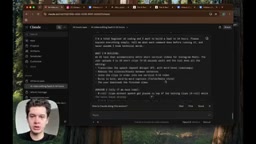
He repeatedly emphasized that he is not a professional developer—the entire development process relied almost entirely on conversational programming with Claude. The approach: create a new project, describe the product requirements in detail to Claude (AI-automated editing of Instagram Reels with A-roll/B-roll, subtitles, silence removal, animations, etc.), then let Claude propose a solution and generate code directly in the terminal.
Throughout the process, he only did two things: describe requirements in natural language, and reply "yes" when Claude presented options. He even skipped some non-essential features—for example, he proactively asked Claude to remove the login module because "building login at this stage is a pure waste of time."
Progress was faster than expected: about two hours in (1 PM), the first version of the app could run through the basic flow—landing page, uploading footage, generating clips with subtitles. He tested the first output: the tool automatically removed 7 seconds of silent footage, and the pacing felt good. The only shortcoming was that animations weren't in yet.
By 4:30 PM, he had added motion design and B-roll sequencing logic, and the output quality was approaching publishable level. Though details still had flaws—animations were positioned too high, and a few segments dragged—the minimum viable product (MVP) had essentially taken shape.

What is vibe coding: The term was coined by AI researcher Andrej Karpathy in early 2025, referring to an entirely new way of programming—developers (or even non-developers) describe desired outcomes to large models in natural language, the model generates code, and the person primarily acts as a "validator" rather than an "implementer." Its core characteristic: barely reading code line by line, instead judging correctness by running results, and when problems arise, continuing to use conversation to have the AI make fixes. This mode dramatically lowers the barrier from idea to a runnable product, but it also comes with obvious weaknesses—when a system is composed of multiple services (database, payment, authentication) coupled together, what breaks is often not a piece of code but the connections and state transitions between services. At that point, users lacking architectural understanding struggle to locate the problem. The author getting stuck for five hours during backend integration is a textbook example of vibe coding's capability boundary.
The Real Challenge: Five Hours Spent on Frontend-Backend Integration
At 6 PM, the frontend was largely usable, and he started recording marketing videos—planning to post one each at 8 PM, 10 PM, and midnight, plus another at 9 AM the next morning. Then he turned to backend integration: Supabase for the database, Stripe for payments, Better Auth for authentication.
That's exactly where problems hit. By 11 PM, he had spent nearly five hours connecting the frontend and backend, and the frontend actually stopped working. He was candid in the video:
"Vibe coding really does let people who don't understand code build products quickly, but the reality is it requires a massive amount of time and energy."
At this point, he also admitted that launching this SaaS within 24 hours at a beginner level was "nearly impossible." He even reflected on why he hadn't chosen a simpler project, like a habit-tracking app. But he chose to keep going and inserted a mid-process running video as a cutaway—which is probably a rare touch of authenticity in long-form content.
What Supabase, Stripe, and Better Auth each do: Supabase is an open-source "backend-as-a-service" platform built on PostgreSQL that provides database, storage, user management, and real-time subscriptions—developers get a backend without setting up their own servers. Stripe is the most mainstream online payment infrastructure today, enabling subscriptions, one-time payments, and paywalls with just a few lines of code. Better Auth is an authentication library for modern frontend frameworks, handling registration, login, and session management. This trio is a common "standard stack" for indie developers building SaaS today. The advantage is that each piece has a mature solution; the difficulty is that they need to communicate with each other—for example, after successful authentication, the user must be written to the database, and after successful payment, the subscription status must be written back. This kind of cross-system "glue logic" is precisely the part that large models struggle most to get right in one shot.
Launching at 1:30 AM: Functionally Usable
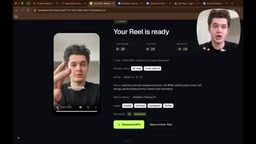
At 1:29 AM, the app finally worked end-to-end. By then the interface supported: uploading all short-video footage, selecting subtitle styles, choosing whether to add animations and sound effects, and then generating Reels with one click.
He tested it: from upload to finished output took about 5 minutes. He noted that manually editing the same content would take at least 15 to 30 minutes. The output quality was "pretty good for a product made in 24 hours."
He then transferred the video from his Mac to his iPhone and posted the first video edited with his own tool on Instagram—at the time, it had zero views. As for Stripe payments, he admitted he hadn't set it up that night and planned to wake up at 10 AM the next morning and knock it out in an hour.

At 11:44 AM the next day, he completed the Stripe payment integration, and the entire flow worked: downloading a video triggers the paywall, selecting an annual plan redirects to the Stripe payment page. From start to finish, exactly 24 hours—a fully functional, payment-enabled AI SaaS was officially live.
What are A-roll and B-roll: These are terms from the video editing industry. A-roll refers to the primary footage, usually a person talking to camera—the core of the narrative. B-roll refers to supplementary footage, such as product close-ups, ambient shots, or action clips, used to intercut while the person speaks, avoiding visual monotony and enhancing rhythm and information density. For a Reels editing tool to automate this, it must identify which clips are primary content and which work as inserts, then decide placement and duration. When the author mentions adding "B-roll sequencing logic" at 4:30 PM, he means letting the AI automatically determine the insertion order of B-roll footage—a key element in making the final product look "human-edited."
What This Experiment Shows
The value of this story isn't in "building a SaaS in 24 hours" itself, but in what it reveals about the real capability boundaries of AI programming today:
What works: For non-technical people with clear requirements who are willing to describe logic in natural language, AI can indeed rapidly generate usable frontend interfaces and basic business logic. Someone with zero programming experience can see an interactive MVP within two hours.
What's hard: Backend integration—connecting the database, payments, and authentication—remains a bottleneck. This isn't about AI failing to write code; it's that connecting systems, managing state, and debugging require an understanding of the overall architecture. The creator got stuck here for five hours, far exceeding frontend development time.
The more critical insight: His closing line in the video is worth remembering—"The solution is not the product, it's the distribution." In his view, product capabilities have been massively democratized by AI, and what truly determines success is whether you can consistently capture user attention. His choice to post Instagram videos daily is essentially using content distribution to drive traffic to his product.
For anyone considering a similar path, the takeaway is: pick a direction where you genuinely feel the pain point, use AI to quickly validate feasibility, but don't underestimate the complexity of backend integration. More importantly, before writing the first line of code, figure out where your users will come from.
Related articles

How Big Can Stars Really Get? The Physical Limits of the Largest Stars
Red supergiants are the largest stars by volume, with radii up to 2,000 times the Sun, engulfing the inner solar system. But there is no precise upper limit on stellar size—models predict up to 15,000 solar radii. The most massive blue stars are far smaller than red supergiants—biggest and heaviest are two different things.

Apple HomeView Smart Display Full Feature Breakdown: Wall-Mount or Desktop, $299
Apple launches HomeView, a $299 smart display with wall-mount and desktop options, 12MP camera for facial recognition, smart home control, music playback, and recipe step-by-step cooking. Full breakdown of watch faces, apps, privacy, and cooking integration.

Where Did the Promised New Studio Go? Craft Computing Answers After Five Years
Craft Computing's host responds to viewer questions: the new studio promised five years ago was shelved as construction costs soared from $30,000 to $75,000, and was replaced by a 168-square-foot garage conversion.