No Competitive Programming Required: How CS Students Can Pivot to AI/ML and Land Internships
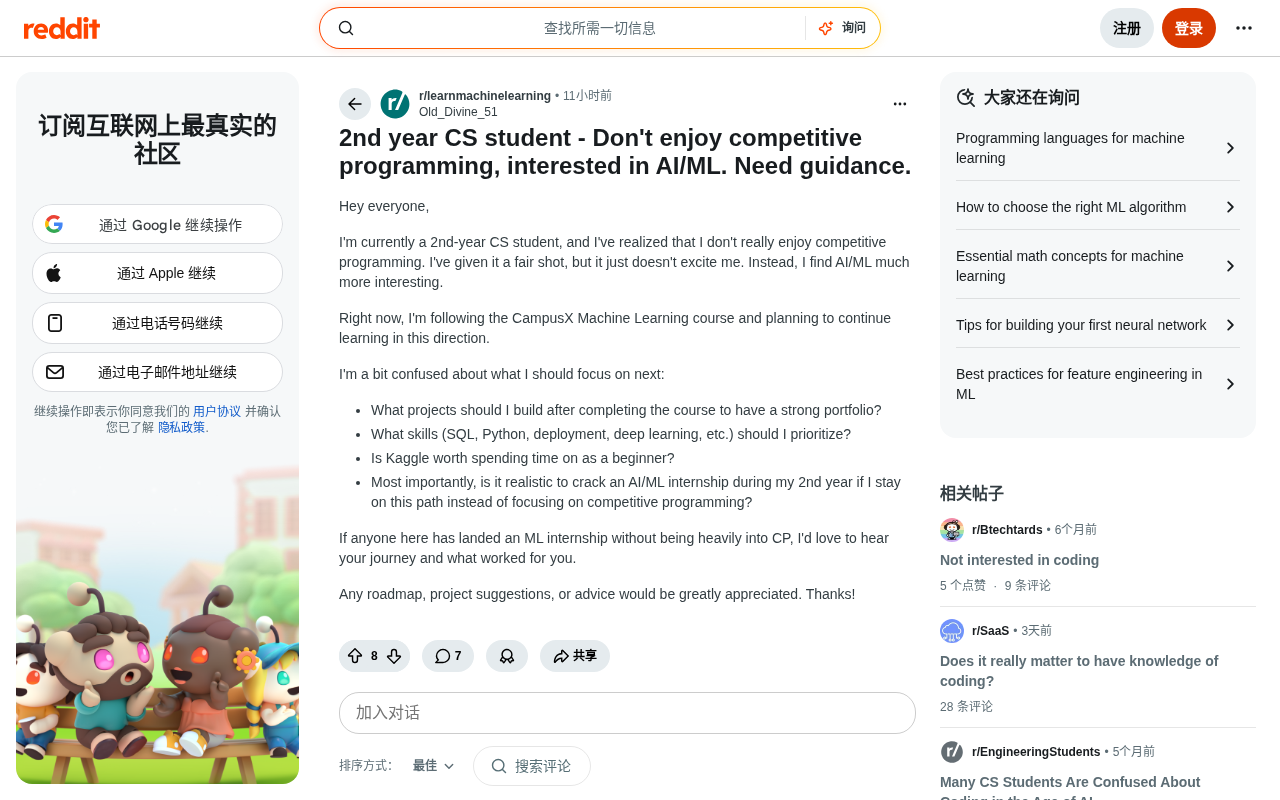
A pragmatic roadmap for CS students to pivot to AI/ML and land internships—without competitive programming.
You don't need to grind LeetCode to break into AI/ML. This guide lays out the real skill priorities—Python data tools, SQL, classical ML, deep learning, and deployment—plus how to build an end-to-end project portfolio, use Kaggle wisely, and land an AI/ML internship as a sophomore.
Competitive Programming Isn't the Only Way Into AI/ML
In CS learning communities, one question comes up again and again: "I tried competitive programming (CP), but found I just don't enjoy it. Instead, I'm passionate about AI/ML—is this path still viable for me?"
This kind of confusion is extremely common. For a long time, competitive programming has been seen as the "standard path" to landing a job at a big tech company, with LeetCode and Codeforces rankings almost becoming synonymous with technical ability. But the truth is, the skill stack required for AI/ML overlaps surprisingly little with competitive programming.
Competitive Programming originated with the ACM International Collegiate Programming Contest (ICPC) in the 1970s. Its core focus is optimizing algorithms—graph theory, dynamic programming, data structures—to their limits under strict time and space constraints. This training system gave rise to platforms like LeetCode and Codeforces, and was adopted into the hiring processes of companies like Google and Meta. AI/ML roles, however, demand something entirely different: statistical intuition, data sense, and model generalization ability are the core—not writing a red-black tree from scratch in 30 minutes.
It's worth noting that competitive programming and AI/ML also differ fundamentally in their cognitive modes. CP trains the ability to find optimal algorithmic solutions under strict constraints—answers are deterministic, and the criterion is simply pass/fail. AI/ML's core challenge, by contrast, is making optimal decisions amid uncertainty: data is noisy, labels are incomplete, and the standard for a model being "correct" is fuzzy. This shift in mindset can actually require extra adjustment for those transitioning from a CP background. CP trains algorithmic thinking and rapid problem-solving, while AI/ML values data processing, statistical modeling, engineering deployment, and domain understanding. These are different skill systems—and to pursue AI/ML, you don't need to prove yourself in competitive programming first.
Skill Priorities: Spend Your Time Where It Matters
If you want to pivot to AI/ML, rather than agonizing over "should I grind LeetCode," focus your energy on the skills that genuinely matter. Here's a more pragmatic prioritization.
1. Python and Data Processing: The Foundation of the Foundation
Python is the dominant language of AI/ML, but knowing the syntax is far from enough. The real core is the data-processing trio: NumPy, Pandas, and Matplotlib/Seaborn.
NumPy, Pandas, and Matplotlib/Seaborn form the foundational layer of Python's data science ecosystem. NumPy provides high-performance multidimensional array operations, implemented in C under the hood, making it dozens to hundreds of times faster than pure Python loops. Pandas builds a DataFrame abstraction on top of it, giving structured data manipulation an expressiveness close to SQL. Matplotlib is the bedrock of Python's entire visualization ecosystem, with Seaborn providing a high-level wrapper for statistical charts on top. The design philosophy of these three deeply influenced the API design of later frameworks like TensorFlow and PyTorch.
From a historical perspective, NumPy emerged in 2005 from Travis Oliphant's consolidation of the earlier Numeric and Numarray libraries, while Pandas was developed by Wes McKinney at AQR Capital Management in 2008 to solve pain points in financial data analysis. This means these tools were born to "solve real business problems" from the start—not as academic toys. Understanding their design motivations helps you grasp their API logic more intuitively. In real machine learning projects, 60%–80% of the time is spent on data cleaning, feature engineering, and exploratory data analysis (EDA); model training is actually just a small final step. Being able to manipulate data fluently is the most worthwhile ability to invest in first when getting into AI/ML.
2. SQL: An Underrated Essential
Many beginners skip SQL, thinking it's "not AI enough." But in industry, data is almost always stored in relational databases, and your ability to efficiently extract, aggregate, and clean data directly impacts your productivity.
SQL (Structured Query Language) was born in 1974 from IBM's System R project, with the core design principle of enabling even non-programmers to manipulate data in a way close to natural language. Half a century later, it remains the most universal language in data engineering—mainstream data warehouses like PostgreSQL, MySQL, BigQuery, Snowflake, and Redshift all use SQL as their interface. More notably, feature engineering in modern AI/ML workflows relies heavily on SQL, and many companies' Feature Stores are built on top of SQL databases. Mastering window functions, CTEs (Common Table Expressions), and aggregation logic is key to extracting the features ML needs from data. SQL doesn't require much time to master, but it's the common language of both data roles and ML roles—not knowing SQL will leave you stuck in a lot of real-world work.
3. Machine Learning Fundamentals → Deep Learning: In That Order
First get a solid grasp of classical machine learning (linear regression, logistic regression, decision trees, random forests, SVMs, clustering, etc.)—both theory and practice—before moving on to deep learning. Deep learning is trendy, but if you haven't even figured out the bias-variance tradeoff, how to prevent overfitting, or how to choose evaluation metrics, jumping straight into neural networks easily turns you into a "library-caller"—someone who knows how to use tools but not why, and who's helpless when problems arise.
The Bias-Variance Tradeoff is a core concept of statistical learning theory, systematically articulated in Geman et al.'s 1992 research. It describes the two sources of model prediction error: bias (systematic deviation caused by overly simple model assumptions) and variance (instability caused by the model being overly sensitive to noise in the training data). The two are in tension: an overly simple model underfits (high bias), while an overly complex model overfits (high variance).
This framework hasn't become obsolete in the deep learning era—it reappears in new forms. For example, Dropout regularization reduces variance by randomly dropping neurons; BatchNorm implicitly acts as regularization while stabilizing training; and the "Double Descent" phenomenon that emerged in the era of large language models (LLMs) is an intriguing challenge to the classical bias-variance curve—when the number of model parameters exceeds the number of training samples, test error actually decreases again, prompting researchers to reconsider the very boundaries of overfitting. Understanding this framework is the key dividing line between being a "library-caller" and becoming a true ML engineer—it explains the motivation behind nearly all core techniques, including regularization, cross-validation, and ensemble learning.
4. Model Deployment: The Key to Standing Out
This is the step most students overlook. Plenty of people can train models, but relatively few can deploy them as usable APIs or web applications. Mastering the basics of Flask/FastAPI, Docker, and Streamlit/Gradio transforms your project from "it runs locally" into "people can actually use it."
Flask was born in 2010 as a representative lightweight Python web framework. FastAPI, launched in 2018, automatically generates OpenAPI documentation based on Python type annotations and offers significant advantages in asynchronous performance, making it the new favorite for ML API deployment. Docker containerization solves the classic "it works on my machine" problem by packaging the runtime environment as an image for consistent deployment. Streamlit (2019) and Gradio (2019) are designed specifically for data scientists, allowing interactive web interfaces to be built in pure Python—dramatically lowering the barrier to developing ML demo applications. The Hugging Face Spaces platform is built around Gradio as its core showcase ecosystem.
From a broader perspective, the rise of MLOps (machine learning operations) as an independent engineering discipline is precisely because of the industry pain point that "a well-trained model can't be reliably deployed." Model drift, data pipeline stability, A/B testing frameworks, monitoring and alerting—these deployment-level challenges are a major source of the current salary premium for AI/ML engineers. Even mastering just the basic deployment tools is a first step toward this high-value direction. In internship interviews, this is a highly tangible competitive advantage.
Project Portfolio: More Convincing Than Any Certificate
After finishing coursework, the most common mistake is to just "take another course," falling into Tutorial Hell. "Tutorial Hell" is a widely recognized phenomenon in programming learning communities: learners keep following tutorials to complete projects but can never solve problems independently. Its psychological root lies in the "illusion of familiarity"—the smooth feeling of following along is mistaken by the brain for genuine mastery, but that fluency actually comes from the external scaffolding the tutorial provides; once removed, you're left with no idea where to start.
Cognitive science research shows that Active Recall and spaced practice are far more effective than passive following. In programming learning specifically, the Feynman Technique is especially applicable here: try explaining the concept you just learned to someone else, or reimplement it without looking at the tutorial—the points of confusion you expose are often exactly your real knowledge gaps. An even more aggressive approach is the "minimum viable project method"—immediately after learning a concept, use it to solve a tiny problem you're personally interested in. Even if the result is crude, this process of active construction leaves a far deeper memory trace than following a tutorial ever could. What truly makes you stand out is end-to-end projects you can complete independently, not course completion certificates.
I recommend progressing along a "from imitation to originality" path:
- Beginner projects: Classic datasets like house price prediction or Titanic survival prediction. The focus is on going through the complete pipeline—data cleaning → feature engineering → modeling → evaluation → retrospective review.
- Intermediate projects: Pick a field you're genuinely interested in (sports data, music, games, etc.), scrape or collect your own data, and build a meaningful analysis or prediction project from scratch.
- Bonus projects: Build a project with deployment—like an image classification web app or a sentiment analysis API—deploy it live, and include the GitHub link and demo URL.
A single project with a clear README that solves a real problem and is live and accessible beats ten Jupyter notebooks sitting on your hard drive.
Kaggle: Use It as a Tool, Not an Arena
Kaggle was founded by Anthony Goldbloom in 2010 and acquired by Google in 2017. It now has over 15 million registered users and is the world's largest data science competition platform. For beginners, Kaggle is worth using, but don't get obsessed with rankings. Its real value lies in:
- Providing a wealth of high-quality public datasets—an excellent resource for practice;
- The Notebooks section, which contains a huge amount of high-quality open-source analysis—a treasure trove for learning how others approach problems;
- Playground-level competitions, which are great for practicing the full modeling pipeline and are beginner-friendly.
A word of caution: top Kaggle solutions often rely heavily on model ensembling and fine-grained tuning—top solutions typically stack dozens of models (Stacking/Blending), burning enormous amounts of GPU resources to squeeze out three decimal places of accuracy. This is clearly out of step with the industry's engineering philosophy of "good enough is good enough, prioritize maintainability."
This gap has structural reasons. Kaggle competitions are judged by the extreme optimization of a single metric, whereas industry ML systems must simultaneously satisfy latency constraints (Latency SLA), interpretability requirements (especially in regulated industries like finance and healthcare), training and inference cost control, and continuous monitoring and iteration after launch. A solution ranked in the top 1% on Kaggle might be completely unusable in industry because its inference speed is 10 times slower. Moreover, Kaggle datasets are usually carefully cleaned, while real industrial data is often full of missing values, formatting errors, and business logic anomalies. For beginners, treating Kaggle as a learning tool rather than a ranking competition platform yields the greatest returns.
Landing an AI/ML Internship as a Sophomore: Is It Realistic?
Back to the core question: without grinding competitive programming, can a sophomore land an AI/ML internship?
The answer is: yes, realistically—but it requires strategy. To be honest, pure AI/ML research internships have a relatively high bar for sophomores, and many roles lean toward upperclassmen with research experience or more mature skills. But the opportunities are there; the key is finding the right entry point:
- Enter from an adjacent angle: First aim for data analyst, data engineering, or application-oriented software development internships. These roles are equally friendly to an AI/ML background and let you accumulate real industry experience.
- Knock on the door with projects: When you lack work experience, your GitHub portfolio and projects are your most powerful resume. A portfolio demonstrating end-to-end ability beats any certificate.
- Be proactive: Keep an eye on early-stage startups, university research labs, and open-source communities—these places are more flexible about your year and degree, and care more about whether you can actually build things.
- Get involved in research: If a professor at your school is doing ML-related research, proactively apply to be a research assistant. This is an efficient way to gain experience and earn a recommendation letter, and it's a strong endorsement on your resume.
One thing worth adding: participating in open-source communities is a frequently overlooked but highly valuable path. Submitting a Pull Request to a well-known ML open-source project (like scikit-learn, Hugging Face Transformers, or PyTorch Lightning)—even just fixing documentation or a small bug—leaves a verifiable record of technical contribution on your resume. And these contributions are permanently public and verifiable on GitHub—far more convincing than a statement like "took such-and-such course."
Choose the Track That Fits You
Disliking competitive programming absolutely does not mean you're unsuited for tech. CP is just one of many skill systems, and the AI/ML path can take you just as far.
There are only a few core principles: don't fall into tutorial hell, start building projects early, prioritize engineering deployment, and let your work speak for itself.
Rather than endlessly agonizing over "should I grind LeetCode," open your computer right now, find a dataset you're interested in, and complete your first end-to-end machine learning project. Once you're pointed in the right direction, the rest is just a matter of time.
Key Takeaways
- AI/ML and competitive programming are different skill systems; being weak at CP doesn't hold you back from AI/ML
- Skill priority order: the Python data-processing trio → SQL → classical ML → deep learning → model deployment
- Understanding fundamental theory like the bias-variance tradeoff is key to avoiding becoming a "library-caller"
- Deployment skills (Flask/FastAPI, Docker, Streamlit/Gradio) are a severely underrated competitive advantage
- Independently completed end-to-end projects > course certificates; live deployed projects > local notebooks
- Kaggle is a learning tool, not a ranking arena; top solutions have a structural gap with industry's engineering philosophy
- Landing an AI/ML internship as a sophomore is feasible; the strategy is: enter through data roles + knock on the door with a project portfolio + get involved in research or open-source communities
Related articles
Spotit: Turn Every Mac App into a Real-Time Interactive Tutorial
Spotit is an AI-powered interactive tutorial tool for Mac. Press a shortcut, ask in plain language, and it highlights exactly where to click next — guiding you through any Mac app as you learn by doing.
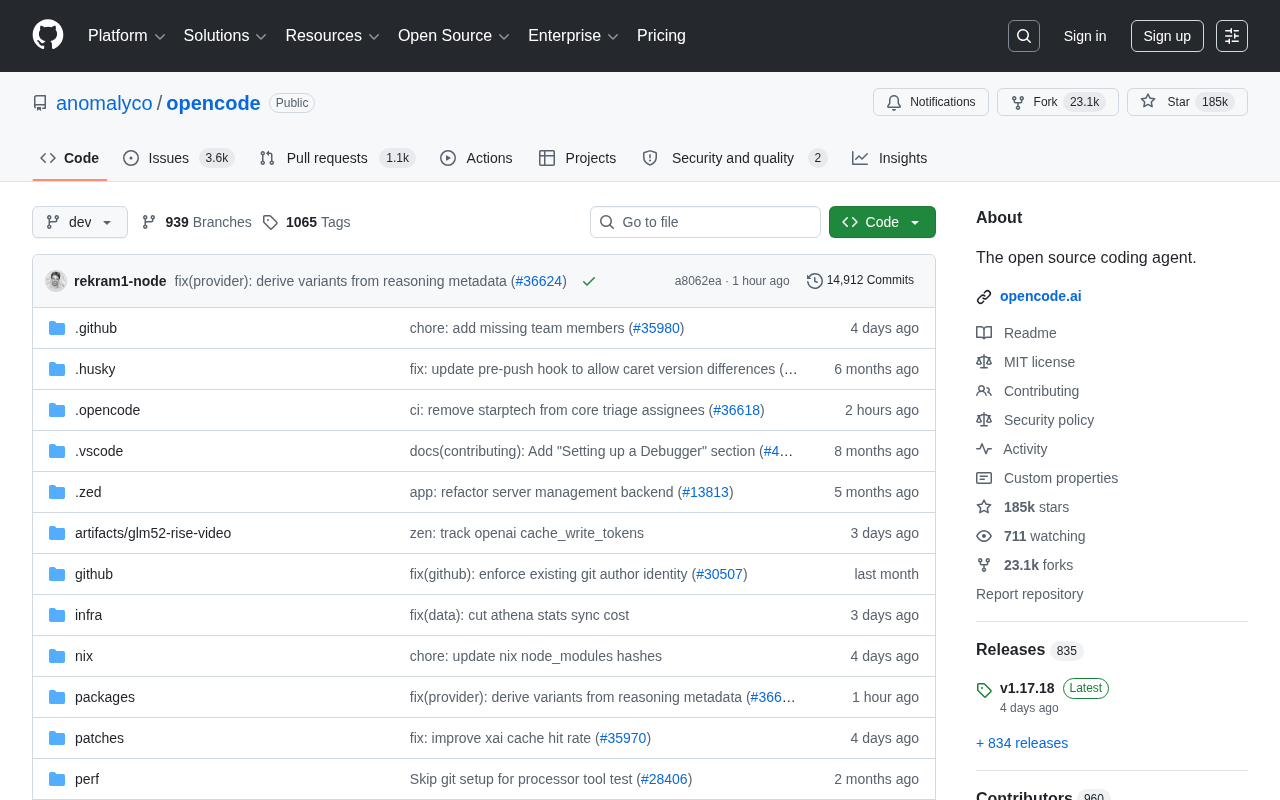
OpenCode: The Open-Source Coding Agent That Hit 150K GitHub Stars
OpenCode is an open-source TypeScript coding agent with 150K+ GitHub stars. Learn about its features, advantages, and use cases for AI-powered development.
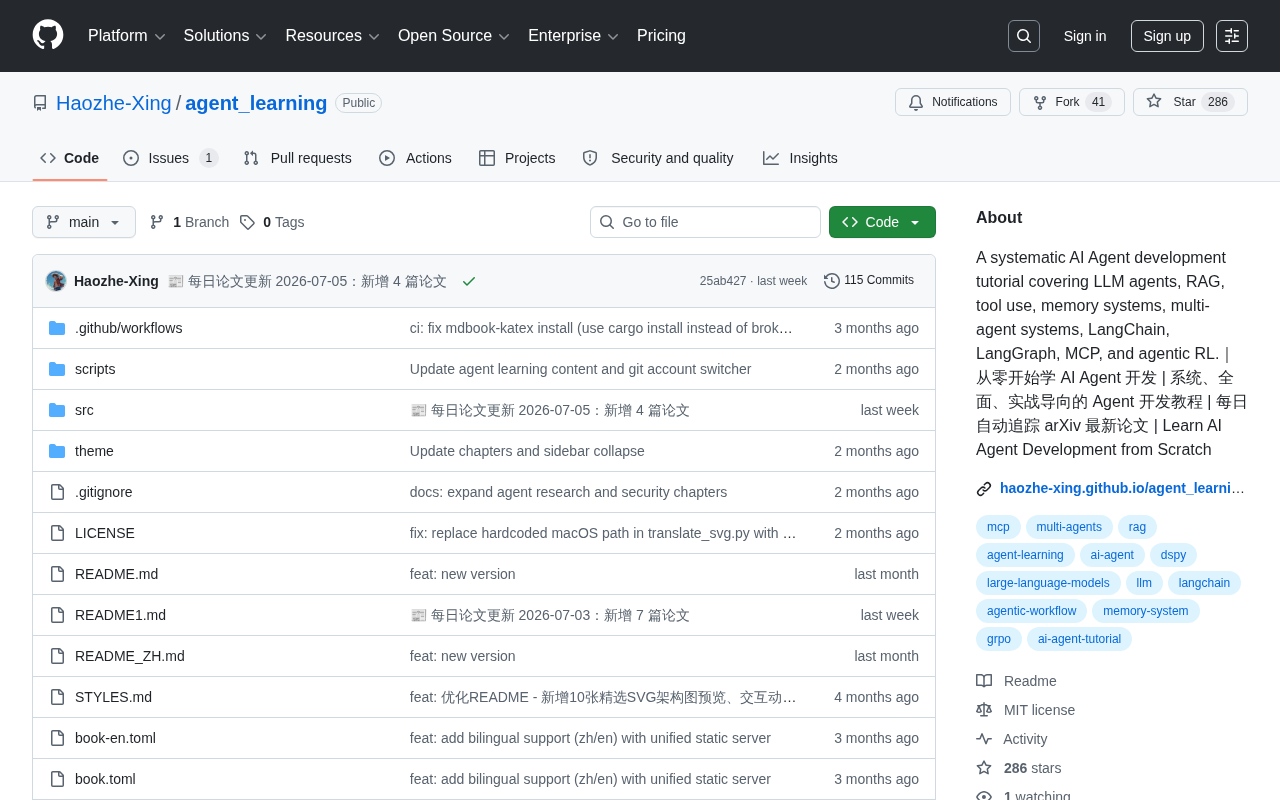
Learning AI Agent Development from Scratch: An Open-Source Tutorial Worth Bookmarking
Haozhe-Xing/agent_learning is a systematic, hands-on open-source tutorial for learning AI Agent development from scratch, with daily arXiv paper tracking built in.