No Response During EACL Rebuttal? A Practical Guide to Handling Unresponsive Reviewers

A guide to handling unresponsive EACL reviewers who penalize disclosed limitations, including when to contact the Area Chair.
A researcher submitting to EACL faced a common review dilemma: one reviewer gave a score of 2 with confidence 5, but their core criticism was a limitation the paper had already explicitly disclosed — which EACL rules say should not count as a weakness. After the rebuttal went unanswered, the author was left in limbo. This article argues the real issue isn't reviewer silence but a procedural violation, making a confidential message to the Area Chair a legitimate option. It offers concrete advice on how to write that message and reflects on the deeper tension between encouraging honest disclosure and inconsistent rule enforcement.
The Dilemma of Academic Conference Rebuttals
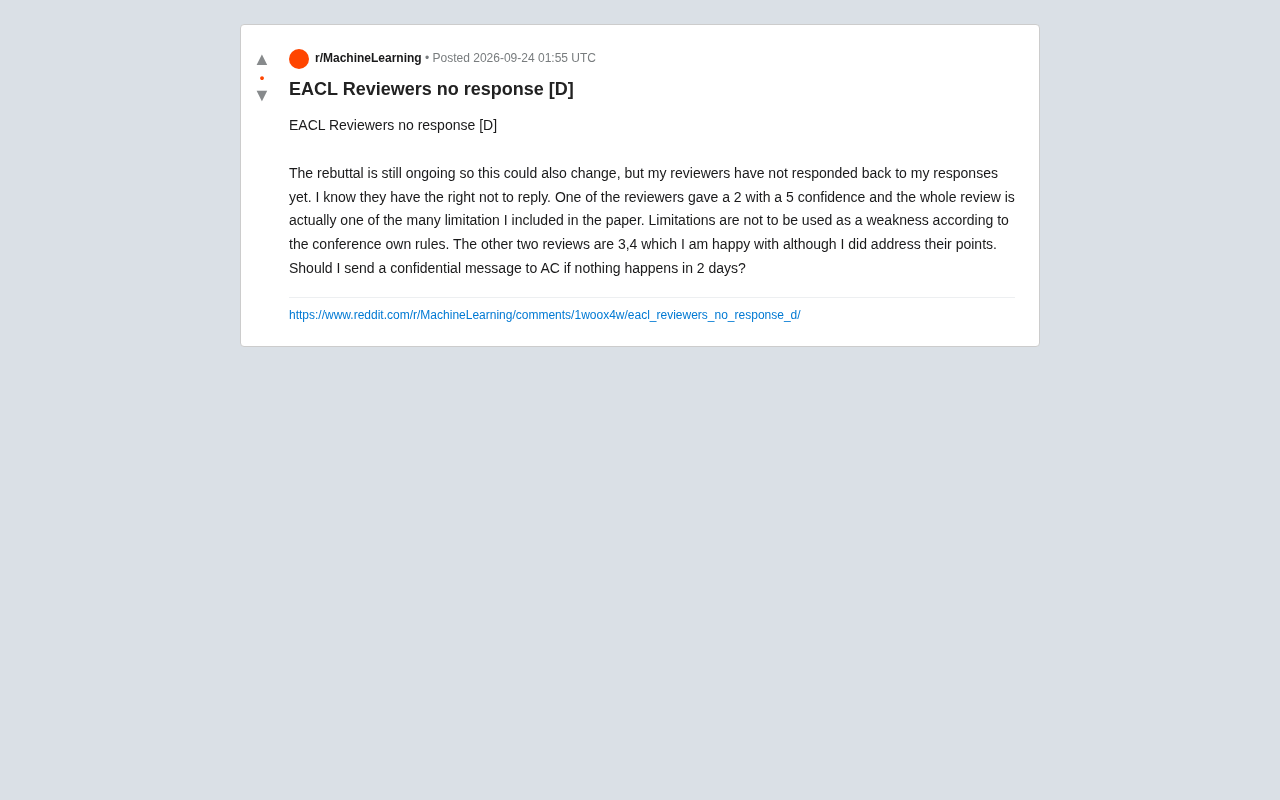
For any researcher submitting to a top-tier conference, the rebuttal stage is an agonizing wait. Recently, a researcher shared a classic predicament on Reddit's machine learning community: after submitting their rebuttal for an EACL (European Chapter of the Association for Computational Linguistics) paper, the reviewer went completely silent.
This scenario is far from rare in academia. Reviewers are entitled to choose not to respond to an author's rebuttal — but when the scores seem clearly unjustified, that silence puts authors in a frustratingly passive position. This is exactly the bind the researcher found themselves in.
The Core Issue: Scores vs. Conference Rules
According to the author, the problem centered on one particular reviewer who gave a score of 2 with a confidence rating of 5 — a combination that should raise immediate red flags. A low score paired with high confidence typically signals that the reviewer believes their judgment is beyond question.
The deeper contradiction lies in the review content itself. The author pointed out that the reviewer's central criticism was actually one of the paper's explicitly stated limitations. And according to EACL's own guidelines, a paper's limitations should not be penalized as weaknesses.
This has become an important principle at many top conferences in recent years. Requiring authors to proactively and honestly disclose research limitations is meant to promote academic transparency. If reviewers then use these self-disclosed limitations as grounds for rejection, they are effectively punishing honesty — directly undermining the very purpose of the mechanism.
The author's other two reviews came in at 3 and 4, within an acceptable range, and the author had carefully addressed both reviewers' comments. The real sticking point was the one review that was both low-scoring and in apparent violation of the conference rules.
The Confidence Score in top conference reviews is the reviewer's self-assessment of how certain they are in their judgment, typically tied to their familiarity with the subject area and independent of the paper score. In ACL-affiliated venues (including EACL), confidence is usually rated on a 1–5 scale: scores of 1–2 indicate limited familiarity with the field, while 5 indicates very high certainty. When a review combines a low paper score with high confidence, it theoretically means the reviewer is very sure the paper has fundamental flaws. However, if the criticism doesn't hold up — such as penalizing already-disclosed limitations — that high confidence can actually draw the Area Chair's attention, because it amplifies the gap between the reviewer's assertions and the actual evidence, making it easier to identify as a review quality issue.
Should You Send a Confidential Message to the AC?
The author's biggest question was: if there's still no progress within two days, should they send a confidential message to the Area Chair (AC)?
From standard academic submission practice, this is a reasonable option worth considering — but timing and approach matter.
When Contacting the AC Is Appropriate
The most compelling reason to reach out to the AC isn't "the reviewer didn't respond" — it's that the review clearly violates conference rules. Reviewers have the right not to respond to rebuttals, and silence alone is difficult to appeal. However, the issue of "penalizing disclosed limitations as weaknesses" directly implicates EACL's review guidelines. This is a procedural matter, and it falls within the AC's responsibility to address.
How to Write an Effective Confidential Message
If you decide to contact the AC, aim to include the following:
- Stay objective and professional — avoid emotional language and don't accuse the reviewer directly
- Cite the conference rules precisely — reference the specific guideline stating that limitations should not be treated as weaknesses
- Draw clear parallels — map the reviewer's criticisms to the corresponding limitations already disclosed in the paper
- Focus on the substance — concentrate on whether the scoring rationale is justified, rather than demanding the AC simply raise the score
This approach allows the AC to quickly grasp the core issue and makes a fair resolution far more likely.
The Area Chair (AC) is a pivotal role in top conference review systems. ACs oversee the review process for a set of papers, coordinate reviewer feedback, and make final acceptance recommendations in contested cases. ACs are typically senior researchers in the field. When there is significant disagreement among reviewers or a procedural issue arises, the AC has authority to ask reviewers to reconsider their assessments or even bring in additional reviewers. The "confidential message to AC" mechanism exists precisely to give authors a low-key, non-confrontational channel for flagging clearly unjust reviews — distinct from a formal appeal, with a lower threshold for use, but still requiring substantive grounds.
Key Takeaways for Submitters
This case is small in scale but reflects broader tensions that run through academic peer review.
The double bind of disclosing limitations. Conferences encourage authors to honestly disclose research limitations, but the enforcement of review standards doesn't always align with stated rules. When writing papers, authors should remain honest — but during the rebuttal, they can proactively cite conference guidelines to protect themselves.
Low scores with high confidence deserve scrutiny. When you encounter a review with a low score, high confidence, and weak criticism, there's no need to panic. Such reviews tend to be treated with caution in the AC's overall assessment — especially when other reviewers have provided positive evaluations.
Silence is not the end. Reviewers not responding during the rebuttal phase is normal. Your rebuttal still enters the AC's decision-making process. Rather than stressing over whether a reviewer replies, focus on making your response logically clear and well-supported.
Use appeal channels wisely, but sparingly. A confidential message is an effective tool, but it should be used when there is a genuine procedural issue — and presented in a professional, evidence-based manner, not as repeated pressure.
For researchers in the throes of rebuttal anxiety, this case offers a practical reference: identify genuine procedural problems, arm yourself with the rules, and seek the Area Chair's intervention at the right moment and in the right way.
Related articles

Why Does a 35GB Quantized Model Blow Up an 80GB GPU? The Truth About KV Cache VRAM
Why does a 35GB 4-bit quantized LLM still blow up an 80GB GPU? This article breaks down the four components of inference VRAM, provides precise KV Cache formulas, compares GQA vs DeepSeek MLA memory, and offers production-grade OOM prevention like FP8 KV Cache.

Turning Company Workflows into Agent Skills: A Practical Guide
An agency owner turns team workflows into Agent Skills: one command handles article writing, six-platform distribution, and dual human approval. This guide breaks down the Skill file structure, two invocation methods, three-tier storage layout, security review process, and how to turn your own weekly repetitive tasks into executable, auditable skills.

China Releases "Qiusuo" 4.0: The First Evaluation Benchmark Covering the Entire AI Industry Chain
China's CESI releases "Qiusuo" 4.0, the first AI full-industry-chain evaluation benchmark system, covering computing power, LLMs, agents, security governance, and industry applications with 16 evaluation tools and open-source code tools to solve cross-environment incomparability.