No Spoilers! Twitter Users Plead: At Least Wait Until Sunday

A tweet pleading for no spoilers until Sunday reflects spoiler anxiety and the sharing conflict in the social media era.
A short tweet from Twitter, "please don't post spoilers on the movie 🙏🙏 at least until sunday lol," has sparked a discussion about online spoiler culture. Although the tweet doesn't name a specific movie, it reflects audiences' desire to protect their viewing experience in the social media era. The article analyzes the roots of spoiler anxiety: the conflict between the desire to share and the fresh experience, and the uncontrollability exacerbated by Twitter's public timeline and algorithmic recommendations. Gentle requests and the self-deprecating "lol" have become common social strategies, but their effectiveness depends on community self-regulation. Although platforms offer spoiler-hiding features, they rely on posters actively using them and have limited effect. The article ultimately points out that in the streaming era, mutual understanding and simple spoiler warnings are sustainable ways to protect viewing surprises.
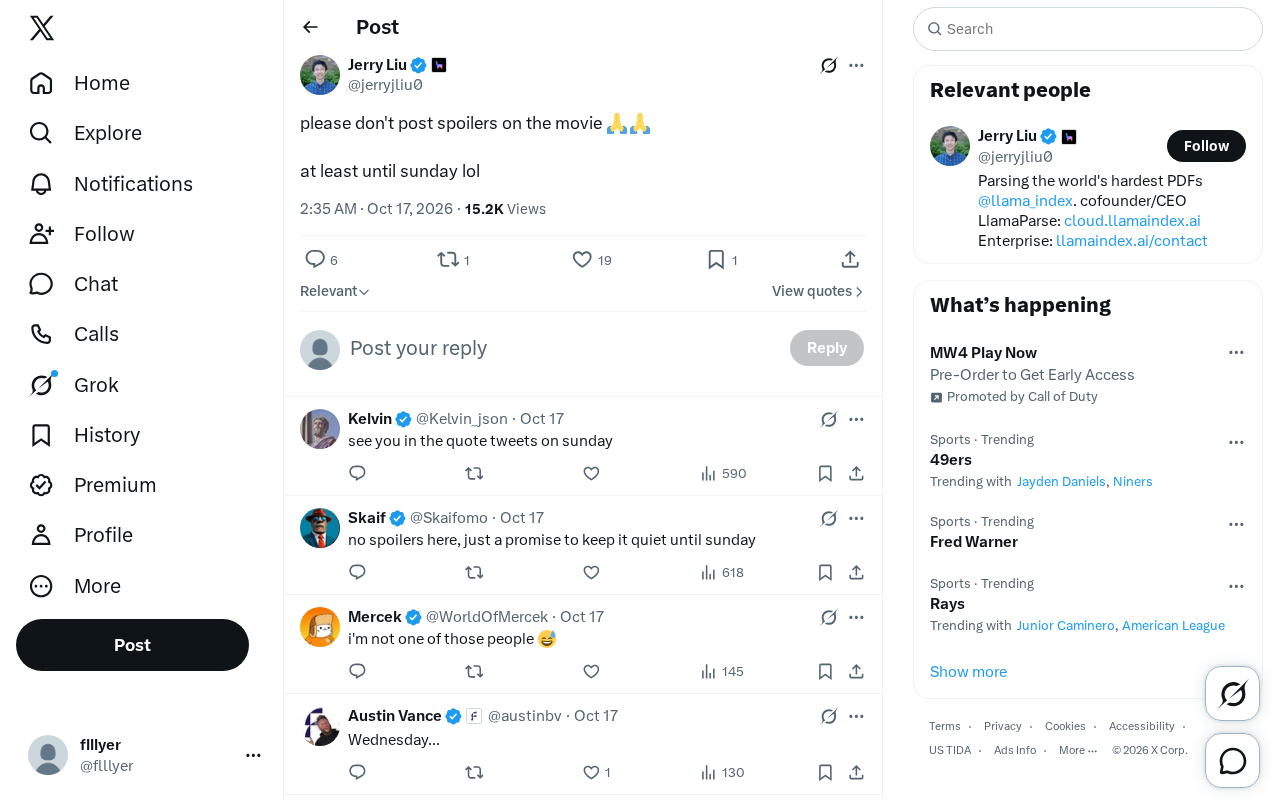
A short tweet from Twitter is sparking a discussion about online spoiler culture. The tweet reads: "please don't post spoilers on the movie 🙏🙏 at least until sunday lol". This seemingly casual plea touches on a widespread pain point in the digital age: on social media, spoilers spread far faster than people expect, and audiences are increasingly conscious of protecting their viewing experience.
The Spoiler Anxiety Behind the Tweet
The tweet doesn't name a specific movie, but uses "the movie" to imply a highly anticipated new release. The two praying emojis and the self-deprecating "lol" express both a sincere request and a sense of helplessness—the poster knows spoilers are hard to avoid entirely. Weekends are typically peak viewing times, and the request to "at least wait until Sunday" suggests the poster may plan to watch over the weekend and hopes not to have key plot points revealed beforehand.
This anxiety is not unique. In the social media era, a post containing key plot details can be widely shared within minutes, and even incidental browsing can ruin the surprise. The phrase "at least" is particularly telling: it acknowledges that banning spoilers entirely is unrealistic and asks only for a brief buffer period.
"Spoiler" is an English term referring to the act of revealing key plot points, endings, or twists before others have watched or read a work. The concept became widespread with the rise of internet forums and social media, and conventions such as "spoiler alert" gradually emerged. In film and television, spoilers can undermine audiences' anticipation and emotional impact, giving rise to complex social etiquette around them. Different cultures have varying tolerance for spoilers, but it is generally accepted that actively avoiding discussion of key plot points shortly after a work's public release is a way of respecting others' viewing experience.
The Social Dilemma of Spoiler Culture
The spoiler issue is essentially a conflict between different users' needs. Some viewers are eager to share their reactions, while others want to preserve a complete fresh experience. Twitter's public timeline makes this conflict more pronounced: users cannot fully control what they see, and even if they don't follow spoiler accounts, algorithmic recommendations may push relevant posts into their view.
The poster uses "lol" to soften the tone and avoid sounding too serious or accusatory—a common social strategy. However, whether this gentle request works depends on community members' self-awareness. Without enforcement mechanisms, the boundaries of spoilers are often blurry—what counts as a spoiler? Does trailer content count? How long after release can people discuss it? There are no unified answers to these questions.
Algorithmic recommendation systems are mechanisms by which social media platforms automatically push content based on user behavioral data (such as likes, dwell time, and search history). Their goal is to boost user engagement, but they often lead to information cocoons and accidental exposure: even if users don't actively follow a topic, algorithms may push posts containing spoilers into their timeline due to relevance. This uncontrollability exacerbates spoiler anxiety, as users find it difficult to completely block content they don't want to see. Although platforms offer keyword filtering, it requires manual setup and cannot cover text in images or videos, or metaphorical expressions.
How Platforms and Communities Respond
Some platforms have begun offering spoiler-hiding features, such as warning labels or collapsed content on posts. But such features rely on posters actively using them, limiting their effectiveness. Community self-regulation is equally important: among film fans, established rules (such as not discussing key plot points during the first week of release) can play a role, but they are hard to maintain when content spreads across communities.
For ordinary users, the most practical strategy may be to actively reduce browsing of related topics before watching, or to use the platform's keyword blocking feature. The request in the tweet is simple, but it reminds us: between the desire to share and the viewing experience, more mutual understanding is needed.
A Short Tweet, A Not-So-Short Discussion
The tweet itself contains limited information, but the spoiler culture discussion it reflects is universal. With the deep integration of streaming and social media, new films enter public discussion almost immediately upon release, making it increasingly difficult for audiences to preserve surprises. The poster choosing a public request rather than accusation may be a more sustainable form of community communication—after all, most spoilers aren't malicious, just enthusiasm for sharing that doesn't consider others.
Next time you're about to post your thoughts on a new movie, think about this tweet: a simple spoiler warning, or saving key plot points for discussion next week, can keep more people's viewing experience intact.
One-line Summary
A tweet pleading for no spoilers until Sunday reflects spoiler anxiety and the sharing conflict in the social media era.
Paragraph Summary
A short tweet from Twitter, "please don't post spoilers on the movie 🙏🙏 at least until sunday lol," has sparked a discussion about online spoiler culture. Although the tweet doesn't name a specific movie, it reflects audiences' desire to protect their viewing experience in the social media era. The article analyzes the roots of spoiler anxiety: the conflict between the desire to share and the fresh experience, as well as the uncontrollability exacerbated by Twitter's public timeline and algorithmic recommendations. Gentle requests and the self-deprecating "lol" have become common social strategies, but their effectiveness depends on community self-regulation. Although platforms offer spoiler-hiding features, they rely on posters actively using them and have limited effect. The article ultimately points out that in the streaming era, mutual understanding and simple spoiler warnings are sustainable ways to protect viewing surprises.
Related articles

Aerial Manipulators: The Next Step for Drones from 'Seeing' to 'Changing'
Starting from a Reddit discussion, this article analyzes the technical challenges, potential applications, and deployment bottlenecks of aerial manipulators, exploring the key challenges for drones moving from environmental perception to physical manipulation.

Selective Auditing: Making AI Decisions Both Reliable and Labor-Efficient
New research on AI decision reliability: a selective auditing algorithm minimizes human audit frequency while keeping unaudited error rates below a threshold, with experiments showing major labor savings.

Low-Cost Abstention Strategy: How LLM Ticket Classification Reduces Misrouting Costs
Cost-aware abstention framework cuts ticket routing costs by 38.1%, reduces misrouting from 15.3% to 3.5% on 47,837 IT tickets, outperforming LLMs.