Nobel Chemistry Laureate Kenso Soai: The Mystery of Chirality and the Origin of Life

Kenso Soai won the Nobel Prize for discovering the first asymmetric autocatalytic reaction, providing a key chemical model for life's homochirality.
Kenso Soai was awarded the Nobel Prize in Chemistry for discovering the Soai Reaction, and gave an official telephone interview shortly after the announcement. The conversation centered on molecular chirality — a core mystery of life's origins — specifically why Earth's life uses almost exclusively single-handed molecules. The Soai Reaction is the first real chemical example satisfying the Frank criterion: a chiral product catalyzes its own formation, dramatically amplifying even the tiniest initial chiral bias. Soai humbly described his work as "a small contribution" and referred to researchers worldwide studying his reaction as "scientific friends," embodying the borderless spirit of fundamental science.
Japanese chemist Kenso Soai sat down for an official Nobel Prize telephone interview shortly after receiving the award. In this brief yet deeply meaningful conversation, he spoke about his most celebrated scientific discovery — the Soai Reaction — and its profound connection to the grand question of how life on Earth began.
A Call from the Nobel Committee
The interview was initiated by Nobel Prize representative Adam Smith. When the call connected, Soai could barely contain his excitement, repeatedly saying he was "very moved to hear the news." Asked about his first reaction upon learning he had won, he replied with characteristic modesty: "The Nobel Prize Committee has recognized our research, and we are very happy to receive this award."
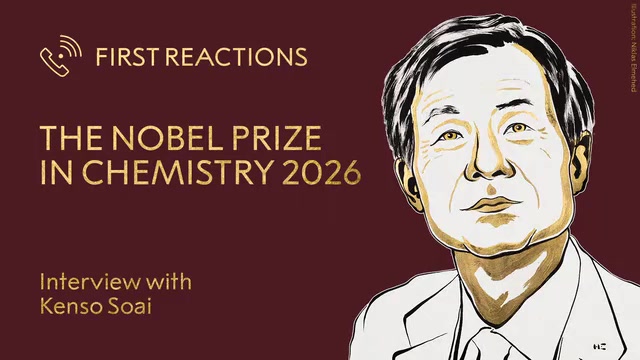
Though the conversation was short, it conveyed the unmistakable joy of a scientist whose life's work had been recognized by the international community. The ending had a delightful twist — Soai politely interrupted the interviewer to explain that Japan's Prime Minister would be calling to congratulate him at 7:45 a.m. Tokyo time, which was just one minute away.
Chirality and the Century-Old Puzzle of Life's Origin
At the heart of the interview lay a fundamental question that has puzzled scientists for over a century: the origin of molecular chirality.
Chirality refers to the property of certain molecules that exist in two mirror-image forms that cannot be superimposed on each other — much like a pair of hands. What is deeply puzzling is that life on Earth almost exclusively uses molecules of one particular "handedness" — amino acids are nearly all left-handed (L-form), while sugars are nearly all right-handed (D-form). This phenomenon is known as homochirality, and why it exists is one of the central mysteries in the study of life's origins.
Soai mentioned in the interview that long before him, French microbiologist Louis Pasteur had attempted to induce chirality in molecules. "But he did not publish it — he only mentioned it in a lecture," Soai said. "So we have made a small contribution to solving the homochirality problem." Behind this humble statement lies a major advance in a scientific puzzle that had gone unsolved for a hundred years.
Pasteur's work on chirality dates back to 1848, when he manually sorted two types of sodium ammonium tartrate crystals under a microscope and found they were mirror images of each other — the first time chirality had been observed at the molecular level. He later attempted to use external forces such as polarized light or magnetic fields to induce a chiral bias in chemical reactions, but those experiments were never successfully published. This historical context illustrates that even the pioneer who discovered chirality could not explain how it spontaneously arose and was amplified at the dawn of life. Modern theories suggest that weak parity-violating forces in the universe, or circularly polarized light from cosmic rays, may have provided a faint chiral "seed" in the early Earth's chemical environment. But a tiny initial bias is far from enough — a chemical mechanism is needed to amplify that bias to near-100% homochirality. This is precisely the critical gap that the Soai Reaction fills.
The Soai Reaction: The Final Piece of the Frank Criterion
The interviewer emphasized that the Soai Reaction "satisfied the last criterion of the Frank model," calling it "a remarkable discovery."
The Frank criterion refers to the theoretical prediction of asymmetric autocatalysis — a process in which a chiral product catalyzes the formation of more product with the same handedness, thereby amplifying chirality through a self-reinforcing loop. For decades, this mechanism existed only as a theoretical construct, with no real chemical reaction to serve as proof.
The greatness of the Soai Reaction lies in the fact that it became the first — and to date most exemplary — experimental demonstration of this theory. It shows how a tiny chiral asymmetry can be dramatically amplified through autocatalysis, providing a crucial chemical model for understanding how life could have evolved a single handedness from a chemically unbiased environment.
The Frank criterion was proposed on theoretical grounds by British physicist F. C. Frank in 1953. Using a mathematical model, he demonstrated that if a chiral molecule could catalyze its own formation (autocatalysis) while suppressing the formation of its mirror-image counterpart (mutual inhibition), then even an infinitesimally small initial difference in the ratio of the two chiral forms would eventually evolve into a nearly pure single-handedness outcome. The model was logically elegant, yet for forty years no real chemical reaction could be found to validate it. The Soai Reaction, first reported in 1995, uses an addition reaction between pyrimidine-5-carbaldehyde and an organozinc reagent; the resulting alcohol product can catalyze the next round of reactions with exceptionally high efficiency, generating more product of the same handedness. Even more strikingly, even when the initial chiral bias is less than 0.00005%, after multiple cycles the enantiomeric excess (ee value) of the product can exceed 99.5%. This was the first real-world case of Frank's model stepping off the page and into the laboratory.
A Reaction That Connects Chemists Around the World
When asked how it felt to know that chemists around the world were studying this unique reaction he had discovered, Soai's answer reflected the warmth of the scientific community.
"I think many international researchers are attracted to this phenomenon," he said. "And so I'm very pleased to know that they are examining our reaction. We are friends — scientific friends."
The phrase "scientific friends" perfectly captures the essence of fundamental research: a truly important discovery does not belong solely to its discoverer — it becomes a shared asset that the global research community explores, validates, and builds upon together. The reason the Soai Reaction has given rise to an entire field of study is precisely because it touches on the most fundamental questions at the intersection of chemistry and life science.
Conclusion: A Major Breakthrough Behind Quiet Modesty
This brief telephone interview offers a window into the intellectual character of a world-class scientist: always restrained and modest in describing his own work — calling a Nobel Prize-worthy discovery "a small contribution" — while holding genuine respect and friendship for colleagues around the world.
What the Soai Reaction resolves is not merely an abstract question of chemical mechanism. It speaks to one of humanity's most profound questions: where did life on Earth come from? Through an elegant chemical system, it demonstrates how symmetry can be broken and how a single handedness can be amplified — lighting an experimental torch in the study of life's origins.
Related articles

Understanding DeepSeek in 3 Minutes: The Rise from a Quant Hedge Fund to an Open-Source AI Leader
DeepSeek's history in 3 minutes: from High-Flyer Quant's compute build-up to V2's MLA inference cost cuts, V3's $5.576M training bill, R1's open-source global shock, and V4 with a $7B Series A.

Local Creative Writing Model Showdown: Fine-tuned Qwen3.8 27B Wins, DeepSeek v4.1 Underwhelms
Bilibili creator tests seven local creative writing models: Hemingway and HumanLike Chat based on Qwen3.8 27B perform best, DeepSeek v4.1 is plain, Dongfang Shuo ranks last with confused characters. Includes three test prompts, scores, and usage advice.

Liang Wenfeng's Three Big Bets: Why Did DeepSeek Open-Source Its 82% Gross Margin?
Why did DeepSeek open-source DeepInfer, its 82% gross margin inference framework, and then launch a hundred-billion funding round? An analysis of Liang Wenfeng's three big bets and the open-source strategy.