Nobody Owns 'Whether the Model Is Right': The Real Blind Spot in MLOps Monitoring

The real MLOps bottleneck isn't missing tools — it's that no one owns whether the model is actually correct.
This article examines why models fail silently in production: not from insufficient tooling, but from a lack of clear ownership. Platform and ML teams each cover half the problem, assuming the other handles the rest — creating a dangerous vacuum. The author argues that stacking more drift metrics doesn't help, and that the real challenge is the natural time delay in authoritative signals. The solution is a two-layer system: cheap device-side counters (empty-output rate, per-class rate, confidence histogram shape) act as fast tripwires to trigger rollbacks, while a weekly joined-label scorecard provides accurate evaluation. Most critically, ownership must land on one specific person's name, paired with a pre-agreed threshold and a default rollback action.
All Green on the Dashboard, But the Model Is Quietly Failing
Many teams have encountered this scenario: every monitoring panel shows green, the service is running normally, but the model's outputs have long since gone wrong. Where's the problem? A user in the Reddit r/MLOps community nailed it in one sentence:
"Your dashboards look fine because they were designed to answer 'is the service up?' — and nobody owns whether the model is right."
This reframes the entire problem. The real bottleneck was never the instrumentation itself — it's the absence of clear ownership.
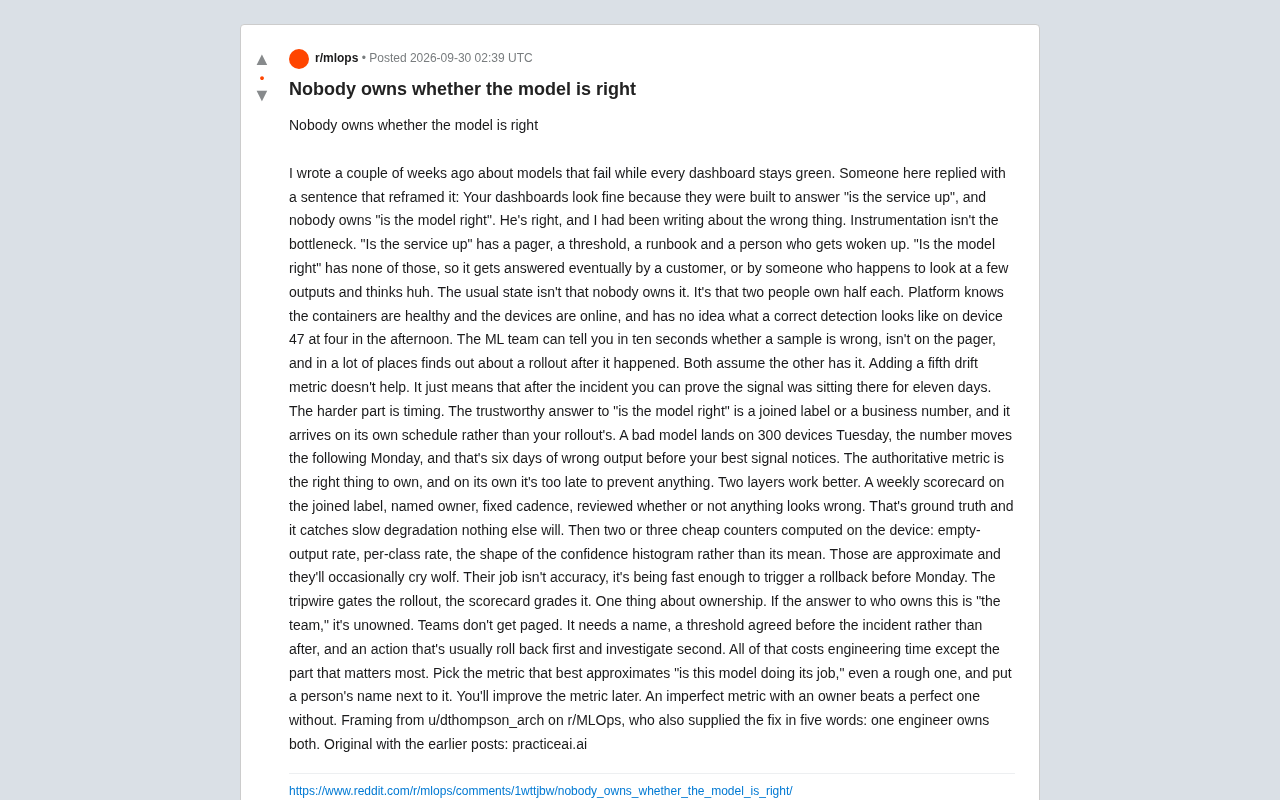
"Is the service up?" has a mature, battle-tested system behind it: there's a pager, there are thresholds, there are runbooks, and there's a person who gets woken up at 2 AM. But "is the model right?" has none of that. So that question usually gets answered by a customer, or by someone who happened to glance at the outputs and thought, "Hm, that doesn't seem right."
It's Not That Nobody Owns It — Two Teams Each Own Half
The author points to a subtler reality: it's usually not that nobody is responsible, but that two teams each own half — and both assume the other team is covering the rest.
The Platform team knows whether containers are healthy and devices are online, but has no idea what "a correct detection on Device 47 at 4 PM" is supposed to look like. The ML team can tell in ten seconds whether a sample is wrong, but they're not in the pager rotation — in many cases, they only find out a model was shipped after it's already live in production.
Both sides assume the other has it covered. The result is that nobody truly does. This "distributed non-ownership" is more dangerous than having no owner at all, because it gives the organization a false sense of security.
Adding Another Drift Metric Won't Save You
When models fail, many teams instinctively add more monitoring — tacking on a fifth data drift metric, for instance. But the author makes a sharp point: this doesn't help.
The only thing another metric gives you is the ability to prove, after an incident, that the signal was sitting there for 11 days. In other words, you don't lack signals — you lack someone who watches them, owns them, and acts on them.
The Real Problem Is the Time Gap
The deeper issue is timing. The most reliable way to answer "is the model right?" is through joined labels or a business metric. But these authoritative signals arrive on their own schedule, completely out of sync with your deployment cadence.
The author gives a precise example:
- On Tuesday, a bad model gets deployed to 300 devices
- By the following Monday, the business numbers start shifting
That's six full days of bad outputs before your most reliable signal catches on. Authoritative metrics are the right thing to be accountable to — but relying on them alone means everything happens too late to prevent an incident.
Data Drift refers to the phenomenon where the statistical distribution of input data shifts away from the training data after a model is deployed in production. Common detection methods include PSI (Population Stability Index), KS tests, and JS divergence. Drift monitoring is genuinely valuable — it can detect changes in feature distributions and flag that the model may be operating outside the coverage of its training set. The problem is that drift metrics are correlative signals, not causal ones: a shift in data distribution doesn't necessarily cause model errors, and model errors don't necessarily come with detectable drift. More importantly, even if a drift metric fires an alert, if no one is explicitly assigned to respond to it and there's no agreed-upon response process, that signal is just another entry in the alert queue. This is why the author's core argument isn't "drift metrics are bad" — it's that "piling on more metrics doesn't fix a lack of ownership."
A Joined Label is a supervision signal created by aligning a model's predictions with the ground-truth outcomes that emerge later. In industrial quality inspection, for example, a model might predict "this part passes" on the production line, but the true label may not arrive until a manual inspection is done or a downstream process reports back — a delay of hours or even days. This delay is especially pronounced in financial risk (will a loan default?) and recommender systems (will the user actually buy?), a problem known as "Label Delay." Because of this, metrics based on joined labels, while the most authoritative, are inherently unsuited for real-time alerting. Their value lies in precise after-the-fact evaluation, not fast early interception. This is the fundamental motivation behind the author's two-layer monitoring architecture.
Two Layers: Tripwires for Speed, Scorecards for Accuracy
The author's solution splits monitoring into two layers, each with a distinct job.
Layer 1: Weekly Scorecards
A weekly scorecard based on joined labels, with a named owner, a fixed review cadence, and a standing review regardless of whether anything looks abnormal on the surface. This is the model's ground truth — it catches slow degradation that nothing else will find.
Layer 2: Cheap Counters on the Device (Tripwires)
Compute two or three low-cost counters at the device level:
- Empty-output rate
- Per-class hit rate
- The shape of the confidence histogram (not just its mean)
These metrics are approximate and will occasionally cry wolf. But their job isn't to be accurate — it's to be fast enough to trigger a rollback before next Monday's business numbers move.
In the author's words: tripwires block releases, scorecards grade releases. One optimizes for speed, the other for accuracy. They're complementary.
The shape of the confidence histogram is a monitoring dimension worth paying special attention to. Looking only at the mean confidence can mask problems: a healthy classifier typically produces a bimodal distribution — high at both ends, low in the middle — because the model is fairly certain about most samples. When the model starts to degrade or encounters out-of-distribution data, confidence scores cluster toward the middle, producing a flat distribution where a large number of predictions fall in the 0.4–0.6 range, even if the mean barely changes. This shape shift tends to appear earlier and with greater sensitivity than mean drift. It's a low-cost early-warning signal that's especially practical on edge devices with limited compute, since a histogram only requires maintaining a fixed number of buckets — minimal memory and computational overhead.
Ownership Has to Land on One Person's Name
The article closes with a key principle about ownership:
If the answer to "who owns this?" is "the team," then nobody owns it. Teams don't get paged.
Real ownership requires three things:
- A specific person's name — not a team
- A threshold agreed upon in advance — not debated after an incident
- A default action — usually rollback first, investigate later
The author admits all of this takes engineering time, but the single most important step costs almost nothing: pick one metric that best approximates "is the model working?" — even a rough one — and write one person's name next to it.
The metric can be refined later. An imperfect metric with an owner beats a perfect metric with none.
The core fix was summed up in five words by r/MLOps user u/dthompson_arch: one engineer owns both. Have the same person own both "is the service up?" and "is the model right?" — and the accountability vacuum disappears on its own.
Final Thoughts
This discussion from MLOps practitioners hits a soft spot that's often overlooked in ML engineering: no matter how comprehensive your technical monitoring is, it can't substitute for clear ownership. Model observability is fundamentally an organizational and process problem, not a purely technical one. For any team deploying models in production, this is a lesson worth revisiting again and again.
Related articles

Workbuddy for Absolute Beginners: How a Desktop AI Agent Fits Into Real Workflows
A beginner's guide to the Workbuddy desktop AI agent: installation, claiming credits, file management, and building automated workflows—compared with CodeX for fit and cost, helping professionals shift from AI question-askers to AI managers.

OpenAI's New Agent Stack: Computer Use, Decisions API, and Ultra-Fast Workflows
OpenAI Dev Day unveiled a new agent stack: Computer Use outperforms humans, Decisions API delivers ultra-low-latency classification via Luna, Agents API opens the same Computer Use capabilities, and GPT-6.1 Sol costs only one-seventh of Astra. Core updates, benchmark data, and developer insights.

Liang Wenfeng Open-Sources DeepInfo Inference Framework, Takes On U.S. Ban
DeepSeek open-sources its DeepInfo inference framework after its models, featuring GPU/CPU cross-pipelining, small-model prediction with large-model verification, and full Huawei Ascend and NVIDIA chip support—facing the U.S. federal ban head-on. This article analyzes its significance for AI deployment and open-source strategy.