Nobody Reads Code Anymore: The "Whiteboard Defense" in the Age of AI Programming

As LLMs take over coding, engineers face shrinking comprehension and soul-crushing alienation — the whiteboard defense is the fix.
A YouTube rant reveals a spreading engineering dilemma: LLMs handle code, tests, and docs while engineers work 12-13 hours just "pressing enter" — nobody thinks or understands the system, causing soul-crushing alienation. Mitchell Hashimoto's "whiteboard defense" is the antidote: engineers should explain any delivered system and defend key decisions at any time, not memorizing every detail but answering "why X over Y" and "when will it fail." The root issue is the imbalance between speed and understanding.
A heated rant from YouTube has struck a deep chord among engineers. In the video, the creator doesn't hold back his anger and exhaustion: "I'm sick of it. The state of engineering is awful. Nobody here understands anything. Everything is just garbage code piled on top of garbage code."
This emotional outburst isn't just venting. It precisely captures a spreading industry phenomenon: as LLMs take over more and more coding work, engineers are losing their understanding of the systems they build.

Everything Is Being Done by LLMs, Nobody Is Thinking Anymore
The video creator describes a suffocating daily reality: people work 12 to 13 hours a day, and what they're essentially doing is "pressing the enter key." Code is generated by LLMs, tests are written by LLMs, documentation is produced by LLMs, and the engineer themselves — at least in this description — has degenerated into a button-presser confirming outputs.
"In reality, nobody is even thinking anymore. Everything is done by LLMs. It's a soul-crushing feeling."
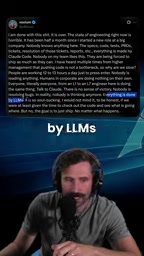
The impact of this statement lies in the fact that it doesn't come from some anti-AI tech conservative, but from a frontline developer actively riding the AI programming wave. The "soul-crushing feeling" he describes stands in stark contrast to the industry's abundant optimistic narratives about AI boosting productivity.
The problem isn't LLMs writing code per se. The problem is that when generation speed far outpaces understanding speed, there may not be a single person on the team who can clearly explain how the system actually works. Code accumulates, complexity balloons, and comprehension shrinks.
Mitchell Hashimoto's "Whiteboard Defense"
The video creator cites a concept proposed by Mitchell Hashimoto — the "whiteboard defense" — and treats it as a benchmark for responsible AI use.
Hashimoto's core argument is simple: at any given moment, I should be able to pull you aside and have you explain any customer-facing system you've delivered. You should be able to clearly articulate how it works and defend your decisions.

You might not have noticed that Hashimoto's standard isn't so harsh as to require you to memorize the specific implementation of every function. What he's asking for is something higher-level: Why did you choose approach X over approach Y? Under what conditions would this system fail?
These questions are entirely reasonable — any engineer who takes responsibility for their work should be able to answer them. And if you can't — that means you probably don't truly own the system you delivered.
Mitchell Hashimoto is the creator of the infrastructure-as-code tool Terraform and a co-founder of HashiCorp, long regarded as one of the most influential practitioners in engineering. The "whiteboard defense" he advocates isn't a formal methodology but a criterion for engineering culture — inspired by the whiteboard sessions common in interviews, but repurposed for daily delivery: rather than assessing candidates during interviews, assess yourself anytime after a system goes live. This aligns with software engineering concepts like the "bus factor" (whether a project can continue after key members leave) and the goal of "maintainability." Hashimoto repeatedly emphasizes that AI can be a productivity lever, but only if the user retains accountability for the results.
Why the "Whiteboard Defense" Solves the Soul-Crushing Problem
The video creator offers an interesting corollary: if people can answer these whiteboard-defense-style questions, two things happen.
First, you will actually build things ("you will build"). Not because of how many lines of code you can type, but because you understand what you're doing, your decisions are grounded, and your system has logic.
Second, you'll find you no longer experience that soul-crushing feeling of "everything is garbage code."

The logic here is actually quite clear: the soul-crushing feeling comes from a loss of meaning. When your work is just pressing the enter key, of course you feel empty. But if you're required to understand, explain, and defend what you're doing, the work regains cognitive depth — and cognitive depth is the core source of professional satisfaction for engineers.
The Imbalance Between Speed and Understanding
This rant deserves to be taken seriously because it points to a structural problem, not a personal emotion.
The core selling point of AI programming tools is speed. Faster code generation, faster iteration, faster delivery. But when the entire industry is chasing "ship as much as they can," the speed of understanding hasn't kept pace.
Understanding takes time — it requires reading code, tracing call chains, thinking through edge cases. These are exactly the things LLMs are best at helping you skip. After skipping, you deliver code but not understanding; you complete tasks but don't accumulate knowledge.
Hashimoto's whiteboard defense is essentially a course-correction mechanism: it reintroduces a rigid requirement for understanding alongside speed. You don't need to reject AI tools, but you need to ensure you're still the person who can take responsibility for the system.
This isn't a technical problem — it's a question about engineers' professional identity. When we discuss whether AI will replace engineers, the real risk may not be replacement, but rather voluntarily surrendering your comprehension while using AI — and then finding yourself as an operator of a role you don't even recognize.
In software engineering research, this phenomenon of "code growing faster than understanding" has an approximate term called "cognitive debt," distinguished from the more familiar "technical debt." Technical debt concerns code quality and future maintenance costs, while cognitive debt concerns whether the team's mental model of the system is still intact. Martin Fowler and others have also repeatedly discussed the value of "understanding as an engineering asset." When LLMs drive the marginal cost of code generation toward zero, cognitive debt accumulates in more insidious ways — because the code appears to run, tests are all green, yet nobody can explain how it would behave under extreme conditions. This is also why the whiteboard defense is seen as a course-correction mechanism: it makes "can you explain it" a delivery standard once again.
One-line Summary
When LLMs take over coding, engineers face shrinking comprehension and soul-crushing alienation — the whiteboard defense is the course correction.
Paragraph Summary
A YouTube rant video reveals a spreading dilemma in engineering: LLMs have taken over code, test, and documentation generation, engineers work 12-13 hours a day but are just "pressing enter," nobody thinks, and nobody understands how the system works — followed by a soul-crushing sense of alienation. The article cites Mitchell Hashimoto's "whiteboard defense" as the antidote: engineers should be able to explain at any time how any delivered system works and defend key decisions — not memorizing every function detail, but answering "why X over Y" and "when will the system fail." If they can, they'll not only truly build systems but also regain cognitive depth and professional satisfaction. The fundamental problem is the imbalance between speed and understanding: AI accelerates code generation, but comprehension hasn't kept pace, and engineers may unknowingly surrender their mastery of the system amid efficient delivery.
Related articles

Workbuddy for Absolute Beginners: How a Desktop AI Agent Fits Into Real Workflows
A beginner's guide to the Workbuddy desktop AI agent: installation, claiming credits, file management, and building automated workflows—compared with CodeX for fit and cost, helping professionals shift from AI question-askers to AI managers.

OpenAI's New Agent Stack: Computer Use, Decisions API, and Ultra-Fast Workflows
OpenAI Dev Day unveiled a new agent stack: Computer Use outperforms humans, Decisions API delivers ultra-low-latency classification via Luna, Agents API opens the same Computer Use capabilities, and GPT-6.1 Sol costs only one-seventh of Astra. Core updates, benchmark data, and developer insights.

Liang Wenfeng Open-Sources DeepInfo Inference Framework, Takes On U.S. Ban
DeepSeek open-sources its DeepInfo inference framework after its models, featuring GPU/CPU cross-pipelining, small-model prediction with large-model verification, and full Huawei Ascend and NVIDIA chip support—facing the U.S. federal ban head-on. This article analyzes its significance for AI deployment and open-source strategy.