Nobody Will Vouch for the AI's Answer: Who Is Checking AI Output?

No AI vendor vouches for answer correctness; checking falls to users, so systems should carry their own evidence.
Microsoft, the Allen Institute, LangChain, and Google Cloud AI Research all state in their docs and papers that they do not vouch for the correctness of AI output, leaving verification to users. LangChain frames reliability as an iterative goal, not a promise; the Harness² paper admits its optimization signals don't guarantee correctness. Drawing on thirty years of distributed systems debugging, the author argues we should ask who is checking the answer rather than whether the model is good, and describes Merlin's reverse assumption: the system must carry evidence and refuse claims the evidence doesn't support. For developers, this means building architectures that output conclusions plus evidence.
When Every Vendor Pushes the Responsibility onto You
Microsoft states it plainly on its Agent Framework overview page: "You are responsible for carefully reviewing and testing applications built with Microsoft Agent Framework in the context of your specific use case... including implementing your own responsible AI mitigations, such as meta-prompts, content filters, or other safety systems."
The Allen Institute is equally direct in its OLMo model card: "Many statements made by OLMo or any LLM are often inaccurate, so facts should be verified."
In its Series B funding announcement, LangChain defines the entire category it operates in as: "the process of iteratively refining non-deterministic LLM systems into reliable experiences." Note the word "iteratively"—reliability is a goal you work toward version after version; nobody promises you'll actually arrive.
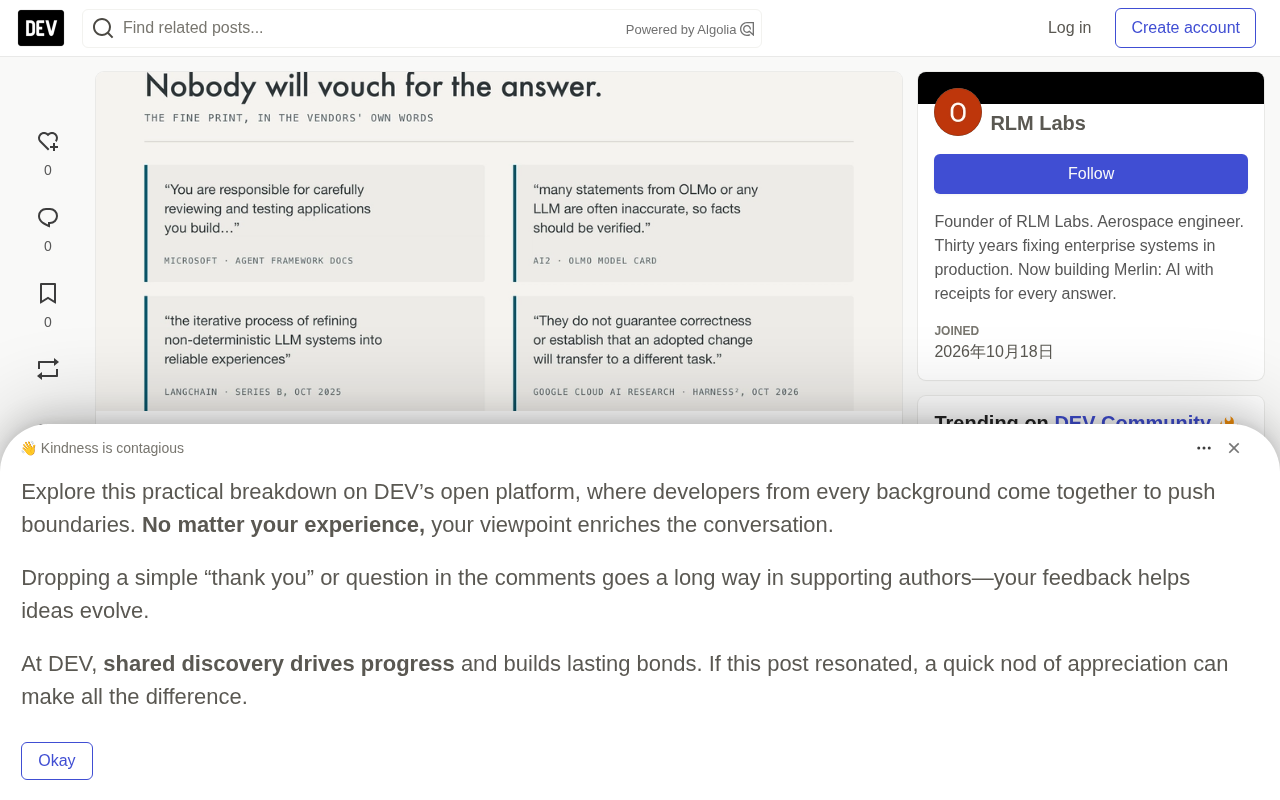
There's a telling pattern here: model vendors, framework vendors, platform vendors, and now research labs are all drawing the same line—each party is improving the odds, and none is vouching for the answer itself. The checking falls to whoever reads the output.
OLMo is a series of open-source large language models led by the Allen Institute for AI (AI2), notable for releasing not only model weights but also training data, training code, and evaluation tools, with the goal of making LLM research fully reproducible and transparent. A model card is a standardized document released alongside a model to describe its intended use, training data, evaluation results, limitations, and ethical considerations, and has become a common component of responsible AI practice.
LangChain is a development framework for building LLM applications, offering abstractions such as chaining, tool integration, memory management, and retrieval-augmented generation to help developers orchestrate non-deterministic model outputs into usable application flows. Its definition of the category in its Series B announcement reflects the core tension in current LLM application engineering: reliability is not a property the model ships with, but a target that must be continuously approached through engineering.
The Honesty of Harness² and Its Boundaries
On October 9, 2026, Google Cloud AI Research published Harness², a framework for improving a model's surrounding system without modifying the model itself. The work is solid in its own right, and the paper reports gains on three professional benchmarks.
But in the limitations section, the authors wrote this about the signals that determine whether a given change is effective: "they do not guarantee correctness, nor do they establish that adopted changes will transfer to different tasks."
This honesty is respectable, but it is also worth noting: even at the research frontier of building self-improving systems, the boundary is drawn in the same place. The system optimizes for probability, not for truth.
In AI engineering, "harness" in Harness² typically refers to the runtime framework wrapped around a model (such as prompt orchestration, tool calling, output parsing, and evaluation loops) rather than the model weights themselves. Harness²'s approach is to improve task performance by improving the surrounding system without fine-tuning the model; such methods are often called "system-level optimization" or "scaffold optimization."
The "signals" the paper refers to are evaluation metrics or feedback mechanisms used to judge whether a given surrounding change is effective. The authors acknowledge that such signals reflect only probabilistic improvement, do not constitute a guarantee of output correctness, and do not guarantee that a change effective on one task will transfer to others. This reveals a fundamental boundary in self-improving systems research: a gap remains between the optimization objective and truth verification.
An Old Engineer's Judgment
The author draws an analogy from thirty years of distributed systems troubleshooting, and the analogy is apt. In that work, you learn one thing quickly: the system in the demo environment is not the system in front of you, and the only thing you can trust is what you have verified yourself—log lines, row counts, diffs.
AI simply raises the same problem one level. The output reads fluently, and whether it's right or wrong, it reads fluently. More importantly, the companies selling the output have written the rule into their own documentation: checking is your job.
This brings a shift in perspective: rather than asking "is this model good," ask "who is checking this answer." The former is the battleground of vendor marketing; the latter is the real dividing line for engineering in practice.
Merlin's Reverse Assumption
When the author's team built Merlin, they adopted the opposite assumption: if nobody is willing to vouch for the answer, then the system producing the answer must carry the evidence for it itself, and must refuse to claim anything the evidence does not support. This is not a feature you can toggle on and off; it is the underlying rule by which the entire system operates.
The takeaway is that the trustworthiness of an AI application cannot be backstopped by extra user vigilance, nor can it rely on goodwill beyond model vendors' disclaimers. System design needs an intrinsic mechanism—evidence travels with the answer, and no evidence means no conclusion.
The rest of the series will show where things go wrong (including in their own system) and what they actually built. But the starting point is the question these quotes leave you with: stop asking whether the model is excellent, and start asking who is checking the answer.
Evidence travels with the answer is a system design principle requiring every output conclusion to be accompanied by traceable, verifiable support (such as quoted source document fragments, computation steps, data row counts, or diffs), and requiring the system to explicitly refuse to output or flag uncertainty when the evidence is insufficient to support the conclusion. This contrasts with the traditional model of "output the conclusion, and let the user verify it themselves."
In engineering terms, this usually means the system must maintain a structured evidence chain, perform attribution on generated content, and build confidence and refusal mechanisms into the output protocol. The cost is higher architectural complexity and lower surface coverage, but what you get in return is auditability and internalized responsibility—the system no longer offloads the checking burden entirely onto the reader.
What This Means for Developers
For teams building AI applications, this argument raises a concrete architectural question: is your system outputting conclusions, or conclusions plus evidence?
Frameworks and platforms on the market are all optimizing the quality of the former, while responsibility for the latter goes unclaimed. When every vendor's disclaimer points to the same place, that is exactly where engineering teams must build their own line of defense. Evidence chains, verifiable output structures, and explicit expression of uncertainty are no longer nice-to-have features; they are the necessary infrastructure for bearing the responsibility of checking.
Related articles

JobRunner MCP Server: AI Agents Can Now Fix Failed Java Jobs
JobRunner launches an open-source MCP server enabling AI agents to view cluster status, diagnose failures, and recover Java jobs—incident response from any cloud coding environment or existing agent.

MLAI Digital Launches 9 Security Agents: MCP Server Safeguards the Full Lifecycle of Agentic AI
MLAI Digital launches Security MCP Server with nine built-in specialized security agents covering vulnerability discovery, attack simulation, prompt injection detection, API and infrastructure assessment, and accelerated remediation—embedding security validation across the full Agentic AI lifecycle from development to production.

Running Isaac Lab on H100 GPUs: Exploring Better Approaches
Exploring optimization methods for running Isaac Lab on NVIDIA H100 GPUs, including MIG configuration, mixed precision, TensorRT acceleration, and community experience to improve robotics simulation and reinforcement learning efficiency.