NobodyWho Open-Source Inference Engine: A Multi-Platform SDK for Running LLMs Locally

NobodyWho wraps llama.cpp into a multi-platform SDK for running LLMs entirely on local devices.
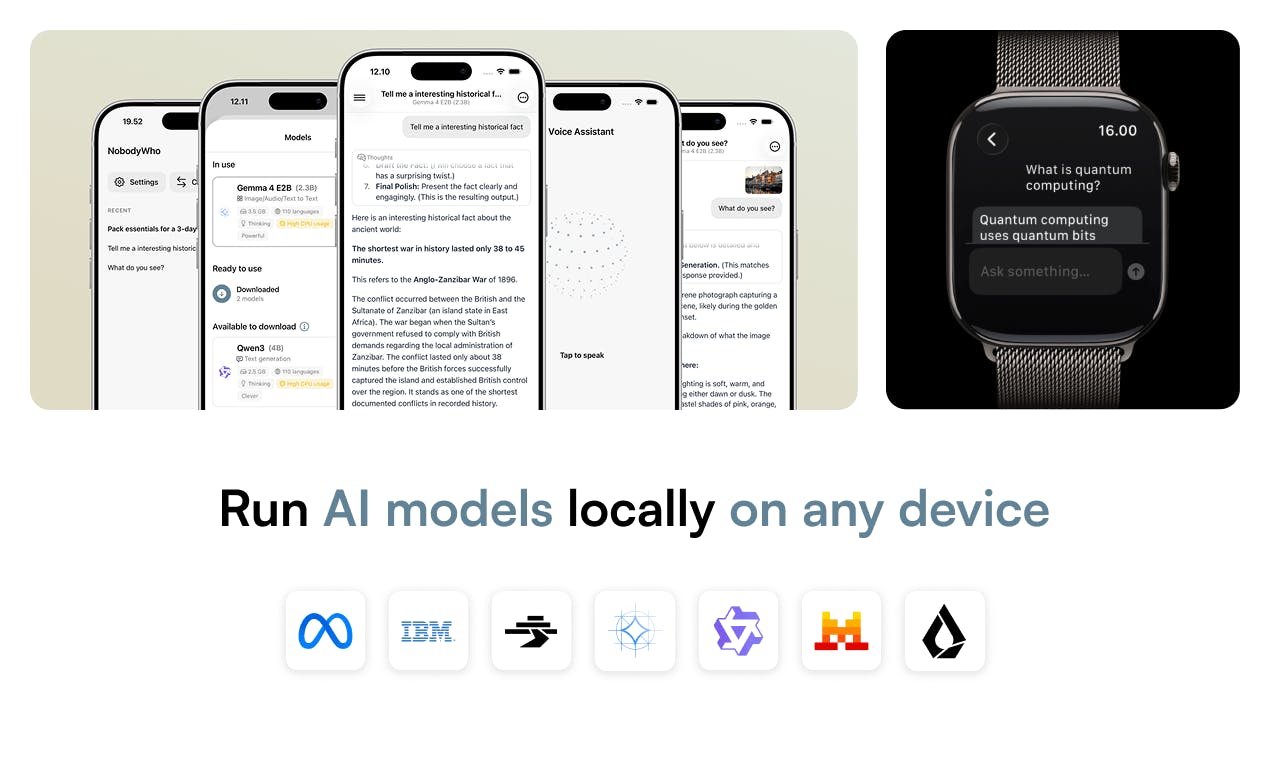
NobodyWho is an open-source inference engine built on llama.cpp that enables developers to run large language models locally without API keys or cloud dependencies. It offers SDKs for Swift, Kotlin, Flutter, React Native, Python, and Godot, along with features like type-safe tool calling with constrained decoding, multimodal input, TTS/STT, GPU acceleration via Vulkan and Metal, and Hugging Face model downloads.
Another Step Forward for On-Device AI
In an era where LLM applications are heavily dependent on cloud APIs, an open-source inference engine called NobodyWho has attracted attention on Product Hunt. Its core proposition is clear: run large language models (LLMs) entirely on local devices — no API keys, no cloud calls, completely free and open source. After launch, it garnered 85 upvotes and 10 comments, ranking 12th on the daily leaderboard.
NobodyWho is built on top of the well-known llama.cpp. Initiated by Georgi Gerganov in March 2023, llama.cpp was originally created to run Meta's LLaMA models on ordinary consumer hardware. Implemented in pure C/C++ without relying on heavyweight frameworks like PyTorch, it introduced the GGUF quantization format, which can compress models from 16-bit floating point down to 4-bit or even 2-bit integers, drastically reducing memory footprint. Today, llama.cpp supports over a hundred model architectures and has become the cornerstone of the on-device inference ecosystem, serving as the underlying engine for projects like Ollama, LM Studio, and GPT4All. NobodyWho builds on this foundation with engineering-level packaging, wrapping complex low-level inference capabilities into multi-platform SDKs that developers can call directly, significantly lowering the barrier to on-device AI integration.
A Cross-Platform, Full-Capability Combo
What makes NobodyWho most noteworthy is its remarkably broad language and framework support. It provides integration for Swift, Kotlin, Flutter, React Native, Python, and Godot simultaneously. This means whether you're an iOS/Android native developer, a cross-platform mobile app developer, a Python backend engineer, or even a Godot game engine developer, you can integrate local LLM inference within your familiar tech stack.
A Comprehensive Feature Set
Based on the official description, NobodyWho goes well beyond simply "getting a model to run" — it provides a complete set of core capabilities needed for on-device AI applications:
- Type-safe Tool Calling: With automatic grammar generation to ensure the model outputs structured, parseable results;
- Multimodal Input: Support for input formats beyond pure text;
- Voice Capabilities: Built-in text-to-speech (TTS) and speech-to-text (STT);
- GPU Acceleration: Hardware acceleration via Vulkan and Metal, covering both cross-platform and Apple ecosystem needs;
- Hugging Face Model Downloads: Direct model retrieval from Hugging Face, simplifying model management workflows.
The tool calling with automatic grammar generation is particularly impressive. Constrained Decoding refers to the process of dynamically masking invalid candidate tokens during model generation through predefined formal grammars (such as regular expressions, JSON Schema, or BNF grammar), ensuring model output strictly conforms to a specified format. The core implementation sets the probability of tokens that don't comply with transition rules to zero at each sampling step, based on the current state of the generated sequence within a grammar automaton. On-device small models are often less stable than cloud-based large models at instruction following — models with fewer parameters are more prone to format errors or hallucinated outputs during free generation. Constrained decoding forces the model to output according to predefined grammar without sacrificing inference speed, guaranteeing structural reliability of tool calls. This is a critical engineering technique for ensuring reliable tool calling on-device.
GPU Acceleration Technology Choices
Vulkan is a cross-platform graphics and compute API maintained by the Khronos Group, supporting Windows, Linux, Android, and other systems. Its compute shader capabilities make it an important choice for running GPU inference on non-NVIDIA hardware. Metal is Apple's proprietary graphics and compute framework, deeply optimized for Apple Silicon's (M-series chips) unified memory architecture, allowing CPU and GPU to share memory space and avoiding data copy overhead. NobodyWho's support for both means Android/Windows devices get hardware acceleration through Vulkan, while iPhone/iPad/Mac users leverage Metal to unlock Apple Silicon's computing power — achieving true full-platform GPU inference coverage.
Convenience of Model Acquisition
Hugging Face is currently the largest open-source AI model hosting platform, with over 1 million models hosted as of 2025. For on-device inference, community members continuously upload various quantized versions (such as GGUF format Q4_K_M, Q5_K_S, etc.), allowing developers to directly select models with appropriate precision based on target device memory and compute capabilities. NobodyWho's integrated Hugging Face download capability means developers don't need to manually convert formats or hunt for model files, further reducing friction across the entire pipeline from model selection to local deployment.
Why On-Device Inference Is Becoming Increasingly Important
NobodyWho's emergence isn't an isolated event — it's part of the broader on-device AI wave. Running models on local devices primarily addresses three core pain points:
Privacy and Data Security. All inference is completed locally on the device, with user data never leaving the device. This is extremely attractive for sensitive scenarios in healthcare, finance, and legal domains, as well as privacy-conscious personal applications.
Cost and Availability. No API call fees and no dependence on network conditions. For applications requiring high-frequency calls or offline operation (such as in-vehicle systems, industrial equipment, edge computing nodes), local inference is a hard requirement.
Latency Control. Local inference eliminates network round-trip time, offering clear advantages in scenarios demanding real-time responsiveness like voice interaction and game NPC dialogue — which also explains why NobodyWho specifically supports the Godot game engine.
Positioning and Challenges
From an engineering perspective, NobodyWho's core value lies in its integration capability as a "glue layer." While llama.cpp itself is already powerful enough, directly integrating it into Flutter or React Native still requires substantial adaptation work. NobodyWho unifies fragmented capabilities — cross-language bindings, GPU backend configuration, model downloads, and tool calling — into a single package, saving developers significant repetitive effort.
Of course, running LLMs on-device has inherent limitations. Current mainstream mobile devices typically have 6-16GB of memory (of which roughly 3-8GB is available for model use), which determines that models running smoothly on-device usually range from 1B to 8B parameters (requiring approximately 2-5GB of memory after 4-bit quantization). Representative small models like Llama 3.2 3B, Phi-3 Mini 3.8B, and Gemma 2B already demonstrate practical capability for simple Q&A, text summarization, and tool calling tasks, but still show significant gaps compared to cloud-based flagship models like GPT-4 and Claude in complex reasoning, long-text comprehension, and multi-turn dialogue consistency. Developers need to balance "model capability" against "device resources" when making technology choices.
However, as next-generation chips like Apple M4 and Qualcomm Snapdragon X Elite push NPU computing power to tens of TOPS, the scale of models runnable on-device is expanding rapidly. Additionally, the multi-platform, multi-capability combination also means high maintenance costs — as an open-source project, its long-term iteration and community activity will determine how far it can go.
Summary
NobodyWho represents a pragmatic approach to on-device AI: rather than reinventing the wheel, it builds on the mature llama.cpp foundation with comprehensive multi-platform SDKs and an out-of-the-box feature set, putting local LLM capabilities into the hands of a broader developer community. For teams looking to build privacy-first, offline-capable, low-cost AI applications, it deserves a spot on the technology evaluation shortlist. As on-device computing power continues to grow, the potential for tools like this will only expand further.
Related articles

RAG Getting Started in Practice: From Principles to Building an Enterprise Knowledge Base
Bilibili RAG course highlights: from retrieval-augmented generation principles, document chunking and vectorization, to five accuracy factors and enterprise knowledge base boundaries, with fine-tuning vs RAG selection advice.

AI Model Selection Guide: DeepSeek vs. Qwen3 in Practice
How should AI developers choose models? Based on a Bilibili tutorial, this article breaks down the Function Calling differences between DeepSeek V3 and R1, Qwen3's programmatic thinking mode switching and agent capabilities, and outlines a multi-model learning path and practical selection logic.

Anchoring, Loss Aversion, and Nudges: 5 Psychological Tactics Retailers Use to Make You Spend
Behavioral economics reveals how retailers use anchoring, framing, loss aversion, and nudge theory to manipulate your spending decisions. This article breaks down 5 common psychological tactics and offers counterstrategies like slowing down decisions and setting your own anchors to see through the pricing design behind discounts.