None of NeurIPS's 73 Workshops Focus on Causal Inference: Is the Field Being Marginalized?

NeurIPS 2026 has zero causal inference workshops among 73, raising concerns about the field's marginalization.
NeurIPS 2026 announced 73 workshops with none dedicated to causal inference, prompting researchers to question whether the field is being sidelined. The article analyzes how the LLM boom has reshaped top conference priorities, squeezing traditional subfields like causal reasoning. However, it argues the field remains healthy through dedicated venues like UAI and CLeaR, deep cross-disciplinary impact, and emerging intersections with large models in areas like causal interpretability.
A Silent Shift in the Academic Landscape
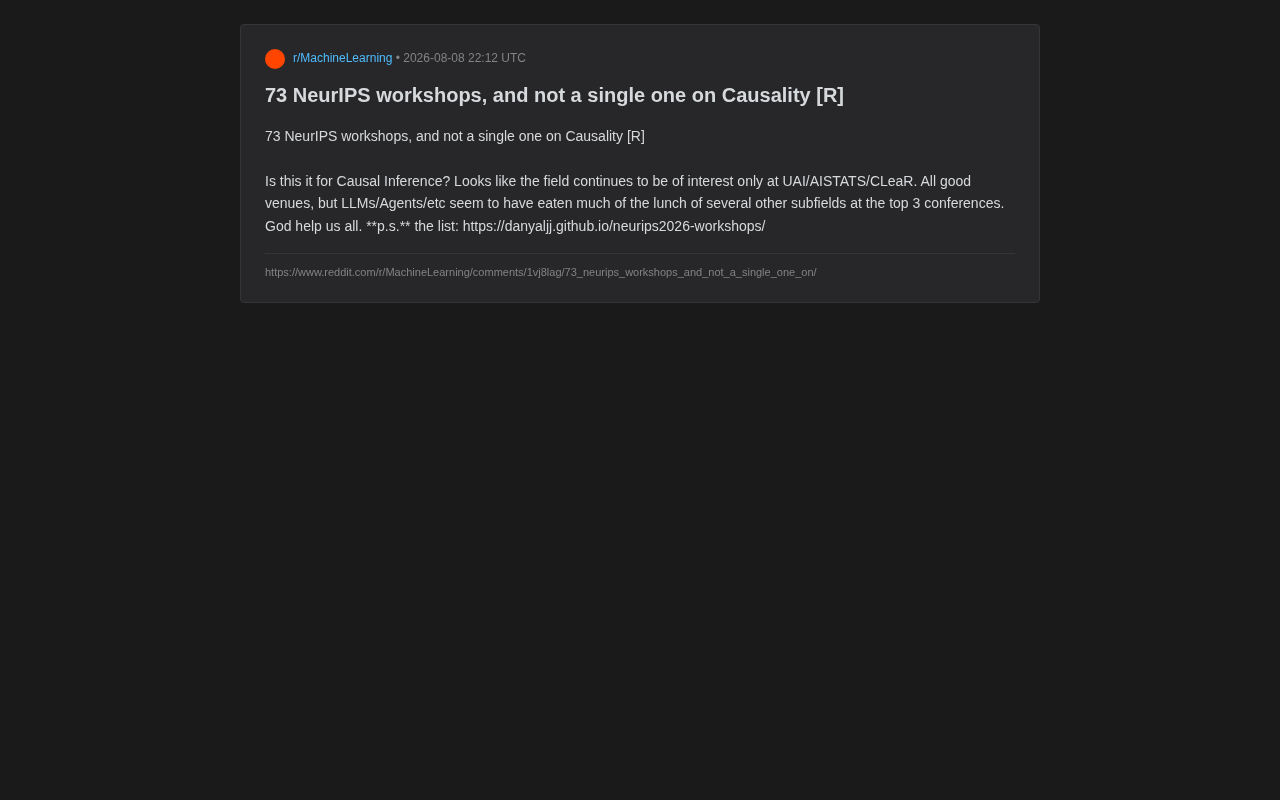
Recently, a discussion from the Reddit machine learning community caught the attention of researchers: among the 73 workshops announced for NeurIPS 2026, not a single one is dedicated to Causal Inference. Many researchers view this as a significant signal — causal inference, a direction once held in high regard, is gradually losing its voice on the stage of top machine learning conferences.
Causal Inference is a theoretical and methodological framework aimed at identifying causal relationships from data, rather than mere correlations. Its modern form consists of two major frameworks: Judea Pearl's Structural Causal Models (SCM) and Directed Acyclic Graph (DAG) framework, and Donald Rubin's Potential Outcomes Framework. Pearl's do-calculus provides mathematical tools for inferring intervention effects from observational data, while the Rubin Causal Model defines causal effects through counterfactual reasoning. Over the past three decades, these two frameworks have profoundly influenced methodological developments in statistics, econometrics, and epidemiology. It is precisely because this direction carries such deep theoretical foundations that its "absence" from top conference workshops is so thought-provoking.
The original poster's lament is representative: "Is this it for Causal Inference?" In their view, the active venues for causal inference have contracted to specialized conferences like UAI, AISTATS, and CLeaR, while at the "Big Three" general conferences — NeurIPS, ICML, and ICLR — the field's presence is being increasingly squeezed by hot topics like Large Language Models (LLMs) and Agents.
The "Attention Economy" Behind Workshop Numbers
Workshops may seem like mere "side dishes" at a conference, but they actually serve as sensitive barometers of academic trends. NeurIPS workshops are typically proposed by active researchers in the field and approved after review by the conference organizing committee. A successful workshop proposal needs to demonstrate sufficient community interest (usually evidenced by expected submission volume and confirmed invited speakers), clear thematic positioning, and the organizing team's academic influence. The operational cycle of workshops is relatively flexible — from proposal to execution usually takes only a few months — so they can reflect shifts in research hotspots more quickly than main conference papers, which require lengthy review cycles. Whether a subfield can successfully organize an independent workshop often depends on having enough active researchers, sufficient submissions, and adequate industry attention as support.
Therefore, when causal inference comes up empty among 73 workshops, the message isn't simply "nobody is doing this research," but rather a more nuanced signal: in the scarce resource of limited conference slots, causal inference has fallen behind in competition with LLMs, Agents, multimodal learning, generative models, and other directions.
Top Conferences Are Being "LLM-ified"
A line from the original post — "LLMs/Agents/etc seem to have eaten much of the lunch of several other subfields" — captures the prevailing sentiment of recent years. Since the generative AI wave erupted in late 2022, the submission structure of top ML conferences has tilted significantly. Statistics show that during NeurIPS 2023-2025, LLM-related submissions grew by over 300%, while the submission share of traditional directions like Bayesian methods, kernel methods, and probabilistic graphical models continued to decline. This shift is reflected not only at the academic paper level but also in industry talent demand and venture capital flows — massive human resources, compute, and funding have poured into LLM-related directions, forming a self-reinforcing ecosystem loop. Meanwhile, traditional directions like reinforcement learning, probabilistic graphical models, and causal inference have been relatively diluted.
This doesn't mean these directions are no longer important. Rather, under the logic of the "attention economy," hot topics inherently carry stronger dissemination effects, employment appeal, and financial returns, creating positive feedback loops that further amplify imbalances in resource allocation.
Is Causal Inference Really in "Decline"?
It's worth maintaining perspective: absence from workshops does not equate to the death of a field. In fact, causal inference has its own unique academic ecosystem:
- Dedicated conferences remain solid: As the original post points out, UAI (Uncertainty in Artificial Intelligence), AISTATS (Artificial Intelligence and Statistics), and CLeaR (Causal Learning and Reasoning) are all high-quality dedicated venues. UAI, founded in 1985, is one of the oldest conferences in probabilistic and causal reasoning; AISTATS focuses on statistical learning theory and methods; and CLeaR, newly established by the causal inference community in 2022, aims to provide a dedicated platform for frontiers like causal discovery and causal representation learning. The creation of CLeaR itself reflects both the causal community's proactive response to compressed space at top conferences and demonstrates that the community hasn't disappeared — its center of gravity has simply shifted.
- Deep cross-disciplinary influence: Causal inference permeates economics (e.g., instrumental variables and regression discontinuity designs in policy evaluation), epidemiology (e.g., propensity score matching in vaccine efficacy assessment), statistics, and other fields. Its influence extends far beyond NeurIPS as a single metric. The 2021 Nobel Prize in Economics, awarded to researchers who made outstanding contributions to causal inference methodology, is the best proof of this cross-disciplinary impact.
- Room for integration with large models: The combination of causal inference and large models is being explored in multiple directions. First, using causal graphs to analyze and eliminate spurious correlations in large models to improve out-of-distribution generalization. Second, applying causal intervention frameworks to understand the internal reasoning mechanisms of large models — so-called "causal interpretability." Third, injecting causal knowledge into the model training process to enhance models' causal reasoning abilities. Additionally, causal inference offers theoretical guidance for addressing the hallucination problem in large models. Therefore, it's entirely possible that causal inference will return to the mainstream spotlight in the form of "causality + LLM."
The Posture a Healthy Field Should Have
From a positive perspective, causal inference possesses solid theoretical foundations and clearly defined problems. This "slow discipline" quality makes it resistant to being swallowed by short-term trends, and it need not rely on conference traffic to prove its value. Looking back at history, similar phenomena have occurred before — Bayesian methods were marginalized by the neural network craze in the 1990s, but their theoretical value was later re-recognized in deep learning uncertainty quantification. Fields with solid mathematical foundations tend to have longer life cycles, and their value is not measured by short-term hype.
Implications for AI Researchers' Direction Choices
This discussion actually raises a deeper question for AI practitioners and graduate students: How do you maintain directional conviction in a hype-driven research environment?
On one hand, riding the LLM wave means more opportunities, resources, and exposure. On the other hand, rooting yourself in foundational directions like causal inference may reveal more lasting value after the wave recedes. The ideal strategy may be to find the intersection of both — using causal perspectives to examine the interpretability and reliability of large models, staying connected to the mainstream while preserving the depth of independent thinking. For example, researchers are currently exploring the use of causal graphs to model information flow in Transformer attention mechanisms, or using intervention experiments (activation patching) to locate where specific knowledge is stored in large models. These works represent organic combinations of causal methodology with cutting-edge hotspots.
The workshop composition of a single conference is insufficient to write the obituary of an entire discipline. But this phenomenon is indeed worth alerting the entire community: when the academic landscape is dominated by a few hot topics, are we inadvertently sacrificing research diversity? And diversity is precisely the foundation for the long-term healthy development of any discipline. Academic history repeatedly proves that today's "niche" often incubates tomorrow's breakthroughs — at the dawn of the internet era, graph theory and network science were similarly niche directions, yet they later became key tools for understanding core problems like social networks and recommendation systems.
Conclusion
"73 workshops, not a single one on causality" — this somewhat resigned observation reflects the structural transformation of the entire machine learning field in the generative AI era. Causal inference may temporarily retreat backstage, but the pursuit it represents — "understanding why the world is the way it is" — will forever remain a core question that artificial intelligence cannot circumvent. As Judea Pearl emphasized in his book The Book of Why, true intelligence needs to answer not only "what is" (the association level) and "what if we do" (the intervention level), but also "why" (the counterfactual level) — and this is precisely the challenge that current large language models have not yet truly conquered. Hot topics will change, but fundamental questions won't disappear. For true researchers, this may be exactly the right time for quiet, deep cultivation.
Note: This article is based on analysis of a single discussion post from the Reddit machine learning community and the publicly available NeurIPS 2026 workshop list. The views presented are individual community opinions and are provided for reference.
Related articles

Workbuddy for Absolute Beginners: How a Desktop AI Agent Fits Into Real Workflows
A beginner's guide to the Workbuddy desktop AI agent: installation, claiming credits, file management, and building automated workflows—compared with CodeX for fit and cost, helping professionals shift from AI question-askers to AI managers.

OpenAI's New Agent Stack: Computer Use, Decisions API, and Ultra-Fast Workflows
OpenAI Dev Day unveiled a new agent stack: Computer Use outperforms humans, Decisions API delivers ultra-low-latency classification via Luna, Agents API opens the same Computer Use capabilities, and GPT-6.1 Sol costs only one-seventh of Astra. Core updates, benchmark data, and developer insights.

Liang Wenfeng Open-Sources DeepInfo Inference Framework, Takes On U.S. Ban
DeepSeek open-sources its DeepInfo inference framework after its models, featuring GPU/CPU cross-pipelining, small-model prediction with large-model verification, and full Huawei Ascend and NVIDIA chip support—facing the U.S. federal ban head-on. This article analyzes its significance for AI deployment and open-source strategy.