Northflank Breached: Another Wake-Up Call for Cloud Platform Security

Cloud development platform Northflank was breached, and its status page notice sparked heated discussion about hosting platform security boundaries.
Cloud development platform Northflank reported a security breach via its official status page, and the Hacker News discussion quickly reached 278 points and 201 comments. Because such platforms hold code repository access permissions, deployment credentials, and environment variables, a compromise could become a springboard for lateral movement into downstream users' infrastructure. Community focus centers on whether secrets were leaked, whether multi-tenant isolation is reliable, and disclosure transparency. The company has not yet disclosed the attack path, scope of impact, or data leakage details; the article recommends that developers check and rotate hosted credentials, evaluate access control policies, and keep following status page updates. The incident is viewed as a stress test of the platform trust model, where security response capability should carry equal weight with feature richness.
Cloud development platform Northflank recently suffered a security breach, and the official status page has published a related notice. The news quickly sparked heated discussion on Hacker News, garnering 278 points and 201 comments in a short time, once again pushing developer community concerns about cloud platform security into the spotlight.
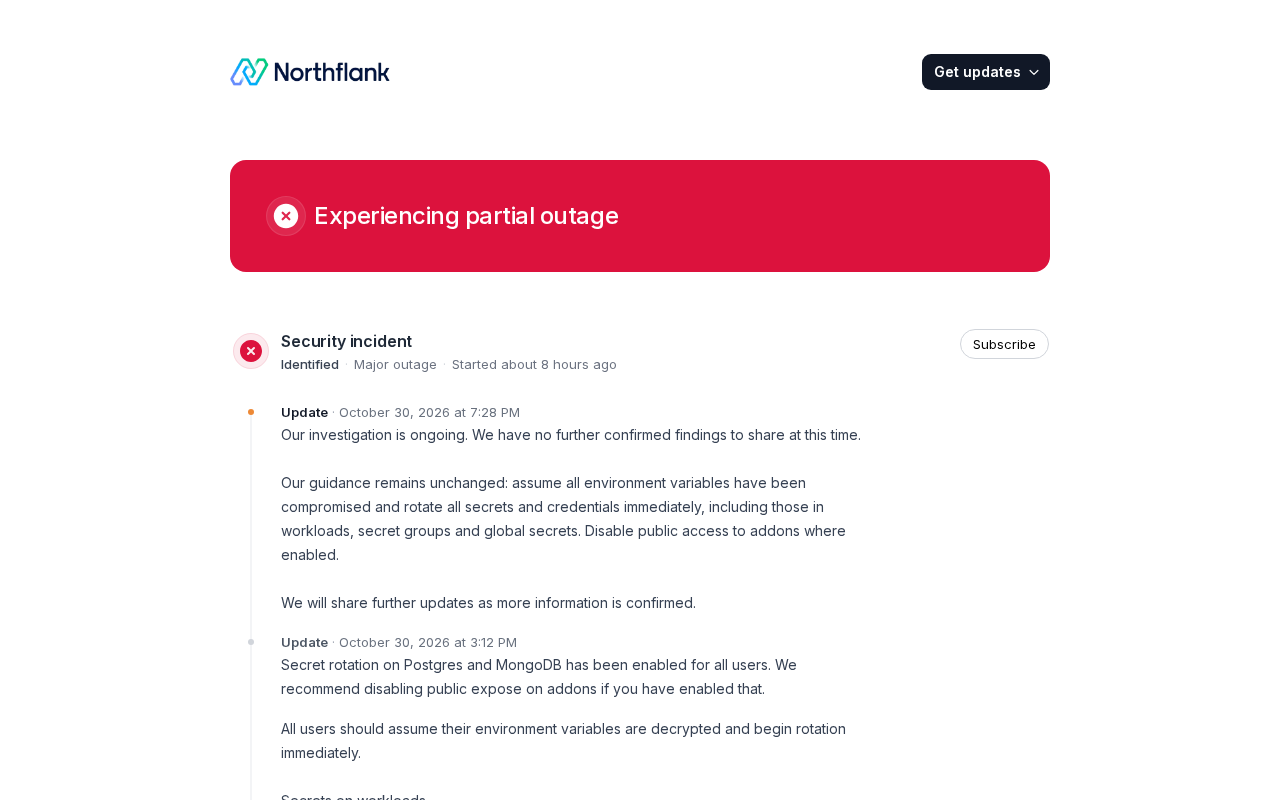
Event Overview: The Status Page as the Only Source
According to public information, Northflank reported the breach through its status page (status.northflank.com). Currently available information comes mainly from that status page and the Hacker News discussion thread; the company has not yet disclosed the specific attack path, the scope of affected users, or details of any data leakage.
The level of discussion on Hacker News (278 points, 201 comments) indicates that this is not an isolated minor security incident—the developer community is highly sensitive to the security boundaries of hosting platforms, especially platforms like Northflank that carry responsibilities for CI/CD, deployment, and infrastructure management.
Why Security Incidents at Cloud Development Platforms Are Especially Sensitive
Northflank positions itself as a developer-friendly cloud platform, offering application deployment, database management, and CI/CD pipelines. What makes such platforms special is that they often hold users' code repository access permissions, deployment credentials, environment variables, and even database connection strings. Once the platform side is compromised, attackers may gain not just control of a single account but a springboard for lateral movement into multiple downstream users' infrastructure.
This also explains why the community reaction has been intense. In the Hacker News comments, discussion focused on several areas: whether the breach touched user keys and credentials, whether the platform's multi-tenant isolation is reliable, and the timeliness and transparency of incident disclosure.
Multi-tenant isolation is a key concept for understanding the risks of such platforms. Cloud development platforms typically serve a large number of different customers on the same physical or virtual infrastructure, using namespaces, network policies, container runtime isolation, and role-based access control (RBAC) to ensure tenants are mutually invisible and unreachable. Once the isolation layer is breached, an attacker may be able to jump from one tenant's context to another, forming so-called "lateral movement." Therefore, when discussing breach incidents, the community pays close attention to whether isolation mechanisms have failed, because this determines whether the incident is a localized account compromise or a platform-level systemic risk.
CI/CD pipelines and secrets management are also worth adding. Modern CI/CD systems need to dynamically inject credentials during build and deployment, such as image registry tokens, cloud provider API keys, and database connection strings. These credentials are usually stored in the platform's secrets management service and exposed to build containers as environment variables or temporary tokens during pipeline execution. If the platform side is compromised, attackers may read these secrets or tamper with build artifacts to carry out supply chain attacks. This explains why credential rotation became the most immediate response action for developers after the incident was disclosed.
Information Gaps and the Boundaries of Reasonable Inference
It must be stated frankly that the currently available material is quite limited. Apart from the status page link and the existence of community discussion, we have no exact details about the attack method, the number of affected users, or whether data exfiltration was involved. Any specific description of "how the attackers got in" or "what data was read" goes beyond what the available information can support.
For developers and operations teams following this matter, the pragmatic approach is to check whether secrets and credentials hosted on Northflank need to be rotated, evaluate the platform's access control policies, and continue to follow subsequent updates on the official status page.
Common frameworks for security incident disclosure can help readers judge the value of subsequent information. The industry typically refers to "72-hour notification" requirements under regulations such as GDPR, as well as the disclosure deadlines for critical infrastructure operators under the NIS2 directive. A complete disclosure generally includes: the timeline of incident discovery, the attack vector, affected systems and data categories, containment measures taken, and specific recommendations for users. Currently, Northflank has only confirmed through its status page that an incident exists and has not yet provided the structured information above, so the community's questions about transparency are reasonable. If the company later publishes a post-mortem, close attention should be paid to whether it distinguishes between "confirmed facts" and "preliminary judgments," and whether it provides verifiable improvement items.
A Stress Test for the Platform Trust Model
Security incidents themselves are not rare; what truly determines a platform's long-term reputation is the quality of its response—the speed of disclosure, the granularity of information, and the transparency of post-incident improvements. Northflank's choice to synchronize information through its status page this time is a starting point, but the community clearly expects a more detailed explanation.
At a time when cloud infrastructure is increasingly a critical part of the software supply chain, incidents like this remind us that when choosing a hosting platform, security response capability should carry equal weight with feature richness.
(This article's information comes mainly from the Northflank status page and Hacker News community discussion; incident details are subject to official follow-up disclosure.)
One-line Summary
Cloud development platform Northflank was breached, and the status page notice sparked heated discussion in the developer community about the security boundaries of hosting platforms.
Paragraph Summary
Cloud development platform Northflank reported a security breach through its official status page, and the Hacker News discussion quickly reached 278 points and 201 comments. Because such platforms hold code repository access permissions, deployment credentials, and environment variables, a compromise could become a springboard for lateral movement into downstream users' infrastructure. Community focus centers on whether secrets were leaked, whether multi-tenant isolation is reliable, and disclosure transparency. The company has not yet announced the attack path, scope of impact, or data leakage details. The article recommends that developers check and rotate credentials hosted on the platform, evaluate access control policies, and continue following status page updates. The incident is seen as a stress test of the platform trust model, in which security response capability should carry equal weight with feature richness.
Related articles

Glasshand: Giving AI Agents a Real iPhone and Mac
Glasshand lets AI agents rent real iPhones and Macs, supporting Claude Code, Codex, and more to post, book services, and test iOS apps on real devices. This article explains how it works, its use cases, and potential boundaries.

ChatGPT Images 2.6 Released: GIF Generation, Reference Image Reuse, and 50% Speed Boost
ChatGPT Images 2.6 released: prompt-to-GIF animation with frame-by-frame editing, reusable reference images for yourself, pets, or characters, 50% faster generation, plus Flare and Sunburst API model variants and SVG export for developers.

Rerun: Turn Your AI Subscription into an AI Coworker Team
Rerun, #3 on Product Hunt, turns your ChatGPT or Claude subscription into a team of AI coworkers that run on schedules or triggers, each with tools, a computer, and a shared workspace. It asks before risky actions, is open source (AGPL v3), and supports self-hosting.