Notion Gets Early Access to GPT-6 Astra: From AI Assistant to 'Staff Engineer Collaborator'

Notion engineer's GPT-6 Astra hands-on: AI collaboration evolves from task assignment to goal delegation.
Notion engineer Gwyn shares his hands-on experience with GPT-6 Astra from an official Notion-OpenAI conversation. The key insight: the new model has shifted from a task-executing tool to a 'staff engineer collaborator' that can take on high-level goals. Compared to the previous Sol model, Astra's biggest improvement is communication quality — clearly articulating findings and questions to dramatically shrink the human-AI feedback loop. In a real cache optimization task, Astra identified systemic patterns the team had missed in prior audits and inferred deeper underlying issues. Notion now advises giving the model 'dashboard-level goals' rather than specific tasks.
From 'Handing Out Tickets' to 'Handing Over Problems': A Fundamental Shift in AI's Role
In a conversation between Notion and OpenAI, one central metaphor runs throughout: the new-generation model GPT-6 Astra is more like a "staff engineer collaborator" than the task-executing tool of the past.
One line from the conversation cuts to the core: "You wouldn't hand a staff engineer a pile of small tickets — you'd give them a hard problem you've already tried and failed to solve." This precisely captures the shift in how humans and AI collaborate — moving from task-decomposition-style "spoon-feeding" to goal-oriented "delegation."
This isn't just a model capability upgrade; it's a restructuring of how work gets done. Last year's approach to coding was "give it a task and clear its blockers." This year, it's "give it a goal and help it navigate." The time engineers spend actively engaged in the collaboration has dropped noticeably.
Astra in Codex: A Model That Actually "Talks Like a Human"
Notion engineer Gwyn primarily uses Astra in the Codex environment, since that's where he spends most of his time as an engineer. His first impression was telling.

He noted that with previous models like Sol, the experience was: the model was smart and could find interesting things, but was "really bad at telling me what it found." Astra, by contrast, communicates much more like a human talking to another human.
For engineers whose primary job is unblocking the model, communication quality directly determines collaboration efficiency. Gwyn described how he now watches the chat window mainly to figure out "what the model is asking me and what I need to answer."

This means the feedback loop with the model closes faster, and the time spent actively engaged in collaboration shrinks accordingly. When a model can clearly articulate its confusion and needs, human intervention becomes efficient and precise.
Codex here refers to OpenAI's agentic coding environment designed for software engineering workflows. It allows the model to autonomously execute multi-step operations in a sandbox — reading and writing code files, running tests, calling tools — rather than simply generating code snippets in a chat window. Unlike standard conversational completions, in a Codex workflow the engineer plays more of a "supervisor" role than an "operator" — the model advances the task autonomously, and the human's main intervention point is unblocking the model when it gets stuck. This is precisely why communication clarity matters so much: if the model can't accurately describe where it's stuck or what information it needs, the engineer has to spend significant time guessing and re-confirming, which kills collaboration efficiency.
The First Real Task: Finding Missed Patterns in Cache Optimization
Notion spends heavily on tokens, and one of the key factors affecting costs is cache reuse — specifically, how far actual performance falls from the theoretical maximum. This was the first real task Gwyn handed to Astra.
His prompt was direct: "Here's all the work we've done before, here's our current understanding — what did we miss in our last audit?"

The results were compelling. Sol could dig deep into a specific issue and spot a localized pattern, while Astra was able to "connect the dots faster" — identifying systemic patterns the human team had overlooked, and further inferring that "if you think about it carefully, this actually suggests something else is going on."
Equally notable was the delivery. Astra's output was "very clear: here's the problem, here's the specific scenario — clean, no fluff." Gwyn noted this was nearly identical to how he himself would write it up: "I don't have to re-read it multiple times to understand" — a stark contrast to his past frustrating experiences getting coding agents to explain their findings.
Cache Reuse is an important cost optimization mechanism in large language model API calls. When the prefix portion of a request (such as system prompts or long document contexts) is identical to a previous request, the model provider can reuse already-computed KV caches (Key-Value Caches), skipping redundant computation for those tokens and significantly reducing both inference latency and billing costs. For enterprise users like Notion who call APIs at high frequency, system prompts and background documents often account for the majority of tokens in each request — even small differences in cache hit rates can translate into substantial cost gaps. The gap between "theoretical maximum" and actual performance typically stems from subtle issues: poor request ordering, minor prompt variations causing prefix mismatches, or cache invalidation in multi-tenant concurrent scenarios. These systemic patterns are exactly the kind of problem that's difficult to diagnose through manual inspection one by one.
Advice for the Team: Set Goals, Not Tasks
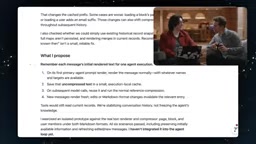
As Astra rolls out more broadly within Notion, Gwyn's advice to colleagues follows the same "staff engineer" logic: don't give it a specific task — give it a top-level goal.
He used a vivid analogy: "Give it a number on the dashboard and tell it 'this number needs another nine' (meaning improvements like going from 99% to 99.9% reliability or efficiency) — that's the appropriate scope to hand this model."
Behind this advice is a clear understanding of the AI collaboration paradigm: once a model can connect the dots, communicate clearly, and navigate autonomously, humans should treat it as a collaborator capable of handling high-level goals — not an execution tool that needs step-by-step instruction.
Signals Worth Watching
Brief as this conversation was, it reveals several directional signals. First, the standard for evaluating models is shifting from "can it find the answer" to "can it communicate clearly and drive the loop to closure" — communication quality is becoming a key dimension of AI capability. Second, the value of enterprise AI applications lies not just in generating code, but in surfacing patterns and cost optimization opportunities that human teams have overlooked. Third, the granularity of human-AI collaboration is rising from the task level to the goal level.
It's worth noting that this content comes from an official co-hosted conversation between Notion and OpenAI. As a single-source early-access account, the descriptions of Astra's capabilities carry some promotional framing, and actual performance awaits broader independent validation.
Related articles

Cursor Can Now Control Your Computer: AI Agents Can Drive Desktop Apps for Testing
Cursor adds desktop control: AI agents can drive desktop apps like the iOS Simulator to test their own features. We analyze the impact on dev workflows, possible technical approaches, and reliability concerns.

Vibecoding a Custom Inference Engine: High Hopes, Harsh Reality
A Reddit developer shares the real experience of vibecoding a custom inference engine: running GGUF Q4 models in the browser with WebGL2 and GLSL, only to fall into tokenizer debugging hell. This article analyzes the engineering challenges of browser-side LLM inference and why cloning llama.cpp is the more rational choice.

How High Are Anthropic's Early Investor Paper Returns Ahead of IPO?
Anthropic's early investor paper returns draw attention ahead of IPO. This article analyzes sources of book gains, capital structure, pre-IPO games and risks, and implications for the AI startup ecosystem.