NovaSynth: Stress-Testing Voice AI Agents with Simulated Callers
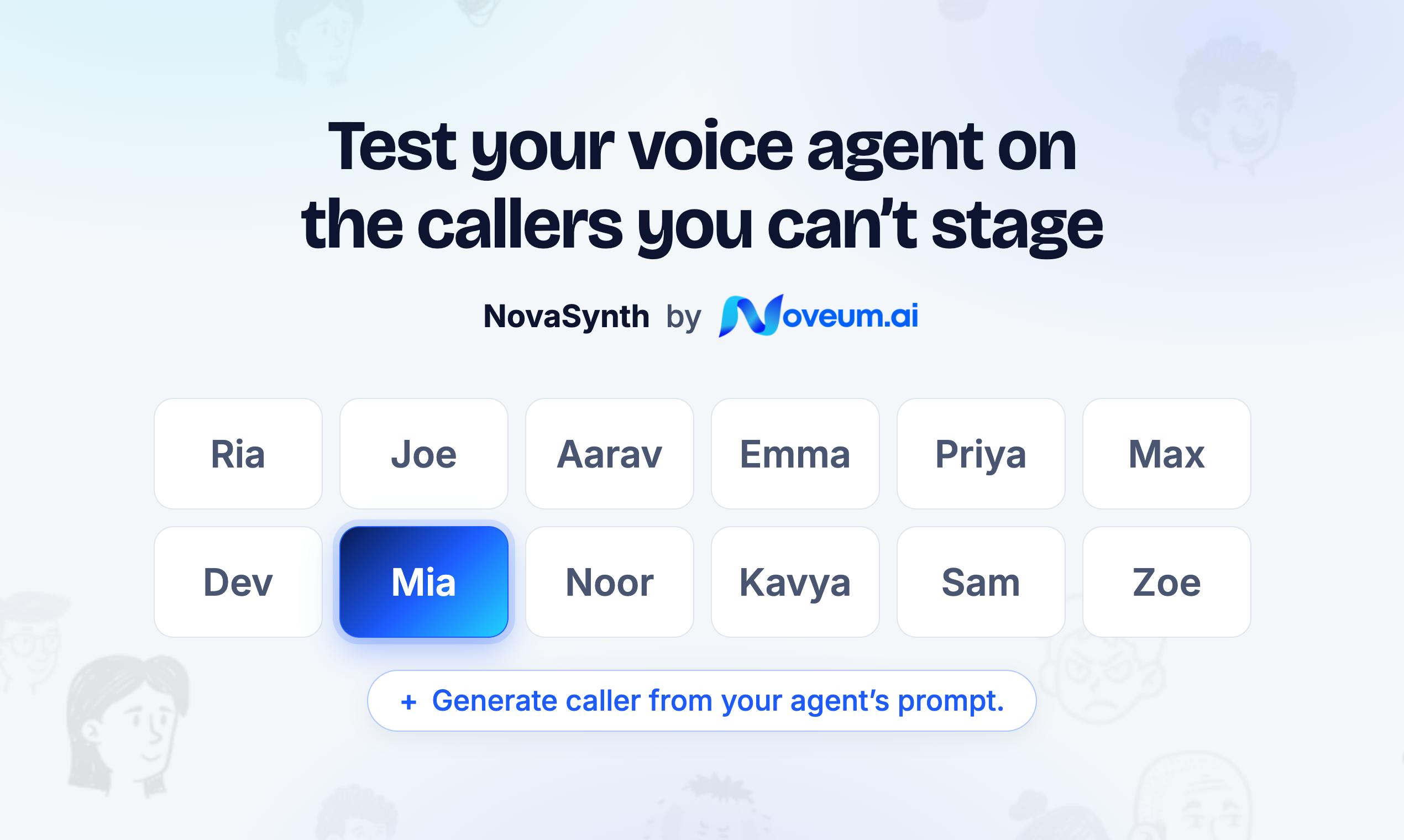
NovaSynth stress-tests voice AI agents with configurable synthetic callers to fill the pre-launch QA gap.
NovaSynth is a voice agent testing tool from Noveum that replaces real user testing with configurable "virtual callers." It supports custom personas, business scenarios, interruptions, background noise, accents, and network conditions, enabling development teams to cover complex production call scenarios at scale without recruiting edge-case users. After each test, the system delivers automated scoring across 30+ audio and transcript dimensions, surfaces critical failure points, and provides fix recommendations — filling the quality assurance gap that voice AI has long lacked compared to the mature text LLM evaluation ecosystem.
Voice AI agents are rapidly moving into real-world use cases — customer service, appointment booking, outbound calls — but one long-overlooked challenge remains: you can't invite every type of user to test your system before launch. Elderly callers with heavy accents, frustrated complainants, users on spotty connections, noisy background calls — these are exactly the scenarios most likely to trip up a voice agent, and exactly the hardest to reproduce manually.
NovaSynth, from the team at Noveum, targets this gap directly. It debuted on Product Hunt with 124 upvotes and a #4 ranking, positioning itself as a tool to "Test your voice agent on the callers you can't stage."
What Problem Does It Solve?
Traditional voice agent testing typically relies on scripted regression cases or a small set of manually recorded samples. The limitations are obvious: narrow coverage, poor scalability, and near-zero ability to capture the full complexity of real-world interactions. A voice assistant that performs flawlessly in a quiet office with a standard accent may completely fall apart on a subway, with a dialect speaker, or when interrupted mid-sentence.
NovaSynth's core approach is to stress-test voice agents at scale using synthetic, configurable simulated callers — not simply generating audio, but building fully realized "virtual callers" with realistic behavioral characteristics.
Configurable Caller Variables
According to official documentation, NovaSynth lets you customize simulated callers across multiple dimensions:
- Custom personas: Users with different personalities, backgrounds, and needs
- Scenarios: Diverse business situations — appointments, complaints, inquiries
- Interruptions: Simulating mid-conversation interjections and talk-overs
- Noise: Background audio challenges that degrade call quality
- Accents: Pronunciation variations across regions and language backgrounds
- Network conditions: Simulated poor connectivity, packet loss, and latency
Combining these variables allows testing to approximate the most difficult edge cases in real call centers — without needing to actually recruit those users.
In the voice AI space, the concept of a "persona" is borrowed from traditional UX design, but carries more specific engineering meaning in a testing context: it needs to encode language style (vocabulary habits, sentence length, slang usage), emotional state (anxiety, frustration, low cooperativeness), and domain knowledge level (familiarity with business terminology). Network condition simulation is typically implemented by injecting packet loss, jitter, and latency into the audio stream — directly affecting the accuracy of Voice Activity Detection (VAD). In weak network environments, an agent may misjudge whether a user has finished speaking, leading to premature interruptions or excessive silence. This is a surprisingly common root cause of real call center complaints.
Automated Scoring Across 30+ Dimensions
Another key capability of NovaSynth is evaluation. It doesn't just run conversations — for every simulated call, it scores performance across more than 30 dimensions at both the audio and transcript levels.
This means teams receive structured quality assessment results rather than a pile of raw recordings. The system actively surfaces the failures and fixes that matter to your team, dramatically shortening the path from "something went wrong" to "here's what to fix and how."
Evaluating audio and text dimensions separately is particularly meaningful: a voice agent might handle semantic understanding correctly while losing points on audio quality, response latency, or tonal naturalness — or vice versa. Multi-dimensional scoring helps teams pinpoint exactly where the breakdown occurred.
Evaluating voice agents is inherently more complex than evaluating text-only LLMs because it spans two modalities. Text-level scoring typically covers intent recognition accuracy, slot filling completeness, factual correctness of responses, and conversational coherence. Audio-level evaluation involves Time To First Frame (TTFF), end-to-end latency, TTS naturalness (automated MOS — Mean Opinion Score — estimation), and ASR Word Error Rate (WER) under background noise. Separating these two dimensions enables root cause isolation: for any given failure, you can trace whether ASR misheard the input, the LLM misunderstood the intent, or TTS output confused the user — rather than simply concluding that "the call didn't go well."
Who Is It For, and Where's the Value?
NovaSynth is categorized under Developer Tools, Artificial Intelligence, and Audio — clearly targeting engineering teams building or operating voice AI products.
Its value proposition breaks down into three points:
- Scaled testing — Turn what was once small-batch manual validation into automated, batch-runnable test suites
- Real-world complexity coverage — Approximate production environments through noise, accents, interruptions, and network degradation
- Actionable insights — Multi-dimensional scoring paired with fix recommendations, so test results directly feed product iteration
As voice agents take on more real customer-facing workloads, the question of "is this actually reliable before we go live?" becomes increasingly urgent. Tools like NovaSynth represent an effort to build the quality assurance infrastructure that voice AI has been missing.
A Few Observations
It's worth noting that the voice AI testing tooling space has historically been sparse. Text-based LLMs already benefit from a rich ecosystem of evaluation frameworks and benchmarks, while voice scenarios — with their additional complexity around audio, real-time interaction, and environmental noise — present a much higher engineering bar. NovaSynth bundles "synthetic callers + multi-dimensional scoring + fix recommendations" into a single workflow. If the results live up to the pitch, it should be genuinely useful for teams pushing voice agents into production.
That said, as a product just launching on Product Hunt, the actual accuracy of its scoring, the realism of its synthetic voices, and how easily it integrates with mainstream voice agent platforms all remain to be validated through real-world usage. Teams interested in adopting it would be wise to run a small-scale pilot against their specific business scenarios before committing it to their testing pipeline.
The text LLM evaluation ecosystem is relatively mature, with public benchmarks like MMLU, HellaSwag, and MT-Bench, as well as commercial evaluation platforms like LangSmith and Braintrust. The voice domain lacks equivalent standardized benchmarks — partly because the privacy sensitivity of audio data makes it difficult for public datasets to reflect real business scenarios, and partly because "good voice interaction" inherently involves subjective experience (Is the tone warm? Are the pauses natural?) that resists single-metric measurement. This is precisely why synthetic test data has unique value in this space: it sidesteps the privacy barriers of real user data while systematically covering edge cases — making it a pragmatic path toward voice AI quality assurance at the current stage of the industry.
Related articles
WAN 2.1 Physics Motion LoRA Benchmark: Rankings and Methodology for 11 Models Tested
A Reddit user benchmarked 11 physics-motion LoRAs on WAN 2.1 using optical flow analysis. Only 3 worked meaningfully; 4 scored below the no-LoRA baseline. Full rankings and methodology inside.
Lucid Partners with Bolt to Target European Robotaxi Market
Lucid Motors has signed a letter of intent with European mobility platform Bolt to explore Robotaxi services in Europe, though no vehicle orders have been placed yet.
AI Assistants Enter the "Phone Call" Era: Instinct and Meta Muse Add Voice Task Execution
AI assistants Instinct and Meta Muse now make phone calls on your behalf — booking restaurants, canceling subscriptions — marking a leap from chat tools to real-world agents.