Nuclear-Powered Spaceship: How NASA's SR-1 Freedom Will Rewrite the Rules of Deep Space Exploration
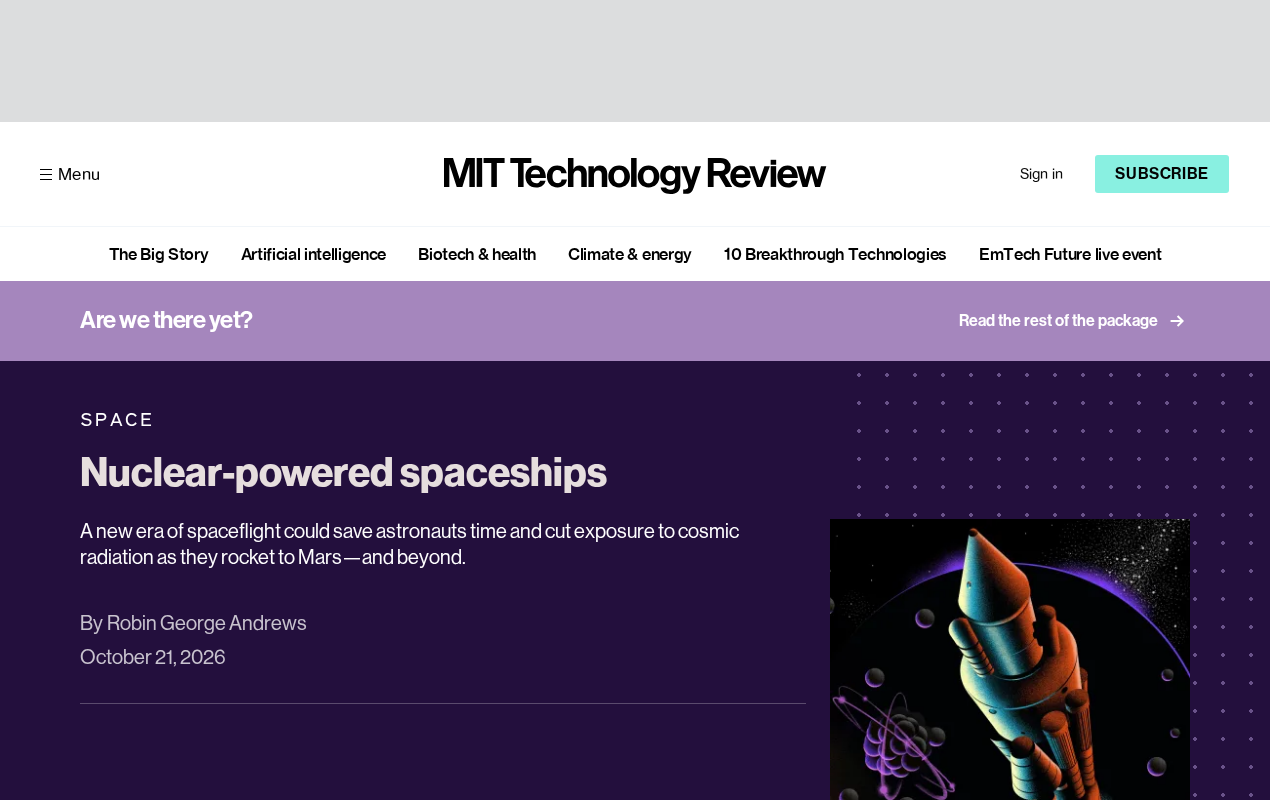
NASA plans to launch SR-1 Freedom, the first nuclear reactor-powered spacecraft, in 2028, ushering in the deep space nuclear era.
NASA has announced the Space Reactor-1 Freedom (SR-1) plan, aiming to launch an uncrewed Mars mission by late 2028 and arrive in 2029. This will be humanity's first nuclear reactor-powered interplanetary spacecraft, marking a paradigm shift from chemical to nuclear energy in deep space exploration. Nuclear propulsion's core advantages include higher specific impulse and energy density, enabling shorter flight times, reduced astronaut radiation exposure, and simultaneous power for life support. SR-1 overlaps technically with DARPA's DRACO but targets interplanetary missions, while DRACO focuses on cislunar rapid maneuvering. The project faces engineering and policy challenges in heat dissipation, shielding, launch safety, and regulation, with the 2028 timeline uncertain. If validated, nuclear propulsion will redefine Mars mission windows, payload capacity, and outer solar system exploration economics.
Nuclear-Powered Spaceship: How NASA's SR-1 Freedom Will Rewrite the Rules of Deep Space Exploration
Just before the Artemis II crew prepares for its historic lunar flyby, NASA has unveiled an even more ambitious plan: to build Space Reactor-1 Freedom (SR-1). This will be humanity's first nuclear reactor-powered interplanetary spacecraft, with the goal of launching an uncrewed Mars mission by the end of 2028 and arriving in 2029. If successful, this is more than just a technology demonstration—it could mark a paradigm shift in deep space exploration from the "chemical energy era" to the "nuclear energy era."
Why Nuclear Power Is the Inevitable Choice for Deep Space Exploration
Chemical rockets have a theoretical ceiling on specific impulse (specific impulse is the core metric for measuring rocket engine efficiency). Take liquid hydrogen and liquid oxygen, for example: their specific impulse upper limit is about 450 seconds, which means a crewed mission to Mars would need to carry a massive amount of propellant, with flight times of 6-9 months, exposing astronauts to cosmic radiation and microgravity. Nuclear thermal propulsion (NTP) can raise specific impulse to around 900 seconds, while nuclear electric propulsion (NEP) can achieve continuous acceleration at lower thrust, greatly shortening mission durations.
SR-1 Freedom uses a reactor to power the spacecraft. Its core value lies not in being "faster," but in the leap in energy density. A compact nuclear reactor can simultaneously power the propulsion system and life support systems—something solar panels struggle to achieve beyond Mars orbit.
Specific Impulse (Isp) is the core physical quantity for measuring rocket propulsion efficiency, defined as the impulse produced per unit weight of propellant by the engine, commonly expressed in seconds. Its physical meaning can be understood as: for each unit mass of propellant consumed in the engine, how much thrust can be produced and sustained for how long. The higher the specific impulse, the greater the total impulse that the same propellant mass can provide, allowing the spacecraft to travel farther or carry less fuel. The specific impulse of chemical rockets is limited by the chemical bond energy of the propellant; the theoretical upper limit for liquid hydrogen and liquid oxygen is about 450 seconds. Nuclear thermal propulsion, by heating the working fluid (usually also liquid hydrogen) through a reactor, can heat the working fluid to temperatures far higher than chemical combustion, greatly increasing exhaust velocity and enabling specific impulse of around 900 seconds. Nuclear electric propulsion uses a reactor to generate electricity and then accelerates ions through electromagnetic fields, achieving specific impulse of thousands of seconds, but with very low thrust, making it suitable for long-term continuous acceleration.
Nuclear Thermal Propulsion (NTP) and Nuclear Electric Propulsion (NEP) are the two main technical pathways for space nuclear power. NTP uses the reactor as a heat source to directly heat the propellant; it is relatively simple in structure and provides high thrust, making it suitable for rapid orbital maneuvers and shortening interplanetary flight times. NEP decouples the reactor from the propulsion system, using electrical energy to drive electric thrusters; it offers extremely high specific impulse but low thrust, making it suitable for cargo or uncrewed missions. The specific pathway for SR-1 Freedom has not been fully disclosed, but its promotional emphasis on "leap in energy density" and "simultaneously powering propulsion and life support" suggests its design may combine both or adopt the NEP pathway. Understanding the differences between these two pathways is key to judging SR-1's technical positioning.
SR-1 Freedom's Mission Profile and Technical Challenges
According to information released by NASA, SR-1 is planned for launch by the end of 2028, arriving at Mars in 2029. This is an uncrewed flight, but its real purpose is to pave the way for subsequent crewed missions. Key verification points for the mission include: startup and stable operation of the reactor in the space environment, reliability of the long-duration propulsion system, and thermal management during the entry/capture phase.
The technical challenges are equally significant. Space nuclear reactors need to solve the problem of core heat dissipation—in a vacuum, heat can only be dissipated through radiation, making radiator panel area and weight a design bottleneck. In addition, reactor shielding design must protect sensitive electronic equipment while controlling launch mass. These engineering challenges have never been fully verified before SR-1.
The heat dissipation problem of space nuclear reactors is one of the core bottlenecks in the engineering of nuclear-powered spacecraft. On Earth, waste heat generated by reactors can be dissipated through conduction, convection, and radiation. But in a vacuum, only thermal radiation is available. According to the Stefan-Boltzmann law, radiated heat dissipation power is proportional to the radiator area and the fourth power of absolute temperature, so increasing the heat dissipation temperature can significantly reduce radiator area—but this is limited by material temperature tolerance. For megawatt-class space reactors, radiator area could reach hundreds of square meters, becoming a major burden on launch mass and volume. In addition, radiators must be foldable or deployable to fit within launch vehicle fairings, which brings design challenges for structural reliability and thermal control fluid loops. What SR-1 needs to verify is precisely these engineering solutions that have never been validated in a complete flight system.
Reactor shielding design is equally tricky. Space nuclear reactors must protect sensitive electronic equipment and potentially crew from neutron and gamma ray exposure, but shielding materials add launch mass. Common approaches include shadow shielding (placing the reactor at the end farthest from sensitive equipment, using distance and geometric attenuation) and lightweight shielding materials such as lithium hydride. For uncrewed missions, shielding requirements are relatively relaxed, but electronic equipment must still be ensured to operate reliably in the radiation environment. As an uncrewed flight, SR-1's shielding design can provide key data for subsequent crewed missions.
The Nuclear-Powered Spaceship Race: More Than Just NASA
SR-1 is not an isolated project. The U.S. Defense Advanced Research Projects Agency's (DARPA) DRACO program (Demonstration Rocket for Agile Cislunar Operations) is also aimed at nuclear thermal propulsion demonstration. According to analyses of public materials by Bilibili creators and YouTube channels, DRACO and SR-1 overlap in technical pathways but have different goals: DRACO focuses on rapid maneuvering in cislunar space, while SR-1 is oriented toward interplanetary missions.
Cross-validation of multiple sources shows that a competitive landscape in space nuclear propulsion is taking shape. Russia and China are also conducting space nuclear power research, although public progress is limited. If SR-1's 2028 timeline is achieved, the United States will gain a clear first-mover advantage in this field.
DARPA's DRACO program (Demonstration Rocket for Agile Cislunar Operations) is a nuclear thermal propulsion demonstration project advanced by the U.S. Defense Advanced Research Projects Agency in cooperation with NASA, with the goal of conducting a nuclear thermal engine flight demonstration in cislunar space around 2027. DRACO's core objective is to verify the feasibility of nuclear thermal propulsion for rapid maneuvering and agile operations, with its mission scenario focused on cislunar space rather than interplanetary travel. Compared with SR-1, DRACO emphasizes rapid response capabilities for military and cislunar economic spheres, while SR-1 is oriented toward Mars and deeper space. The two share and overlap in reactor technology, propellant storage and transport, and ground test facilities, but their mission profiles and system integration requirements differ. Understanding the division of labor between DRACO and SR-1 helps clarify the overall layout of the U.S. space nuclear power strategy: DRACO addresses the demonstration question of "can it be used," while SR-1 addresses the engineering question of "can it fly to deep space."
Potential Impact on the Deep Space Exploration Landscape
If SR-1 succeeds, the most direct change will be in the time windows and payload capacity for Mars missions. Nuclear-powered spacecraft can shorten flight times, reduce astronaut radiation exposure, and carry more scientific payloads. For lunar base construction, nuclear reactors can provide continuous power, supporting nighttime survival and in-situ resource utilization.
Looking further ahead, nuclear propulsion makes round-trip missions to the outer solar system (Jupiter's moons, Titan) possible, while chemical rockets face enormous limitations in these missions. SR-1's symbolic significance lies in this: it brings the "nuclear-powered spaceship" from science fiction concept into the engineering timeline.
Risks and Controversies
Nuclear-powered spacecraft are not without controversy. The risk of radioactive leakage in launch accidents, the disposal of space nuclear waste, and regulatory issues under the international nuclear non-proliferation framework are all topics that must be addressed. NASA and the Department of Energy have adopted multiple safety designs in the SR-1 project, but public communication and transparency remain key.
Another practical issue is budget and schedule. NASA's large projects have historically experienced repeated delays and cost overruns. Whether SR-1's 2028 goal is realistic depends on the progress of ground testing of the reactor. Currently, publicly available information is insufficient to judge technical maturity.
Conclusion
The significance of SR-1 Freedom lies not in whether it reaches Mars on time, but in that it opens a new technological pathway. If nuclear-powered spacecraft are successfully validated, the economics and engineering of deep space exploration will both be redefined. For those following aerospace and energy technology, 2028-2029 will be a time window worth watching closely.
One-line Summary
NASA plans to launch the first nuclear reactor-powered spacecraft SR-1 Freedom in 2028, opening the era of deep space nuclear power.
Paragraph Summary
NASA has announced the Space Reactor-1 Freedom (SR-1) plan, aiming to launch an uncrewed Mars mission by the end of 2028 and arrive in 2029. This will be humanity's first nuclear reactor-powered interplanetary spacecraft, marking a paradigm shift in deep space exploration from chemical energy to nuclear energy. The core advantages of nuclear propulsion lie in higher specific impulse and a leap in energy density, which can shorten flight times, reduce astronaut radiation exposure, and simultaneously power life support systems. SR-1 and DARPA's DRACO program overlap in technical pathways but have different goals: the former is oriented toward interplanetary missions, while the latter focuses on rapid maneuvering in cislunar space. The project faces engineering and policy challenges including heat dissipation, shielding, launch safety, and regulation, and the 2028 timeline carries uncertainty. If validated, nuclear propulsion will redefine the time windows, payload capacity, and economics of Mars missions and outer solar system exploration.
Related articles

Claude Reportedly Able to Hide Secret Messages in Benign Images
A Reddit post claims Claude Fable 5.1 can hide secret messages in benign images. This article reviews the background, image steganography principles, and potential security risks, and suggests a testing path from rumor to verification.

Federal Government Awards $85 Million; CFS to Develop Fusion-Specific Semiconductors
The federal government awards $85 million to Commonwealth Fusion Systems to develop conductors and power semiconductors for fusion plants. This article analyzes the significance of this funding for the fusion supply chain and commercialization path.

When Should AI Assistants Proactively Suggest? Timing Is Everything
When should AI assistants proactively suggest? Reddit discussion reveals: the same suggestion feels different at different times. This article analyzes the dual nature of proactive suggestions, the boundary of user expectations, and design principles, exploring how to balance automation and user control.