NudgeForMe: AI Email Follow-Up Agent That Ensures Silent Emails Don't Cost You Deals

AI agent that auto-drafts follow-ups for unanswered emails so you never lose deals to silence.
NudgeForMe is an AI follow-up agent built by the Snoooz team that automatically scans sent email threads for unanswered conversations, drafts natural-sounding follow-up emails, and places them in your drafts for review. Supporting Gmail, Outlook, and IMAP/SMTP, it uses a human-in-the-loop approach to help sales and BD teams recover opportunities lost to silence—without sacrificing control over outbound communication.
A Neglected Pain Point: Email Follow-Up
In the daily work of sales, business partnerships, and client relationships, the most easily overlooked yet most costly oversight isn't the email you never sent—it's the conversation that went silent after sending, never to be followed up on. An unanswered email could mean a lost deal, a missed partnership, or a prospect slowly going cold.
The data behind this pain point is staggering: according to multiple sales industry studies, 80% of deals require at least 5 follow-up touchpoints, yet 44% of salespeople give up after the first rejection. Research by Iko System found that the first follow-up email can boost reply rates to 21%, while persisting through the sixth email yields a cumulative reply rate of 27%. These numbers reveal a harsh reality: countless business opportunities aren't lost because the product or service isn't good enough, but simply because of a failure to follow up.
Launching at #1 on Product Hunt (159 upvotes, 14 comments), NudgeForMe targets precisely this specific, real-world workflow: ensuring that prospects, deals, partnerships, and client conversations don't silently slip away.
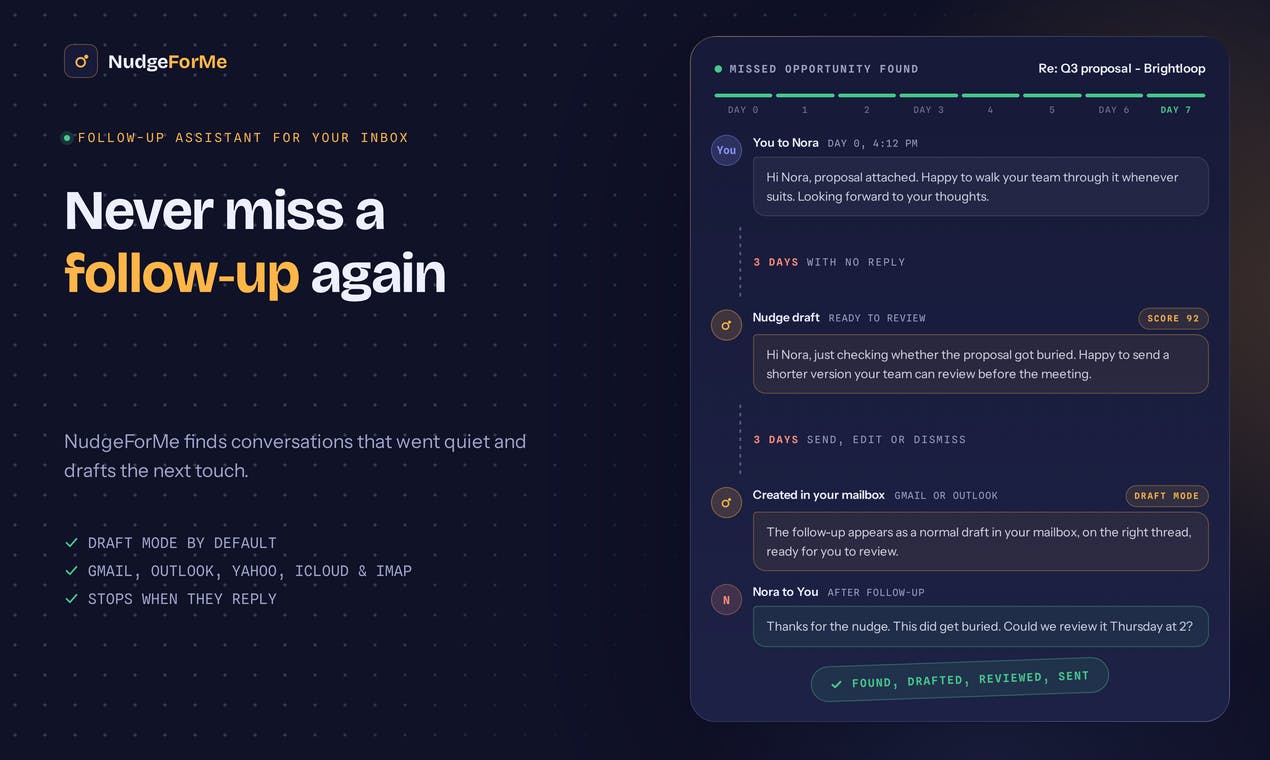
NudgeForMe's Core Functionality: Follow-Up in Three Steps
In simple terms, NudgeForMe is an AI follow-up agent whose core workflow breaks down into three steps:
1. Automatic Scanning of Sent Conversations
NudgeForMe automatically scans your sent email threads and identifies conversations where the other party never replied. This step solves the "can't keep track" problem—in high-volume email environments, manually tracking every email awaiting a response is virtually impossible.
From a technical implementation perspective, this step involves an email thread parsing engine that uses NLP (Natural Language Processing) to understand conversation context, identify sender-recipient relationships, and employ intent detection models to determine which unanswered emails represent "worth following up" business scenarios rather than ordinary notifications or one-way communications. Compared to generic email writing assistants, the challenge for a follow-up agent lies in timing judgment—it needs to consider the email send time, the recipient's historical reply patterns, and industry norms to decide when to trigger a follow-up suggestion.
2. Drafting Natural-Sounding Follow-Up Emails
For these unanswered threads, NudgeForMe drafts natural-sounding follow-up emails directly in your inbox. It doesn't aim for robotic template-style nudges, but emphasizes natural expression that closely mimics human communication style. This relies on an LLM-based text generation module that needs to understand the original conversation's context and the sender's personal style, generating follow-up content that's neither jarring nor ineffective at moving the conversation forward.
3. Draft Mode: Users Always Control the Send Button
This is a critical product design decision for NudgeForMe: it runs in draft mode by default. The AI never sends any email on its own—instead, it places generated follow-up content in your drafts folder for you to review one by one. You can pick out the genuinely valuable opportunities and then send them via Gmail, Outlook, or IMAP/SMTP.
Notably, NudgeForMe supports Gmail, Outlook, and IMAP/SMTP protocols—a design that covers the vast majority of enterprise email scenarios. IMAP (Internet Message Access Protocol) allows applications to read and manage emails on mail servers, while SMTP (Simple Mail Transfer Protocol) handles email sending. Supporting these universal protocols means the product is compatible not only with mainstream commercial email services but can also integrate with self-hosted mail servers and enterprise email systems—crucial for market coverage of a B2B tool.
This "AI suggests, humans decide" model stands out as particularly restrained in today's landscape of proliferating automation tools, and it more easily earns user trust—after all, when real business communication is at stake, a poorly timed or poorly worded automated email could backfire.
In the design philosophy of AI Agents, there exists an "autonomy spectrum": at one end are fully human-controlled tool-type AIs, and at the other are fully autonomous agents making decisions independently. The industry is actively debating this—companies like Anthropic and OpenAI have noted in their AI safety research that an agent's degree of autonomy should be proportional to the reversibility of its tasks. Email sending is a classic "irreversible operation"—once sent, it cannot be recalled, and it directly impacts interpersonal relationships. Therefore, NudgeForMe's choice of a "Human-in-the-loop" model is considered by academia to be one of the best practices for deploying AI agents at the current stage.
The Team Behind NudgeForMe
NudgeForMe is built by the Snoooz team, with their official introduction specifically emphasizing that the product was launched after the team "processed millions of emails." This background carries significant weight:
- It means the team has deep data accumulation and engineering experience in email scenarios;
- It also indicates that NudgeForMe isn't a generic "AI email assistant" but rather a focused tool refined from large-scale practice, targeting a single pain point.
The Snoooz team previously focused on email automation, with their core product helping users intelligently manage inboxes while away from the office. Their experience of "processing millions of emails" means the team has accumulated extensive data insights about email interaction patterns—including reply time distributions across industries, typical email thread lifecycles, and which types of follow-up wording are most likely to elicit responses. In the email AI space, competitors include established sales email tools like Mixmax, Yesware, and Mailshake, as well as next-generation AI writing assistants like Lavender and Regie.ai. NudgeForMe's differentiation lies in not trying to cover the entire email writing workflow, but precisely focusing on proactive intervention in the passive waiting state of "sent but unanswered" emails.
The product's Makers include Rohan Chaubey, Chitresh Singh, Ali Nagi, and Victoria Dash. Based on its category tags, NudgeForMe spans three domains: Email, Productivity, and Artificial Intelligence.
Product Design Philosophy: Why It's Worth Watching
The Value of Focusing on a Single Workflow
Unlike many products attempting to "reinvent the entire inbox experience," NudgeForMe explicitly states it "focuses on one headache-inducing workflow." This convergent positioning aligns precisely with a key trend in AI application deployment today: not pursuing breadth, but going deep on a specific scenario.
For sales and BD teams, follow-up is a high-frequency, repetitive, and high-value action. Research consistently shows that a significant proportion of deals close after multiple follow-ups, yet most people give up after one or two contacts. NudgeForMe uses AI to fill the gap in "persistent follow-up"—the shortcoming most easily undermined by human nature.
Balancing Automation and Control
NudgeForMe's "draft first, send later" design directly addresses the trust challenge universally faced by AI Agent products. A fully autonomous AI agent may be more efficient, but when it makes mistakes, the cost falls directly on real interpersonal relationships and business opportunities. NudgeForMe's choice to return final decision-making power to users represents a pragmatic product philosophy.
The "Small Wedge" Strategy and Market Trends in AI Applications
The "small wedge" product strategy embodied by NudgeForMe reflects an important shift in the 2024-2025 AI application market. After the "general AI assistant" wave triggered by ChatGPT, the market has gradually realized that AI products capable of generating willingness to pay and strong retention are often vertical tools deeply embedded in specific workflows. Y Combinator emphasized "do one thing exceptionally well" as startup advice multiple times in 2024, and Sequoia Capital's analysis pointed out that the biggest trap for AI startups is feature creep. NudgeForMe's success validates a hypothesis: users are willing to pay to solve a specific, recurring pain point, provided the solution is reliable enough and doesn't add cognitive burden.
Conclusion: A Small Wedge Solving a Real Need
NudgeForMe's popularity is no accident. It doesn't rely on flashy technical gimmicks but precisely captures a pain point that nearly every knowledge worker can relate to—those email conversations that should have been followed up but were forgotten.
In an era where AI tools are increasingly homogenized, NudgeForMe's approach of entering the market with a "small wedge, real need, strong user control" mindset offers an insight perhaps more valuable than the product itself: opportunities for AI applications are often hidden in those daily gaps too specific to be noticed.
Related articles

Will Outdated LLMs Become Nostalgia Symbols? The Cultural Value and Era Memory of AI Technology
Will ChatGPT and GPT-4 from 2023 become nostalgia symbols like retro game consoles? Exploring old LLMs' historical value, emotional significance, and how open-source models preserve AI history.

GPL vs MIT License: The Copyleft Philosophy Debate in the Open Source Community
An in-depth analysis of the core divide between GPL and MIT/BSD permissive licenses, exploring the pros and cons of Copyleft's viral clauses, the Rust rewrite movement's impact on license ecosystems, and how developers can choose the right open source license.

Seed7 Language Memory Safety Mechanisms: A Unique Path Through Value Semantics and Deterministic Reclamation
Deep dive into Seed7's memory safety mechanisms including bounds checking, value semantics, null pointer elimination, and deterministic reclamation, compared with Rust's ownership model.