Nuvio 5.0: Handing Financial Back Office to AI Agents
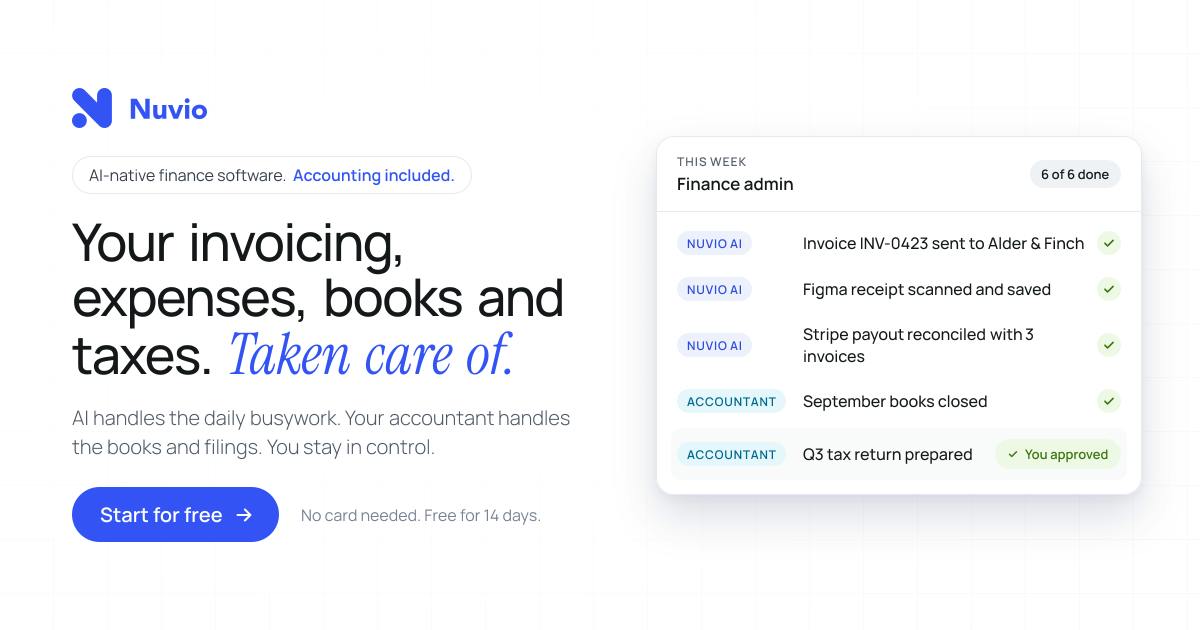
Nuvio 5.0 hands financial admin to AI agents, opens ChatGPT/Claude access, and keeps accountants for tax.
Nuvio 5.0 launched on Product Hunt, pitching the delegation of invoicing, expenses, reconciliation, and other financial admin work to AI agents. Users can use the built-in assistant or connect ChatGPT, Claude, or a self-built agent, positioning the product as an open financial execution layer rather than a closed SaaS. New bookkeeping and tax services are provided by accountants familiar with the system, retaining human involvement in high-risk compliance areas and forming a pragmatic human-AI division of labor. It received 88 upvotes and 7 comments on launch day, ranking 8th—community interest is emerging but discussion is still early. The accuracy, auditability, and permission boundaries of agent execution are key open questions for delivering on the product's promise, and this direction is worth following for small teams seeking a lean finance team.
Financial admin work—invoicing, expense reporting, reconciliation—often consumes a large share of small business owners' time. Nuvio 5.0's pitch on Product Hunt is to hand this work entirely to AI agents. Users can have Nuvio's built-in assistant complete tasks directly, or connect ChatGPT, Claude, or a self-built AI agent to operate it. The product received 88 upvotes and 7 comments on launch day, ranking 8th, placing it at the intersection of Fintech, AI, and accounting.
From manual operation to "let the agent do it"
The core selling point of Nuvio 5.0 is "Hand your financial admin to your AI agent." Traditional financial tools provide an interface where users click buttons themselves; Nuvio opens its execution layer to AI agents. Users no longer need to fill out forms step by step—instead, they express intent in natural language, and the agent calls underlying capabilities to complete actions like invoicing, recording expenses, and reconciling accounts.
The significance of this shift lies in the migration of the interaction entry point. Financial software used to compete on feature lists and interface efficiency; now it competes on "whether the agent can reliably execute on your behalf." Nuvio supports both a built-in assistant and external agents (ChatGPT, Claude, self-built agents), indicating it positions itself as a callable financial execution layer rather than yet another closed SaaS dashboard.
AI Agent refers to an intelligent system capable of perceiving its environment, making autonomous decisions, and calling tools to execute multi-step tasks, distinct from conversational models that only generate text. In financial scenarios, an agent can parse users' natural language instructions, break them down into specific operations such as invoicing and bookkeeping, and complete them by calling underlying services via API. Its core capabilities include task planning, tool invocation, and result validation. Current mainstream implementations rely on interface standards such as large-model Function Calling or the Model Context Protocol (MCP), which allow external systems to be securely exposed to agents. Nuvio's allowance for connecting external agents like ChatGPT and Claude is precisely based on such standardized invocation mechanisms, encapsulating its financial capabilities as a toolset callable by agents.
Three automation scenarios and an open ecosystem
Nuvio 5.0 explicitly lists three automation capabilities: invoicing, expenses, and reconciliation. These three happen to be the most repetitive and rule-based parts of financial admin, and the most suitable for agent intervention—they have clear inputs and outputs, verifiable results, and relatively fixed business rules.
More noteworthy is the ecosystem choice. The product does not lock users into its own assistant but allows connections to ChatGPT, Claude, or users' own AI agents. For developers and small teams, this means Nuvio can be embedded into existing automation workflows, rather than learning a whole new system just for financial features. Considering that most similar Fintech products on Product Hunt still sell "AI-assisted" as their pitch, Nuvio's direct opening of agent access is closer to an "AI-native" approach.
Reconciliation is a key step in financial admin, referring to comparing a company's internal accounts against external data such as bank statements and payment platform records transaction by transaction, ensuring amounts, dates, and counterparties match, and identifying the reasons for discrepancies. Traditional reconciliation relies on manually exporting statements and matching in Excel—time-consuming and error-prone. Automated reconciliation completes matching and anomaly flagging through rule engines or AI agents, but must handle complexities such as multi-source data format differences, partial matches, and timing gaps. For agents, reconciliation results are highly verifiable, making it a suitable entry scenario, but its accuracy depends heavily on the stability of data interfaces and the completeness of exception-handling logic—technical details worth watching when evaluating products like Nuvio.
New bookkeeping and tax services: the boundary of human-AI collaboration
Another update in Nuvio 5.0 is the introduction of bookkeeping and tax services, provided by "accountants already familiar with Nuvio." This detail is telling: on one hand, the product hands routine financial admin to AI agents; on the other, it retains human experts for high-risk, compliance-heavy areas like bookkeeping and tax.
This effectively draws a pragmatic division of labor. Errors in invoicing, expense reporting, and reconciliation can be quickly corrected, but tax filing and accounting involve compliance liability, and fully delegating them to agents is unrealistic at this stage. Nuvio's approach is to have accountants work within the system, able to read data generated by agents while being accountable for results. For users, this lowers the psychological barrier to "handing everything to AI"; for the product, it's a monetization path from tool to service.
Auditability is crucial in financial automation, referring to a system's ability to fully record the source, time, executor (human or agent), and before/after states of every operation for later tracing and compliance review. When AI agents perform actions like invoicing and bookkeeping, without clear audit logs, it becomes difficult to assign responsibility if errors or disputes arise. For scenarios involving external agents (such as ChatGPT, Claude), the agent's call chain and authorization scope must also be recorded. Nuvio's retention of accountants for high-risk steps partly compensates for the shortcomings of pure agent operations in audit traceability. When evaluating such products, attention should be paid to whether they provide operation logs, version history, and permission isolation mechanisms.
Opportunities and open questions
From a positioning standpoint, Nuvio 5.0 captures two trends: AI agents are moving from conversation to execution, and finance is one of the easiest scenarios for execution-oriented agents to land; at the same time, demand among small businesses for "lean finance teams" persists. The result of 88 upvotes and 8th place shows it has attracted attention, but 7 comments also suggest community discussion is still early.
The questions to watch are equally obvious. How is the accuracy and auditability of agent-executed financial operations guaranteed? When ChatGPT or Claude calls Nuvio via API, how are permission boundaries and data security defined? Is behavioral consistency between the built-in assistant and external agents ensured? These are key to whether the promise of "handing the back office to AI" can be delivered. The information disclosed so far centers on capability lists; specific implementation mechanisms and error-handling strategies await more public information.
For small teams evaluating financial automation solutions, Nuvio 5.0 offers a direction worth following: not buying a smarter bookkeeping app, but letting the AI agent you already use take over financial actions directly. If executed well, this approach would change how financial software is used, not just its feature list.
One-line Summary
Nuvio 5.0 hands financial admin to AI agents, opens access to ChatGPT and Claude, and keeps accountants for tax.
Paragraph Summary
Nuvio 5.0 launched on Product Hunt, pitching the delegation of invoicing, expenses, reconciliation, and other financial admin work to AI agents. Users can use the built-in assistant or connect ChatGPT, Claude, or a self-built agent, positioning the product as an open financial execution layer rather than a closed SaaS. New bookkeeping and tax services are provided by accountants familiar with the system, retaining human involvement in high-risk compliance areas and forming a pragmatic human-AI division of labor. It received 88 upvotes and 7 comments on launch day, ranking 8th—community interest is emerging but discussion is still early. The accuracy, auditability, and permission boundaries of agent execution are key open questions for delivering on the product's promise, and this direction is worth following for small teams seeking a lean finance team.
Related articles

The Trust Ladder for AI Coding Agents: Install the Brakes Before Building the Software Factory
How do AI coding agents move from assistants to software factories? A developer deep-dive into the trust ladder, verification-first brakes, three-layer anti-cheating, and why human taste remains irreplaceable.
OpenShell: Putting a Security Leash on AI Agents with Kernel-Level Policies
OpenShell offers a secure private runtime for autonomous AI agents: per-agent sandboxes, kernel-level file and syscall restrictions, network egress policy checks, credentials never landing in agents, and policy changes backed by formal verification and human review—deployable locally or on Kubernetes with one command.

NVIDIA OpenShell: Putting the Brakes on AI Agents
NVIDIA open-sources OpenShell, an Agent security platform using an OS-level sandbox and the Sentry network chip as dual defenses to cage AI Agents. This article breaks down the technical principles, adversarial test results, and real shortcomings of the Alpha stage.