OpenShell: Putting a Security Leash on AI Agents with Kernel-Level Policies
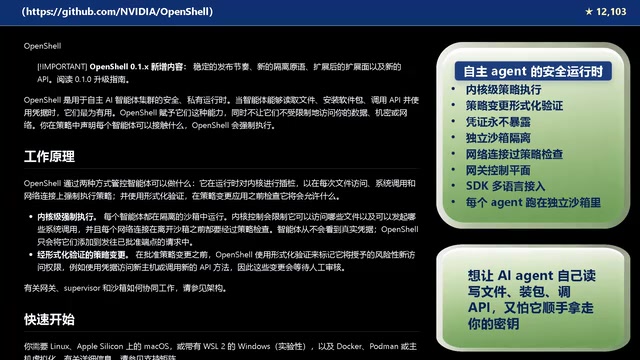
OpenShell uses sandboxes, kernel restrictions, and credential injection to keep autonomous agents within a policy boundary.
OpenShell is a secure private runtime for autonomous agent clusters. Its core idea is not to reduce agent capabilities but to insert a policy boundary between capabilities and assets. Each agent runs in its own sandbox with kernel-level controls restricting file access and system calls; network connections must pass policy checks before leaving the sandbox; keys are never given to agents but injected at the request layer. Policy changes undergo formal verification to flag new high-risk access before human review, making privilege creep auditable. It deploys with a single command, runs locally or on Kubernetes, and offers Python, TypeScript, Go, and Rust SDKs. The real challenge is balancing policy granularity: too loose and the sandbox is useless; too tight and agents are constantly blocked, with human review becoming a bottleneck.
AI agents are getting more capable, and that's exactly what keeps people up at night. Letting them read and write files, install dependencies, and call APIs is a real productivity boost—but once you grant full permissions, you're also handing over your keys, data, and network egress. OpenShell, featured in the GitHub roundup, aims to solve this exact tension: keep the capabilities, but fence off data, credentials, and network access within a policy boundary.
Full permissions are a productivity shortcut and a risk multiplier
Dropping an AI agent directly into your dev environment is essentially wiring up an always-on "auto-executor" to your working directory. It can read and write files, install packages, and make network requests on its own—actions that are productivity during normal development but become channels for data exfiltration and credential leakage when things go wrong.
OpenShell positions itself as a secure, private runtime for these autonomous agent clusters. It doesn't narrow what agents can do; it inserts a policy boundary between capabilities and assets. What's notable about this approach is that security isn't achieved by "granting fewer permissions" but by "keeping things under control even when permissions are granted."
One sandbox per agent, with the kernel as the backstop for system calls
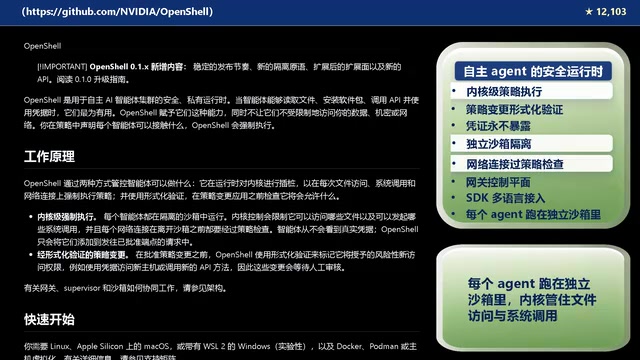
OpenShell runs each agent in its own sandbox, using kernel-level controls to restrict file access and system calls. In other words, policy constraints are pushed down to the operating system level rather than relying on application-layer "gentlemen's agreements."
This matters especially for multi-agent clusters. When multiple agents work in parallel, a single unauthorized file read or process call can contaminate the entire pipeline. Sandbox isolation plus kernel-level restrictions keep the blast radius of any single failure contained within one agent.
System calls (syscalls) are the sole entry point through which user-space programs request kernel services—file I/O, network send/receive, and process creation all ultimately pass through them. Kernel-level restrictions typically use mechanisms like seccomp, Landlock, and cgroups to intercept system calls at the kernel boundary according to allowlists or rules, making them much harder to bypass than application-layer hooks—application-layer restrictions can be circumvented by libraries, subprocesses, or language runtimes, whereas syscall filtering treats all code inside the sandbox equally. The cost is that policies need to be tuned syscall-family by syscall-family: too permissive and isolation fails, too restrictive and common operations like package installs, compilation, and dynamic linking will break—which is the most labor-intensive part of getting any sandbox solution into production.
Network egress goes through policy first, credentials never reach the agent
Network access is another high-risk surface. OpenShell requires every network connection to pass a policy check before leaving the sandbox. That is, an agent can't just get a pass and roam the internet freely—every request gets scrutinized.
Credential handling is even more thorough: keys are never handed to the agent, only injected into requests headed to the network or endpoints. So even if an agent is manipulated by a prompt injection attack, it has no credentials on hand to leak directly. This "credentials never land in the agent" design gets closer to the root cause than simply restricting access scope.
Prompt injection refers to attackers hiding malicious instructions in web pages, files, or tool outputs that the agent reads, luring the model away from its original task to execute the attacker's intent—for example, sending keys from environment variables to an external address. Traditional defenses rely on the model to "recognize and refuse," but models are unreliable at judging embedded text. The credential injection approach moves keys out of the agent's reach: the agent only initiates the request, and a proxy at the boundary attaches credentials during forwarding, so the model can neither see the keys nor exfiltrate them directly. This design shifts security from "depending on model behavior" to "depending on architectural constraints," making it more robust against injection-type attacks.
Policy changes go through formal verification and human review
Permission policies themselves can become a risk source. OpenShell runs formal verification on policy changes first, flagging any newly introduced high-risk access, then waits for human review.
The value of this process is turning "permission creep" into an auditable event. When an agent needs to install a package or call an API, the policy change is explicitly surfaced rather than quietly expanding privileges. For teams that need compliance review, this mechanism with verification and human checkpoints is easier to operationalize than reviewing logs after the fact.
Formal verification means using mathematical methods to model a system or policy and prove that it satisfies given properties, rather than relying on test sampling alone. In the context of permission policies, it can determine whether a new rule introduces unintended access paths—for example, whether a network rule indirectly opens access to a sensitive endpoint, or whether a combination of rules creates a policy conflict or coverage gap. Compared to manually reviewing a diff, formal methods can systematically enumerate rule interactions and catch implicit privilege escalation that's easy to miss by eye. Its limitation is that it requires a sufficiently precise model of the policy language and system behavior; modeling gaps directly undermine the credibility of the conclusions.
Deployment and integration: one command, multi-language SDKs
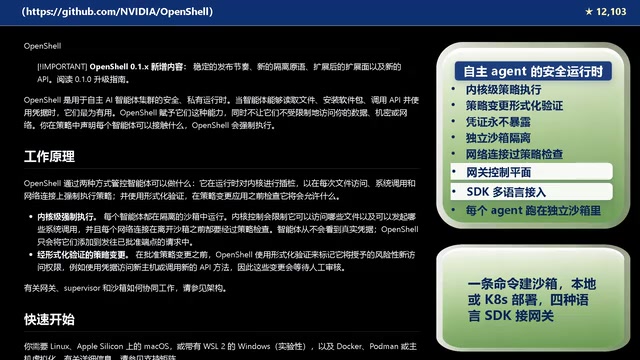
Adoption cost is often the barrier for security solutions. OpenShell supports setting up a sandbox with a single command, running locally or on Kubernetes; Python, TypeScript, Go, and Rust can all connect to the gateway via SDKs.
For teams already running K8s, this means sandboxes can be folded into existing orchestration. For local development, a one-command start lowers the cost of experimentation. Multi-language SDKs mean integration doesn't have to be tied to a single tech stack.
Where should this boundary sit?
OpenShell's trade-off is clear: security not by cutting agent capabilities, but by containing risk within a boundary through runtime isolation, kernel-level restrictions, egress policies, and credential injection.
The scenarios it fits are equally clear—if an agent is really going to do hands-on work, put it in OpenShell. What genuinely needs weighing is policy granularity: too loose and the sandbox is meaningless; too tight and the agent keeps hitting walls, with human review becoming a bottleneck. Whether formal verification and human review mechanisms can strike this balance determines its usability in real clusters.
(This roundup also previewed projects including a code knowledge graph tool, Firebase SDK for Apple platforms, and an open-source workplace AI platform with citations—stay tuned for follow-ups.)
One-line Summary
OpenShell uses sandboxes, kernel restrictions, and credential injection to keep autonomous agents within a policy boundary.
Paragraph Summary
OpenShell is a secure private runtime for autonomous agent clusters. Its core idea is not to reduce agent capabilities but to insert a policy boundary between capabilities and assets. Each agent runs in its own sandbox with kernel-level controls restricting file access and system calls; network connections must pass policy checks before leaving the sandbox; keys are never given to agents but injected at the request layer. Policy changes undergo formal verification to flag new high-risk access before human review, making privilege creep auditable. It deploys with a single command, runs locally or on Kubernetes, and offers Python, TypeScript, Go, and Rust SDKs. The article notes the real challenge is balancing policy granularity: too loose and the sandbox is useless; too tight and agents are constantly blocked, with human review becoming a bottleneck.
Related articles
27-Model Code-to-Video Test: Claude Opus 5.5 Takes the Crown, But the Real Value King Is Someone Else
Artificial Analysis' Code2Video Benchmark has 27 models write HTML videos from pure code: Claude Opus 5.5 tops at 1536, while GPT 6.1 ranks fourth at ~1/10 the cost.
Writing Code with Claude Code Means Passing a Network Admin Exam First: The Pain of Configuring AI Programming Tools
Claude Code's real barrier isn't coding ability but account, network, and regional configuration. Why AI programming tools are painful to set up — and how developers should choose pragmatically.
Jev in Practice: A Decision Model That Replaces Token-by-Token Decoding with a Single Prefill
Breaking down Jev's inference paradigm: skip token-by-token decoding and use a single prefill forward pass to output choices, ordinal scores, and booleans. Comparing encoder and decoder paths, multi-question mask design, duplicate token pitfalls, and RLCD with GRPO for probability calibration training.