Dopamine Jailbreak Tool: Complete Guide to iOS 15-26 Semi-Untethered Jailbreak

Dopamine is an open-source semi-untethered jailbreak tool supporting iOS 15 through iOS 26.
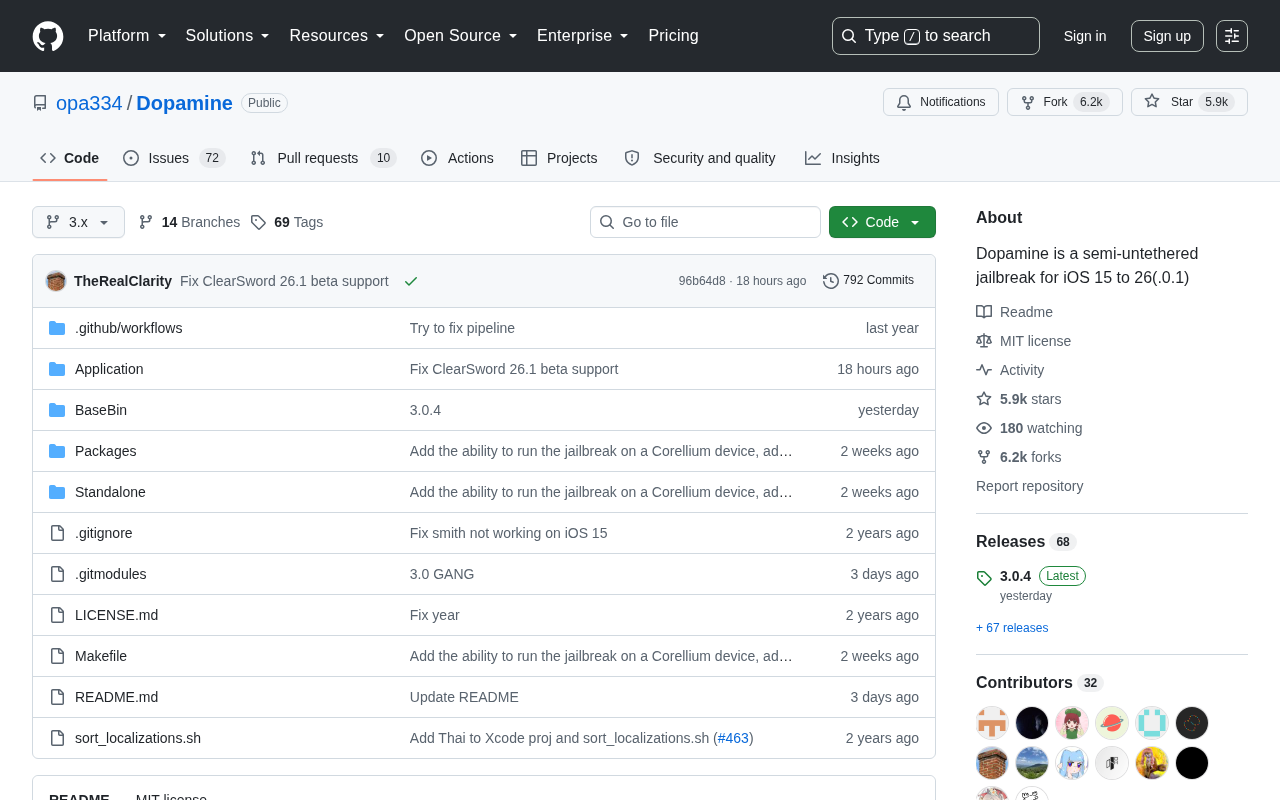
Dopamine is a popular open-source semi-untethered jailbreak tool led by developer opa334, supporting iOS 15 through iOS 26(.0.1). Written in C, it exploits kernel vulnerabilities to temporarily gain system privileges without requiring a computer connection after reboot. With 5,888 GitHub Stars and 6,000+ Forks, it represents the state of the art in modern iOS jailbreaking while highlighting both the possibilities and risks of bypassing Apple's security mechanisms.
Introduction to Dopamine Jailbreak Tool
In an era where Apple continuously fortifies iOS security defenses, jailbreak developers persist in a long-running technical cat-and-mouse game with the company. The open-source project Dopamine, led by renowned jailbreak developer opa334, stands as a hallmark achievement in this ongoing battle. The project has earned 5,888 Stars and over 6,000 Forks on GitHub, with 95 new Stars in a single day—a clear testament to its community momentum.
Dopamine is a semi-untethered jailbreak tool targeting iOS 15 through iOS 26(.0.1). Its existence gives users who wish to break free from Apple's walled garden and gain full control over their devices a viable option once again.
What Is a Semi-Untethered Jailbreak? Comparing Three Jailbreak Types
For readers unfamiliar with jailbreak terminology, understanding the different types is essential. Jailbreaks generally fall into three categories: untethered, tethered, and semi-untethered.
Untethered Jailbreak
The jailbreak state persists after a device reboot with no additional action required. This offers the best user experience but presents the highest technical difficulty. Achieving an untethered jailbreak requires persistently writing exploit code into the device's boot chain so it executes automatically on every startup—this demands bypassing verification steps in the Secure Boot chain, something nearly impossible under Apple's current hardware security architecture.
Tethered Jailbreak
The device must be connected to a computer and re-booted using specialized tools after every restart; otherwise, it cannot boot normally. This makes daily use extremely inconvenient. These jailbreaks typically rely on BootROM exploits in DFU mode (such as the early checkm8 exploit), because modified boot images cannot pass Apple's signature verification, requiring external tools to re-inject at the low level each time.
Semi-Untethered Jailbreak
This is the approach Dopamine uses. The jailbreak environment becomes inactive after a reboot, but users don't need to connect to a computer—they simply re-run the jailbreak app on the device to restore the jailbreak state. The technical principle involves an application installed on the device that triggers a kernel exploit chain from user space, temporarily obtains kernel read/write privileges to modify system security policies, and thereby reactivates the jailbreak environment.
Dopamine's choice of the semi-untethered route represents a pragmatic balance between convenience and technical feasibility. With Apple introducing hardware-level security mechanisms like PAC (Pointer Authentication) starting from A12 chips onward, the difficulty of achieving an untethered jailbreak has increased dramatically, making the semi-untethered approach the mainstream choice for modern jailbreak tools.
Technical Background on PAC: PAC (Pointer Authentication Codes) is a security feature in the ARMv8.3 architecture extension that uses unused high-order bits in pointers to store cryptographic signatures, verifying pointer integrity during function returns or dereferences. This means that even if an attacker tampers with function pointers in memory through a vulnerability, the system can detect the anomaly before execution and terminate the process. Additionally, Apple introduced PPL (Page Protection Layer) in A15 and later chips, isolating kernel page table management to a higher privilege level, further increasing the difficulty of persisting jailbreak code within the kernel. It is precisely these layered hardware defenses that make untethered jailbreaks virtually impossible on modern devices.
iOS Version Support Range
One of Dopamine's most impressive aspects is its broad iOS version support—spanning from iOS 15 all the way to iOS 26(.0.1). This means whether users have older devices or relatively newer models, they have a chance to jailbreak through Dopamine.

Behind this cross-version compatibility lies the development team's deep exploration and adaptation of kernel vulnerabilities across different system versions. The ability to support systems as new as iOS 26 demonstrates significant investment in maintaining and updating exploit chains—particularly remarkable given the increasing scarcity of jailbreak tools today.
Technical Details of Exploit Chains: Modern iOS jailbreaks typically require combining multiple vulnerabilities to form a complete exploit chain. A typical chain includes: first, a user-space code execution vulnerability (such as a WebKit browser engine bug or App sandbox escape); next, a kernel information disclosure vulnerability (used to bypass KASLR—Kernel Address Space Layout Randomization—where Apple loads the kernel at a random address on each boot, requiring attackers to first leak the real address to construct an effective payload); then a kernel code execution or arbitrary read/write vulnerability; and finally, techniques to bypass hardware mitigations like KTRR/AMCC (Kernel Text Read-Only Region protection). Dopamine's support for the broad range from iOS 15 to iOS 26 means the development team must maintain different exploit paths for each major system version, since Apple patches known vulnerabilities and introduces new defenses with every system update. This continuous vulnerability research and adaptation workload is enormous, reflecting the team's deep capabilities in reverse engineering and vulnerability discovery.
Technical Implementation: C Language and Open-Source Collaboration
Dopamine's core code is written in C, which aligns perfectly with the technical requirements of jailbreak tools. Jailbreaking fundamentally involves deep intervention in the operating system kernel, requiring direct memory manipulation and low-level system interface calls—C's advantages in performance and hardware control make it the natural choice.
Why C: iOS's XNU kernel itself is written in C with some C++, so developing jailbreak tools in C allows the most direct manipulation of kernel data structures. Operations performed during jailbreaking include: modifying a process's credential structure to obtain root privileges, manipulating task ports (Mach ports) for cross-process memory access, and modifying sandbox profiles to lift application restrictions. All these operations involve precise memory offset calculations and raw pointer manipulation. C provides the necessary low-level control without introducing the overhead and unpredictability of higher-level language runtimes. Additionally, jailbreak tools need to interact with the IOKit driver framework to trigger kernel vulnerabilities, and these interfaces' native bindings are in C/Objective-C form.
As an open-source project, Dopamine makes its technical implementation fully transparent—both as a contribution to the community and as an invitation for scrutiny and collaboration from developers worldwide. The over 6,000 Forks indicate an active ecosystem of secondary development and research. For security researchers, such an open-source codebase serves as invaluable learning material for studying iOS security mechanisms.
Community Significance of Open-Source Jailbreaking: Dopamine's open-source model continues the fine tradition of the iOS jailbreak community. Early jailbreak tools like redsn0w and evasi0n were mostly closed-source, but later projects increasingly adopted the open-source approach. This trend is closely tied to the security research community's culture—open discussion of exploitation techniques drives progress for both attackers and defenders. The 6,000+ Forks on GitHub mean not only that many developers are porting and improving upon Dopamine, but also that security institutions can audit the code to confirm it contains no malicious backdoors—crucial for building user trust. Notably, vulnerability research from jailbreak tools also provides positive feedback for Apple's security improvements—many vulnerabilities used in jailbreaks are eventually patched by Apple, objectively raising the security level of the entire iOS ecosystem.
Value and Risk Assessment of Jailbreaking
Jailbreaking opens up numerous possibilities for users: installing tweaks from outside the official App Store (through third-party package managers like Cydia and Sileo), deeply customizing the system interface, accessing the file system, and running tools that require root privileges. For tech enthusiasts and developers, it opens a door to complete device control.
However, jailbreaking also carries significant risks:
- Security Risks: Jailbreaking bypasses Apple's sandbox mechanism, reducing overall system security and making devices more vulnerable to malware attacks. Apple's Sandbox mechanism is implemented based on TrustedBSD's Mandatory Access Control (MAC) framework, defining strict permission boundaries for each app. Every application runs in an isolated container directory, only accessing its own data and unable to read contents from other applications or critical system directories. Sandbox policies are enforced through kernel extensions, covering file system access, network communication, inter-process communication (IPC), hardware resource usage, and more. After bypassing the sandbox through jailbreaking, malware can freely access contacts, photos, passwords and certificates stored in the Keychain, and other sensitive data—this is the fundamental reason security risks increase significantly after jailbreaking.
- Stability Issues: Third-party tweak quality varies widely, potentially causing system crashes or abnormal battery drain. Jailbreak tweaks typically modify system process behavior through dynamic library injection (using method swizzling techniques from frameworks like Substrate or Substitute), and different tweaks may conflict with each other.
- Warranty Voiding: Jailbreaking typically voids Apple's official warranty service. While factory resets can eliminate jailbreak traces, Apple's diagnostic systems may detect anomalies.
- System Update Limitations: Performing OTA system updates after jailbreaking may cause compatibility issues or even brick the device (render it unable to boot). Users typically need to wait for jailbreak tool updates before safely upgrading their system.
Therefore, regular users should carefully weigh the pros and cons before deciding to jailbreak, proceeding only with clear needs and a thorough understanding of the risks.
Conclusion: Is Dopamine Worth Your Attention?
Dopamine's continued updates and broad version support prove that the iOS jailbreak community remains vibrant and active. Despite Apple's increasingly robust security defenses, developers like opa334 continue pushing technical boundaries, providing choices for users who pursue device freedom.
Whether you're a technical professional looking to deeply study iOS security mechanisms or a power user hoping to break through system limitations, Dopamine is an open-source jailbreak tool worth following. Of course, any jailbreak operation should be undertaken with full awareness of the risks and in compliance with applicable laws and regulations.
Key Takeaways
Related articles

Gemini 4 Interprets 500-Page Chemistry Patents: Boosting Drug Discovery Efficiency
Isomorphic Labs researchers used Gemini 4 to process 500-page chemistry patents and academic papers, generating high-quality reports in 10-15 minutes — work that originally took a month was done in an afternoon.
Apple HomeView First Look: The Prototype of a Smart Home Control Hub
First look at Apple HomeView smart home control interface: thermostat and accessory customization, up to nine camera live feeds, iCloud+ and Apple Intelligence video descriptions, and tiered permissions blocking recording access in guest mode.

Gemini 4 Teaches a Humanoid Robot to Play Cornhole: A Breakthrough in Video Learning and Self-Iteration
Google Gemini 4 Argon's experiment shows a humanoid robot learning Cornhole from a human video, iterating via the Mojoku simulator, and making seven consecutive real-world hits.