Nvidia CEO Jensen Huang Allegedly Linked to "Chinese Spy"? Late-Night Show Roasts Nvidia Chief

Late-night show mocks Jensen Huang over alleged affair with a Chinese spy, raising chip security and governance issues.
The article recaps *Last Week Tonight*'s satirical coverage of the scandal surrounding Nvidia CEO Jensen Huang: the show opens with ABC News interrupting regular programming to announce that Huang resigned over a "Chinese spy scandal." According to *The New York Times*, U.S. intelligence officials determined that a woman named Alice Wong was recruited by the Chinese government to obtain information from Huang and access Nvidia's cutting-edge chip technology; Beijing denies the allegations. Within the following week, affair reports escalated in a chain, involving the woman, an executive who reported directly to Huang, and a second employee. The show delivers political satire through jokes about his leather jacket collection and the president's logic of trust. The article notes that beneath the comedy, the incident touches the intersection of a key AI chip supply-chain figure's private relationships with national security and export controls—and that official statements and investigation developments are what really matter.
An Interrupted Broadcast: How a Tech Scandal Grabbed the Headlines
The latest episode of the American late-night show Last Week Tonight took aim at Nvidia CEO Jensen Huang. The show opened with a dramatic recreation of the moment the news broke: ABC News suddenly interrupted regular programming on Live with Kelly and Mark to air a special report—the Nvidia CEO had resigned over a "Chinese spy scandal." Anchor Diane Macedo announced the news on camera, while viewers at that moment "might have been waiting to get a thyroid ultrasound."
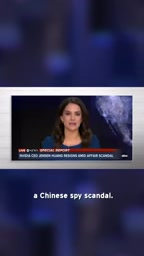
According to The New York Times, U.S. intelligence officials determined that a woman named Alice Wong had been recruited by the Chinese government to obtain information from Huang and gain access to Nvidia's cutting-edge chip technology. Beijing denied the claim. The show joked that President Trump said he had spoken with Huang that day and believed Huang "had no idea she was a spy"—"that's literally how spies work."
From "Spygate" to a String of Affairs: The Plot Accelerates Within a Week
A spy allegation alone would already be sensational enough. But the timeline the show laid out reveals how rapidly things escalated within days: first came reports that Huang had an affair with a woman alleged to be a Chinese spy, then news of a relationship with an Nvidia executive who reported directly to him, and a day later, reports of an affair with a second employee.
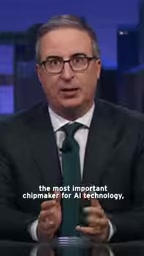
In its signature mocking tone, the show described the 63-year-old CEO: "A midlife-crisis guy who brags about owning 30 to 40 leather jackets and whose closet looks like the costume department of a middle-school production of Grease—and he cheated."
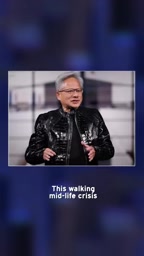
This framing compresses a serious issue involving national security and chip export controls into late-night comedy fodder. But beneath the comedic shell, the core facts point to a genuinely sensitive area: the head of the world's most important AI chip company has been alleged to have personal ties to foreign intelligence operatives.
Chips, Spies, and Trust: Why This Is More Than Gossip
Nvidia is currently the most critical link in the AI computing supply chain. The show explicitly noted that Huang is the co-founder of "by far the most important chipmaker in AI technology." Precisely for this reason, allegations of intelligence infiltration targeting him personally carry significance beyond the private sphere.
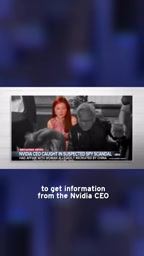
The New York Times report said the woman was recruited to "obtain information from the Nvidia CEO and gain access to the company's cutting-edge chips." This phrasing directly links the affair narrative to export controls and technology security. Beijing denied the allegations, while Trump's statement steered the story in another direction—he chose to believe Huang's claim of "not knowing." The show's jab at this: "He's richer than you, and Trump always believes anyone who's richer than him."
From an industry perspective, the incident touches on an old problem: when a company's technology is regarded as a strategic asset, its executives' personal networks are also scrutinized through an intelligence lens. Nvidia has not yet responded on the show, and the show itself explicitly stated that this was a "very simplified rundown."
Export controls in this context refer to the U.S. export licensing regime for advanced computing chips (especially high-end GPUs used for AI training). Since 2022, the U.S. Commerce Department's Bureau of Industry and Security (BIS) has repeatedly tightened export rules toward China, adding Nvidia's A100, H100, and other chips to the controlled list, and later imposing additional restrictions on downgraded versions made specifically for the Chinese market (such as the A800 and H800). The core logic of this system is that cutting-edge chips are treated as strategic goods, and their flow directly affects military and intelligence capabilities. Therefore, when reports say the woman involved tried to "gain access to the company's cutting-edge chips," the incident escalates from a private scandal to a potential technology-leak risk, touching the intersection of export controls and counterintelligence enforcement.
Corporate governance and executive codes of conduct are key to understanding the fallout. Public companies typically have codes of conduct and conflict-of-interest disclosure mechanisms, but constraints on a CEO's private relationships tend to be weaker. Once an executive is alleged to have ties to foreign intelligence operatives, the board may face pressure to launch an internal investigation, strengthen compliance reviews, or even adjust management; at the same time, U.S. regulators (such as the SEC and BIS) may also inquire about disclosures and export compliance. For a key supply-chain company like Nvidia, any governance instability will be magnified by the market.
Political Satire on Late-Night TV: Turning a Scandal into Public Memory
Last Week Tonight's approach is worth noting. It did not do serious investigative reporting but instead repackaged the news with rapid-fire irony: from the lament that "there are no heroes left," to using the number of leather jackets as a character tag, to mocking the president's logic of trust. This approach brought a story that would normally belong to the business and national security pages into the space of public discussion.
The show's final note landed on Trump's line "Relax, man, our friendship will never be your problem"—used to satirize the tacit understanding between power and wealth. For those following the AI industry, what really matters is not the jokes themselves but how, after this wave of public scrutiny, Nvidia's corporate governance, executive code of conduct, and relationship with U.S. regulators will evolve. The show offers only an entry point; the official statements and investigation developments that follow are what really count.
Related articles

Abnormal Error Rate Spike in Claude Mythos 5.2 and Fable 5.2
Claude Mythos 5.2 and Claude Fable 5.2 show an abnormal spike in request error rates, marked as investigating on the official status page. This article covers the incident overview, practical impact on developers, and recommended responses.

ReAct Runtime Context Trimming: Why Claude Code Acts at 70%
A deep dive into ReAct runtime context trimming: why Claude Code compresses at ~70% usage, why tool calls dominate, why messages must be dropped in pairs, and why codebases don't need RAG.

AI Agent vs LLM: How Cursor and Claude Code Actually Work
An in-depth analysis of the essential difference between AI Agents and LLMs: LLMs generate code suggestions, while Agents modify files and run tests via tool calls. Using a Spring Boot bug fix as an example, it breaks down the workflows, permission control, and verification mechanisms of Cursor and Claude Code.