NVIDIA cuPhoton: Accelerating Black Hole Interferometric Imaging with GPUs

NVIDIA cuPhoton uses GPUs to accelerate the core computation of black hole interferometric imaging, breaking the compute bottleneck of massive baseline data.
Black holes don't emit light; what the Event Horizon Telescope (EHT) captured is accretion disk radiation, with M87*'s observed ring only about 42 microarcseconds across, requiring an Earth-scale virtual interferometer to resolve. The computational burden of interferometric imaging is equally extreme: multi-station pairwise combinations generate massive baseline data, and correlation and inversion must be done for every frequency channel and time step, making traditional CPU pipelines enormously time-consuming. NVIDIA's cuPhoton library GPU-accelerates core operators—baseline correlation and visibility computation, gridding, and imaging inversion—and can be embedded into existing Python/CUDA workflows. The GPU's parallel throughput advantage matches the many independent complex-number and matrix operations in interferometric imaging. The article notes that amid the data growth of next-generation black hole observations, GPU-accelerating the computational pipeline is a necessary step to safeguard scientific output, while open-source library packaging also improves method reproducibility; however, the library only makes computation fast—data cleaning and physical modeling still require the researcher's own oversight.
What Makes Black Hole Imaging So Hard?
Black holes don't emit light themselves—the ring-shaped "photo" we've seen is actually radiation from the blazing accretion disk around the event horizon. The challenge lies in scale: the observed ring of M87* is only about 42 microarcseconds in diameter. Resolving such a tiny structure requires linking Earth-scale telescopes into a virtual giant interferometer—which is exactly what the Event Horizon Telescope (EHT) does.
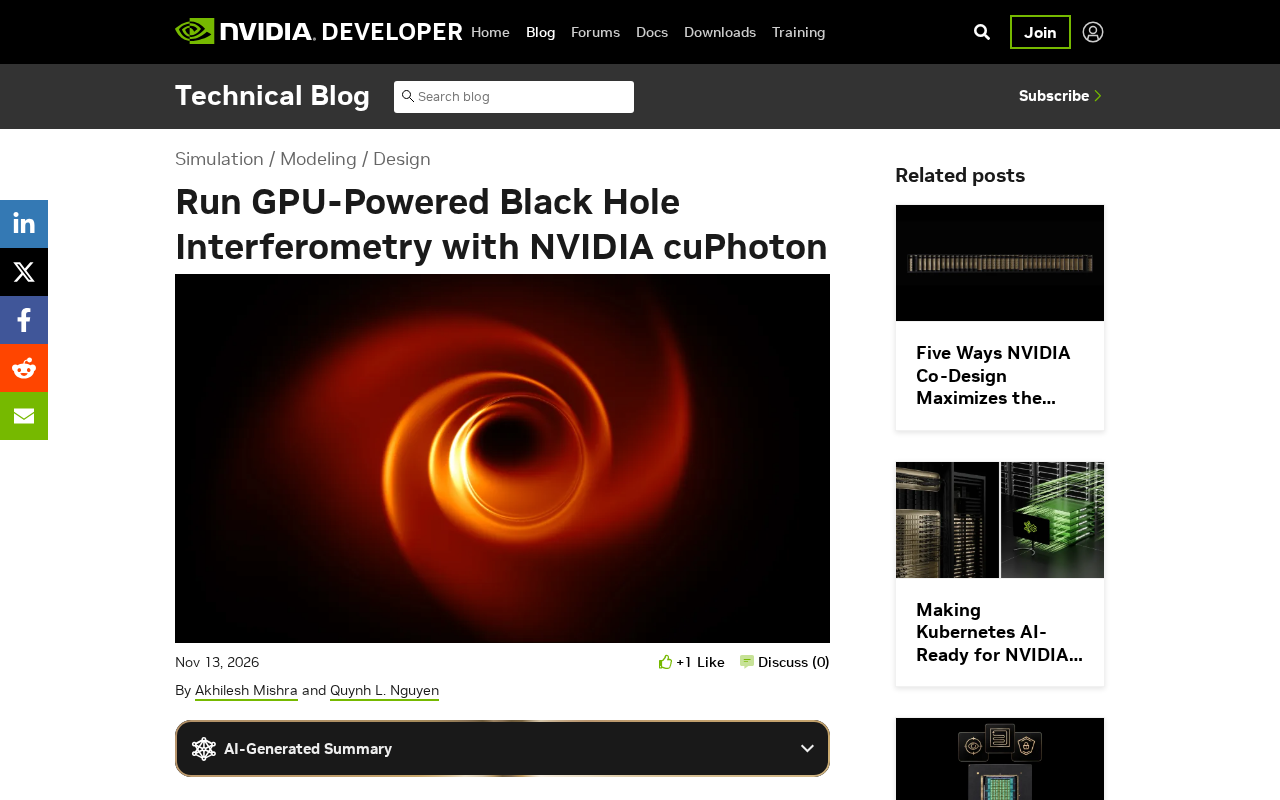
But the computational burden of interferometric imaging is equally extreme. Multiple telescopes paired two by two generate massive amounts of baseline data, and correlation and inversion must be performed for every frequency channel and every time step—traditional CPU pipelines often consume enormous machine hours. NVIDIA's approach is to move this computational chain onto GPUs, using the cuPhoton library to turn the core operators of interferometric imaging into reusable acceleration modules.
Microarcsecond is a unit used in astronomy to measure extremely small angular separations. One microarcsecond equals one-millionth of an arcsecond, and one arcsecond is about 1/3600 of a degree. As an intuitive reference, it roughly corresponds to the angle subtended by a coin on the Moon's surface as seen from Earth. The observed ring of M87* is about 42 microarcseconds in diameter, meaning a telescope with angular resolution better than this scale is needed to resolve it. Traditional single-aperture optical telescopes are limited by the diffraction limit—the larger the aperture, the higher the resolution—but reaching microarcsecond levels would require an Earth-sized aperture, which is engineering-wise impossible. Hence interferometry is essential.
Very Long Baseline Interferometry (VLBI) works on this basic principle: telescopes distributed across different geographic locations are paired up, recording the precise arrival time and phase of the same radio source signal at each station. Through correlation processing, interference fringes corresponding to each baseline (the line connecting two stations) are obtained, which is equivalent to obtaining a virtual telescope with an aperture equal to the baseline length. The longer the baselines and the more of them there are, the richer the sampling on the u-v plane (the spatial frequency plane), and the higher the resolution and fidelity of image reconstruction. The EHT does exactly this: it synchronizes multiple millimeter-wave/submillimeter-wave telescopes around the world to observe the same target, then centrally correlates the data to synthesize an Earth-scale virtual aperture.
What cuPhoton Does
cuPhoton is not a "one-click black hole photo" black box. It breaks down the most compute-intensive stages of interferometric imaging:
- Baseline correlation and visibility computation: Cross-correlation of sampled signals from each station is processed in parallel on the GPU, fully utilizing thousands of parallel cores.
- Gridding and imaging inversion: Sparse, non-uniform visibility data are regularized onto a grid, then the image is reconstructed through iterative optimization—a type of optimization naturally suited to GPU batch computation.
- Integration with the CUDA ecosystem: It can be embedded directly into existing Python/CUDA workflows without rewriting the entire pipeline.
For researchers, this means inversion tasks that previously required queuing can now be iterated faster—parameter tuning, algorithm comparison, and error analysis can all be completed in shorter cycles.
Gridding is a key intermediate step in radio interferometric imaging. The visibility data measured by an interferometer are sparse and non-uniformly distributed in the spatial frequency domain (the u-v plane), whereas the Fast Fourier Transform requires data to lie on a regular grid. Gridding means "smearing" each sample point onto a regular grid according to its coordinates, usually with a compactly supported kernel function (such as an anti-aliasing kernel) to suppress sidelobes and aliasing errors. The choice of gridding kernel and grid density directly affects imaging quality and computational cost, so this step is both a precision problem and a performance problem—parallel GPU implementations can significantly shorten processing time.
Why GPUs Are Especially Suited to This Problem
The mathematical essence of interferometric imaging is a large number of independent complex-number operations and matrix operations, which are naturally parallelizable. CPUs excel at complex control logic, but become a bottleneck when faced with repetitive computation across thousands of baselines; GPUs win on throughput.
This is also the trend in radio astronomy software in recent years: from correlators to imaging inversion, more and more stages are migrating to accelerators. cuPhoton's positioning is to encapsulate these common needs as a library, lowering the barrier for astronomy teams to develop their own GPU code—after all, most radio astronomers are not CUDA engineers.
CUDA is NVIDIA's general-purpose parallel computing platform and programming model, in which developers accelerate computation by writing kernel functions that execute concurrently across thousands of GPU threads. Unlike CPUs, which have a few cores emphasizing low latency and complex branch prediction, GPUs have a large number of simplified cores and excel at performing the same or similar operations on massive amounts of data—so-called data parallelism. Libraries like cuPhoton essentially pre-write operators such as correlation, gridding, and inversion in interferometric imaging as highly optimized CUDA kernels and expose them through a library interface, so researchers unfamiliar with low-level GPU programming can call them directly.
Practical Significance for Astronomical Research
Next-generation black hole observation programs (such as space VLBI and higher-frequency observations) will bring orders of magnitude more data. If imaging inversion remains stuck at CPU-era speeds, the data backlog will directly slow scientific output. Moving the computational pipeline to GPUs is a necessary step to ensure observation capacity and processing capacity improve in tandem.
On the other hand, packaging as an open-source library also makes methods easier to reproduce. When different teams process the same dataset with the same set of accelerated operators, results are more comparable—especially important for research like black hole imaging, where a single image defines the conclusion.
Getting Started
Developers who want to try it can start with the tutorial on the NVIDIA developer blog: prepare a CUDA-capable GPU environment, install cuPhoton and its dependencies, first run through the visibility computation and imaging pipeline on example data, then substitute observational data from their own projects. Note that real interferometric data contain many bad points, calibration errors, and phase problems—the library only makes computation fast; data cleaning and physical modeling still require the researcher's own oversight.
For the intersection of AI and scientific computing, the significance of such tools is that they push "computing infrastructure" down into callable components, allowing researchers to refocus on the problem itself.
Related articles

RePlan-VLA: Progress-Aware Replanning Breakthrough for Long-Horizon Robotic Manipulation
The RePlan-VLA framework converts VLA models' short-horizon capabilities into reliable long-horizon execution through progress-aware adaptive replanning, improving success rates by 21.9% and 10.4% on RoboCasa365 and CALVIN, and validating real-world deployment on a Franka Research 3 robot.

Geometric Bridge Flow Matching: A New Breakthrough in Blind Rigid Motion Correction
Geometric bridge flow matching enables blind rigid motion correction in head CBCT, achieving 37.1 dB PSNR and 0.27 mm RPE on simulated data in ~9.1 minutes, outperforming existing methods.

Google Releases Gemini 4 Hydrogen: 2.5x Faster Without Sacrificing Intelligence
Google releases the lightweight Gemini 4 Hydrogen: 2.5x faster task completion, AA Intelligence Index of 54 beating its flagship sibling, 7.3s single-step on Agent Arena faster than Claude and GPT rivals, four thinking levels with pay-as-you-need pricing, now available across AI Studio and more.