NVIDIA DSX MaxLPS: How to Squeeze Every Watt Out of an AI Factory

NVIDIA MaxLPS uses statistical load staggering to fit more GPUs into existing power budgets without new infrastructure investment.
NVIDIA's DSX MaxLPS (Maximum Load Per Site) technology addresses a persistent pain point in AI data centers: provisioning power based on worst-case peak consumption. Since the probability of all GPUs in a large cluster hitting peak power simultaneously is very low, MaxLPS leverages this statistical staggering to transform power from a static fixed resource into a dynamically reusable elastic one — enabling the same power infrastructure to support more GPU deployments. This requires no additional power investment, relying instead on software and scheduling system coordination to maximize utilization of an existing power budget. The approach reflects a broader shift in AI compute competition from per-chip performance to site-level energy efficiency engineering. Specific implementation details and performance data have not yet been fully disclosed by NVIDIA.
In the operational logic of AI factories, one statement cuts to the core: every watt of unused power is wasted compute capacity. NVIDIA's newly announced DSX MaxLPS (Maximum Load Per Site) technology is built around exactly this premise. It aims to solve a structural problem that has long plagued hyperscale data centers — the massive waste caused by power redundancy.
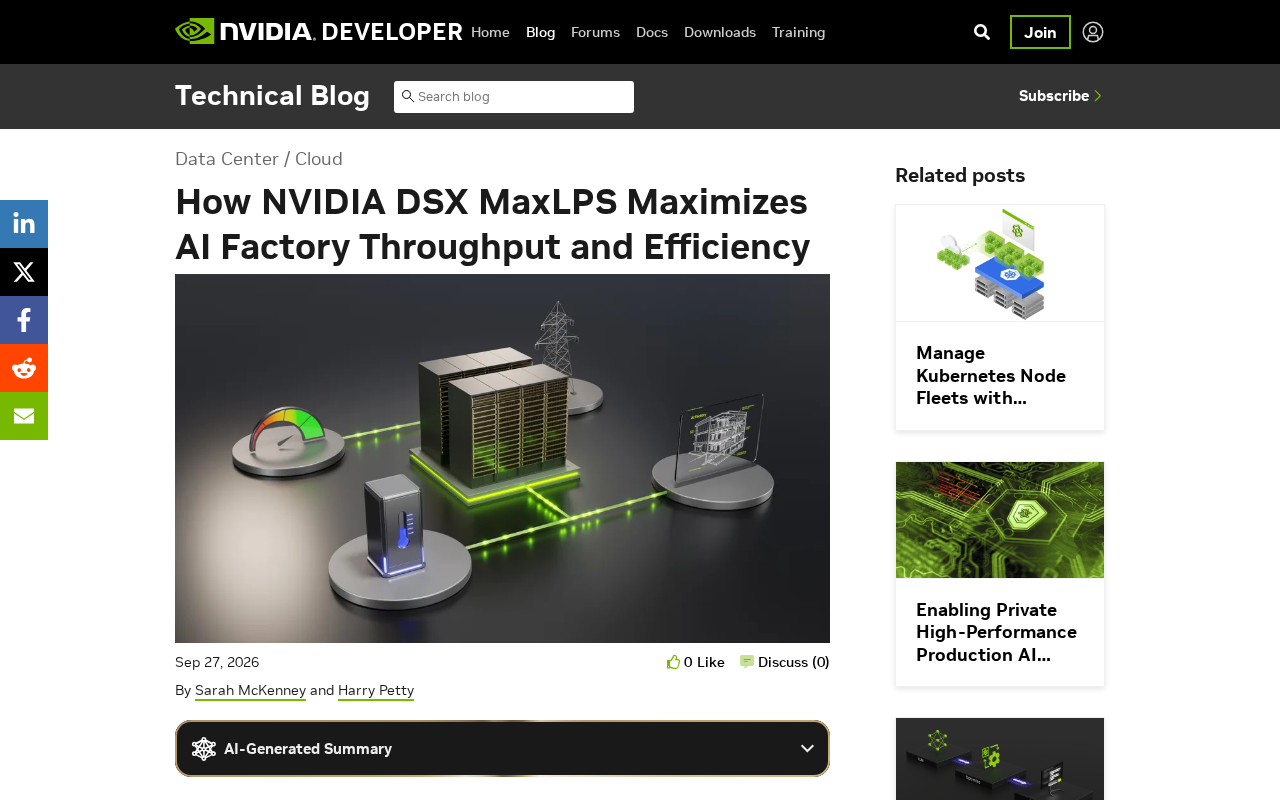
The Power Dilemma in AI Factories
When planning power capacity, traditional data centers typically reserve electricity based on the extreme scenario where all GPUs hit peak power consumption simultaneously. This approach makes sense from a safety and stability standpoint, but it comes at a steep cost: actual power consumption in a facility runs far below its peak the vast majority of the time, leaving enormous amounts of expensive power delivery, cooling, and distribution infrastructure sitting idle.
For AI clusters consuming tens of megawatts, this redundancy isn't just an electricity bill problem — it directly caps the number of GPUs a single site can deploy. In other words, power budget, not physical space, is the real bottleneck for scaling AI factories today. When every GPU is "billed" at peak power draw, the compute capacity a site can accommodate gets artificially suppressed.
The most widely used industry metric for data center power efficiency is PUE (Power Usage Effectiveness), defined as the ratio of total facility power consumption to IT equipment power consumption. The closer PUE is to 1.0, the less power is consumed by auxiliary systems like cooling and power distribution. Leading hyperscale data centers have achieved PUE below 1.1. However, PUE only measures "auxiliary losses" — it doesn't reflect the compute utilization of the IT equipment itself. Even with a perfect PUE, large numbers of idle GPUs still represent enormous waste. MaxLPS targets a different efficiency blind spot that PUE doesn't cover: the gap between reserved IT equipment power and actual utilization. As AI clusters scale into the hundreds of megawatts, this layer of loss has become too significant to ignore in absolute terms.
MaxLPS's Core Approach: From Peak Provisioning to Dynamic Scheduling
The technical premise of MaxLPS is to break the habit of "provisioning for the worst case." In practice, the probability of every GPU in a large-scale training or inference cluster hitting full power consumption at the exact same moment is extremely low — different tasks and different execution phases naturally create staggered load profiles.
MaxLPS exploits this statistical reality through intelligent power management and scheduling mechanisms, enabling a site to accommodate more GPUs within a fixed power capacity. The system continuously monitors overall power consumption levels and dynamically adjusts workloads as they approach the ceiling — converting the power capacity reserved for "extreme moments" into usable compute, without any additional investment in physical power infrastructure.
At its core, this approach transforms power from a static, peak-allocated fixed resource into an elastic resource that can be dynamically reused. For AI factory operators, this means the same power connection and infrastructure investment can support significantly higher throughput.
This approach has a well-established counterpart in electrical engineering: power oversubscription. Internet companies have long applied similar logic to network bandwidth planning — the total port bandwidth of a switch far exceeds its uplink capacity, because statistically, it's impossible for all ports to run at full utilization simultaneously. MaxLPS brings this same statistical multiplexing idea to the power delivery layer of GPU clusters. The key challenge is that unlike network packet drops, exceeding power limits triggers circuit breaker protections or even hardware damage. This means the system needs sufficiently fast and precise power sensing and response capabilities — able to make adjustments within milliseconds to seconds as aggregate load approaches the ceiling, while ensuring no impact on the correctness of running training jobs. NVIDIA's NVLink, GPU drivers, and data center management software stack (such as DCGM) provide the necessary infrastructure for this type of closed-loop control.
The Economics Behind the Efficiency Gains
From an ROI perspective, the MaxLPS value chain is fairly straightforward. Power delivery and cooling infrastructure represent the most expensive, longest-lead-time components of data center construction, and expanding power capacity is often constrained by grid access, regulatory approvals, and civil engineering. When a site's power capacity becomes a hard constraint, fitting more compute into an existing power budget is equivalent to directly improving the output per dollar of capital expenditure.
NVIDIA positions this solution as a key part of AI factory "throughput and efficiency maximization," reflecting an industry shift in focus from per-chip performance toward site-level and system-level energy efficiency engineering. As performance gains from individual GPUs increasingly approach physical limits, improving overall utilization at the cluster and data center scale becomes the new battleground for unlocking compute value.
Implications for AI Infrastructure
MaxLPS reflects a broader trend: the competition for AI compute is expanding from chips themselves to the entire "power-to-compute" conversion chain. Whoever can extract more effective compute from a limited power supply will hold a cost advantage in the AI arms race.
For teams planning or operating AI clusters, this raises several practical considerations: First, power planning should shift from a "peak redundancy" mindset to a "statistical multiplexing" mindset, taking full advantage of natural load staggering. Second, power management needs to be deeply coupled with scheduling systems to achieve dynamic maximization within safe boundaries. Third, efficiency metrics such as throughput-per-watt should become core KPIs for measuring AI factory competitiveness — not just raw scale of compute stacked.
It's worth noting that NVIDIA's current disclosure leans toward concepts and value propositions; specific implementation details, performance data, and supported hardware platforms have yet to be fully published. But the direction it points to — using software intelligence to squeeze every watt of power — clearly signals the next optimization priority for AI infrastructure.
There are currently two main approaches in the industry for deeply coupling power management with scheduling systems. The first is chip-level power capping, which directly limits the TDP ceiling of individual GPUs through drivers or firmware, reducing peak draw in a deterministic manner. The second is cluster-level power-aware scheduling, where resource managers (such as Kubernetes or Slurm) factor current site power levels into task allocation decisions, deliberately staggering high-power workloads over time. The former sacrifices a small amount of per-chip performance in exchange for predictable power draw; the latter exploits natural load staggering between tasks without constraining individual GPU performance. MaxLPS's framing aligns more closely with the latter approach, but in practice the two mechanisms are often used together, forming a multi-layered power safety net.
Related articles

Workbuddy for Absolute Beginners: How a Desktop AI Agent Fits Into Real Workflows
A beginner's guide to the Workbuddy desktop AI agent: installation, claiming credits, file management, and building automated workflows—compared with CodeX for fit and cost, helping professionals shift from AI question-askers to AI managers.

OpenAI's New Agent Stack: Computer Use, Decisions API, and Ultra-Fast Workflows
OpenAI Dev Day unveiled a new agent stack: Computer Use outperforms humans, Decisions API delivers ultra-low-latency classification via Luna, Agents API opens the same Computer Use capabilities, and GPT-6.1 Sol costs only one-seventh of Astra. Core updates, benchmark data, and developer insights.

Liang Wenfeng Open-Sources DeepInfo Inference Framework, Takes On U.S. Ban
DeepSeek open-sources its DeepInfo inference framework after its models, featuring GPU/CPU cross-pipelining, small-model prediction with large-model verification, and full Huawei Ascend and NVIDIA chip support—facing the U.S. federal ban head-on. This article analyzes its significance for AI deployment and open-source strategy.