NVIDIA FLARE Federated Learning in Practice: Scaling Deployments Across Docker, K8s, and Slurm

NVIDIA FLARE decouples FL logic from infrastructure to enable seamless scaling across Docker, K8s, and Slurm.
Federated learning protects privacy by keeping data local, but real-world deployments face highly heterogeneous infrastructure across institutions — Docker containers, Kubernetes clusters, and Slurm HPC schedulers all coexist. NVIDIA's open-source FLARE framework fully decouples training logic and aggregation strategies from the runtime environment, letting the same application code run across all three major orchestration platforms. Docker suits rapid prototyping, Kubernetes provides production-grade elastic scaling, and Slurm lets research institutions run federated tasks directly on existing GPU supercomputing resources — dramatically reducing engineering friction for privacy-sensitive industries like healthcare, finance, and genomics.
Federated Learning (FL) projects often start simply: one server, a handful of clients, each site holding its own dataset. But as projects scale — more participating institutions, larger data volumes, rising compute demands — the original single-machine prototype quickly runs into deployment and orchestration bottlenecks. Smoothly extending federated learning workloads to mainstream infrastructure like Docker, Kubernetes, and Slurm becomes a critical step from experimentation to production. NVIDIA's open-source framework FLARE (Federated Learning Application Runtime Environment) was designed precisely to address this challenge.
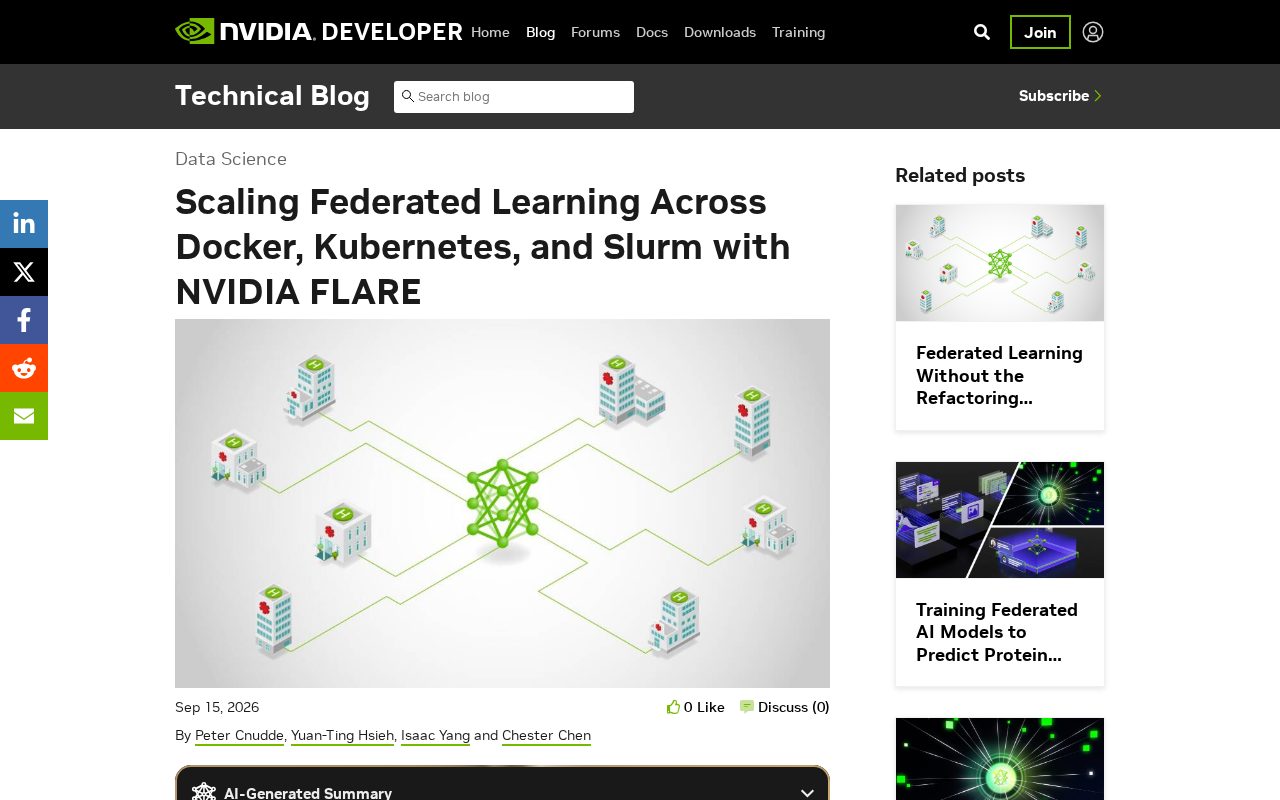
Why Federated Learning Needs Cross-Platform Scalability
The core value of federated learning lies in "keeping data local, moving models instead": participating parties train models locally without uploading raw data, then send model updates to a central server for aggregation. This paradigm is especially critical in industries highly sensitive to data privacy — healthcare, finance, genomics, and beyond.
However, when an FL project moves from proof-of-concept to real-world deployment, the infrastructure across participating sites is often wildly heterogeneous. Some institutions prefer spinning up services quickly with Docker containers; others already run workloads on enterprise-grade Kubernetes clusters; while high-performance computing (HPC) centers and research institutions widely rely on Slurm for job scheduling. A mature federated learning framework must be able to adapt to this heterogeneous environment, rather than requiring all participants to converge on a single technology stack — something that is nearly impossible to achieve in cross-organizational collaboration.
The aggregation process in federated learning typically uses algorithms like FedAvg (Federated Averaging): the server distributes a global model to each client, each party completes several rounds of gradient updates on local data, then uploads model weights or gradients back to the server, which generates a new global model via sample-weighted averaging before starting the next communication round. This "local training → upload updates → global aggregation" loop is easy to implement at small scale, but faces multiple challenges in production: network latency and bandwidth constraints affect communication round efficiency; data volumes and compute capabilities vary wildly across clients (the Non-IID data distribution problem); and Byzantine fault tolerance when participants can drop out at any time. These challenges mean that federated learning frameworks cannot simply replicate the approach of single-machine distributed training — they need to handle asynchronous communication, partial participation, and fault recovery at the orchestration layer.
How FLARE Abstracts the Underlying Infrastructure
NVIDIA FLARE's design philosophy is to decouple federated learning application logic from the underlying runtime environment. Training tasks, aggregation strategies, and other business logic written by developers can be deployed to different orchestration platforms with minimal modification.
Docker: Lightweight Onboarding and Rapid Validation
For early-stage experiments and small-scale sites, Docker offers the lowest barrier to deployment. Packaging FLARE's server and client components as container images allows a federated learning environment to be quickly launched on a single machine or a small number of nodes, making it easy for teams to validate algorithm logic and communication workflows. This tier is well-suited for prototype development and functional testing.
Kubernetes: Elastic Orchestration for Production
As the number of participants grows and higher availability and elastic scaling become necessary, Kubernetes becomes the natural choice. Leveraging K8s's scheduling, service discovery, fault recovery, and resource management capabilities, FLARE's federated learning components can run as standard workloads on enterprise clusters, enabling auto-scaling and rolling updates. For enterprise customers already operating in cloud-native environments, this path seamlessly integrates with existing DevOps workflows.
Slurm: Integrating with High-Performance Computing Clusters
In research and HPC scenarios, Slurm is the dominant job scheduler. Large pools of GPU resources are uniformly managed and queued through Slurm. FLARE supports submitting federated learning tasks as Slurm jobs, enabling research institutions to run distributed training on existing supercomputing infrastructure — making full use of precious GPU compute resources without needing to build a separate cluster for federated learning.
Slurm (Simple Linux Utility for Resource Management) is the most widely used open-source job scheduling system in academia and national supercomputing centers. Users submit sbatch scripts to request CPU/GPU nodes, memory, and runtime; Slurm handles queuing, resource allocation, and reclamation upon job completion. Unlike Kubernetes's always-on service model, Slurm treats "batch jobs" as its fundamental unit — each job has a clear start and end, resources are exclusively held during the job's lifetime and immediately released afterward. This presents unique challenges for federated learning: federated training requires the server and multiple clients to maintain communication within the same time window, while Slurm's queuing mechanism may prevent all parties' jobs from starting simultaneously. FLARE's Slurm support addresses this timing coordination problem — typically through job dependencies or signal files on a shared filesystem to synchronize the startup state of all participants.
The core mechanism behind FLARE's infrastructure decoupling is its "communication abstraction layer" and "Executor" plugin architecture. Federated learning business logic — including local training steps, aggregation algorithms, and privacy-protection mechanisms (such as differential privacy or secure aggregation) — is encapsulated in platform-agnostic Python components. The underlying process launching, network communication, and resource requests are handled by platform-specific adapters. This means the same training code can communicate over a local network inside Docker Compose, discover peers via Services between K8s Pods, or exchange model updates over persistent gRPC connections between Slurm job nodes. This architecture also makes FLARE straightforward to integrate with differential privacy libraries (such as OpenDP) or hardware Trusted Execution Environments (TEE), layering additional privacy guarantees for different deployment environments without modifying the business layer.
The Real-World Value of Heterogeneous Environment Support
Unified support across Docker, Kubernetes, and Slurm means far more than just "technical compatibility." In real cross-institutional federated learning collaborations, different participants typically cannot — and are unwilling to — change their IT infrastructure. Hospital data centers, bank private clouds, and university supercomputing centers each have their own technical standards and security policies.
By absorbing these differences at the framework level, FLARE allows each site to join the same federated learning network using the approach it knows best and that meets its compliance requirements. This dramatically reduces engineering friction in multi-party collaboration, and represents a meaningful step forward in moving federated learning from "feasible in the lab" to "deployable in production."
Implications for Developers and Institutions
For teams evaluating federated learning solutions, FLARE's cross-platform capabilities offer a clear evolutionary path: start with Docker for rapid prototyping, migrate to Kubernetes as scale increases to ensure production stability, and connect to Slurm clusters when large-scale GPU training is needed. Throughout this process, the upper-layer federated learning application logic remains relatively stable, reducing refactoring costs.
As an open-source framework, FLARE also enables the community to build secondary developments and extensions for specific industries and scenarios. For privacy-sensitive industries, the ability to run federated learning securely and scalably on existing infrastructure is precisely the prerequisite for driving this technology toward truly large-scale real-world adoption.
Related articles

Databricks Genie: The AI Analytics Assistant That Tripled a Marketing Team's Data Usage
Databricks' AI analytics assistant Genie tripled marketing team data usage. Discover how this conversational NL2SQL tool lowers the data access barrier and what it means for enterprise AI adoption.

How The Oregon Trail Became a Cultural Icon for Generations
How The Oregon Trail grew from educational software into a multigenerational cultural icon — through classrooms, "You have died of dysentery," and shared childhood memories.

Health Benefits Platform Thatch Hits $1B Valuation as Healthcare Costs Surge
Thatch raises $108M and hits a $1B valuation, backed by a16z, Index Ventures, and General Catalyst, as surging U.S. healthcare costs drive demand for flexible benefits platforms.