NVIDIA Holoscan 5: Enabling Gravity Compensation and Zero-Force Dragging for Robotic Arms

Holoscan 5 uses a low-latency real-time pipeline to support robotic arm gravity compensation and enable "zero-force dragging" interaction.
The article uses the robotic arm "zero-force dragging" demo showcased by NVIDIA Holoscan 5 as an entry point, explaining that robot interaction experience is moving from "pushable" to "weightless." Achieving this effect requires real-time perception of joint posture and loads and millisecond-level computation of compensation torques for each motor, backed by a complete low-latency chain from sensor input to algorithm inference to control output. The value of Holoscan 5 lies in consolidating this real-time pipeline with higher-level AI perception and inference capabilities into the same software stack, enabling robotic arms to more smoothly layer on vision, grasping, and force-control strategies after gravity compensation is achieved. The article also reminds that the compensation feel depends heavily on the accuracy of dynamics parameter identification; the platform provides the computation foundation, and actual performance still needs to be evaluated in conjunction with specific hardware.
From "pushable" to "weightless": a key step in robot interaction experience
Guiding a robotic arm through a trajectory by hand, with the motors outputting precisely the right torque behind the scenes to offset link weight and joint loads—the operator feels almost no resistance, and the machine itself stays stable. This seemingly simple interaction actually pushes the threshold of human-robot collaboration experience to a new level: robots are no longer devices that need to be "programmed," but tools that can be "demonstrated." The NVIDIA developer blog uses exactly this scenario as its entry point when introducing Holoscan 5.
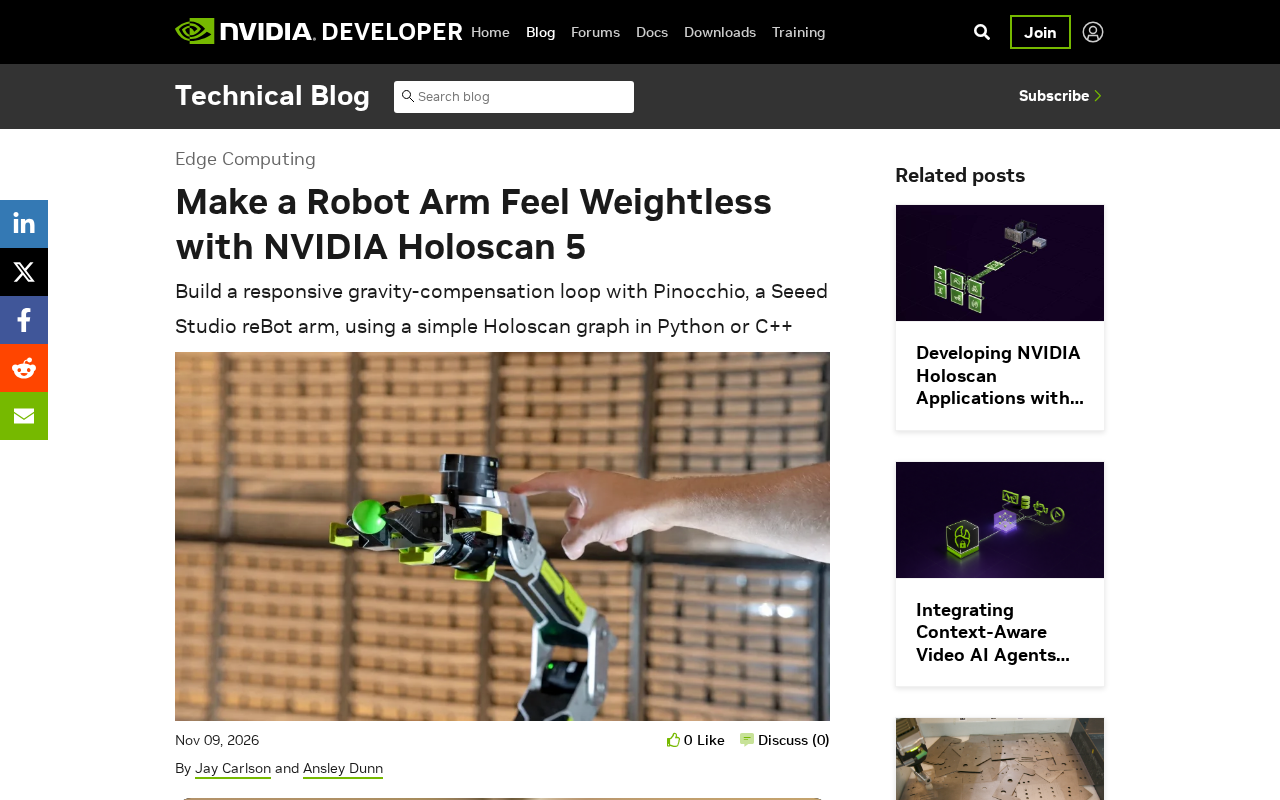
To achieve "zero-force dragging," a robotic arm needs to know its own posture and the loads borne by each joint in real time, and calculate how much force each motor should output within milliseconds. Behind this is a complete real-time perception–computation–control chain, which is precisely the scenario that edge AI computing platforms like Holoscan aim to cover.
What Holoscan 5 does in this scenario
The real-time pipeline is the prerequisite
Holoscan is positioned as a low-latency sensor data processing framework for scenarios such as robotics, medical devices, and industrial inspection. With Holoscan 5, the platform's focus is on making it easier for developers to string "sensor input—algorithm inference—control output" into a pipeline that can run in real time. For robotic arm gravity compensation, the value of this lies in the fact that joint feedback signals need to enter the computation stage at a stable frequency, and algorithm results need to be delivered to the motor drivers within a deterministic time window—any jitter in any segment will immediately degrade the tactile feel in the operator's hand.
What "determinism" in a real-time pipeline means
Real-time does not mean "fast"; it means tasks must be completed within a deterministic time window, which is called determinism. In gravity compensation scenarios, the control loop typically runs at around 1kHz, meaning every 1 millisecond it must complete "read joint encoders—compute dynamics compensation torque—send current commands." If a given cycle is delayed by a few milliseconds due to OS scheduling, memory copies, or PCIe transfers, the operator will feel stuttering or even vibration in their hand. Holoscan adopts a graph-based streaming execution model, combined with technologies such as GPUDirect RDMA that let sensor data bypass host memory and go directly to the GPU, thereby compressing per-cycle jitter. Understanding this is essential to see why "low-latency frameworks" are a necessity—not a nice-to-have performance optimization—for haptic interaction applications.
From gravity compensation to more complex collaboration
Gravity compensation itself is not a new concept; mature dynamics compensation solutions have long existed in the industrial robotics field. What makes Holoscan 5 worth attention is that it brings this type of real-time control task and higher-level AI capabilities into the same compute and software stack: once the robotic arm can already "feel light," layering on visual perception, grasp strategy inference, or force-control policy learning becomes much shorter an engineering path. The interaction of "guiding the robotic arm" emphasized in the original article can be seen as the validation entry point for the entire chain—smooth interaction indicates that the underlying real-time pathway is working.
Basic principles of dynamics compensation and parameter identification
Gravity compensation for robotic arms is typically based on rigid-body dynamics equations: the torque a motor needs to output equals the sum of the gravitational torques of each link, inertial torques, and Coriolis/centrifugal torques, plus a friction compensation term. Among these, the gravity term depends only on joint angles and is the easiest part to model accurately; however, parameters such as mass, center-of-mass position, inertia tensor, and joint friction coefficients often cannot be obtained directly from CAD models and must be estimated through parameter identification experiments—moving the robotic arm along several excitation trajectories, collecting joint angle, velocity, and current data, and fitting the parameter set using least squares or similar methods. Identification errors will directly manifest as "residual weight sensation" in the operator's hand. Therefore, the platform solves the real-time computation and data pathway problem, while the physical accuracy of compensation remains within the domain of control engineering.
Practical implications for developers
For teams building robotics applications, the appeal of this type of platform solution lies in reducing the "reinventing the wheel" portion. Real-time scheduling, sensor integration, GPU-accelerated inference, and interfacing with downstream controllers—these modules that originally had to be assembled separately are consolidated into a single framework, allowing teams to focus their efforts on dynamics models, control strategies, and specific tasks.
It should be noted that the effectiveness of gravity compensation depends heavily on the accuracy of dynamics parameter identification—the more accurately link masses, center-of-mass positions, and joint friction characteristics are calibrated, the closer the compensation feels to "weightlessness." The platform provides the real-time computation foundation, but model quality still depends on the developer's own engineering investment. The original article does not provide specific latency metrics or hardware configurations; actual performance needs to be evaluated in conjunction with the target robotic arm and compute platform.
One-sentence summary
Holoscan 5 puts real-time control and AI perception of robotic arms on the same low-latency pipeline; "zero-force dragging" is the most intuitive demonstration of this pipeline and the starting point toward more complex human-robot collaboration applications.
One-line Summary
Holoscan 5 uses a low-latency real-time pipeline to support robotic arm gravity compensation, enabling "zero-force dragging" interaction.
Paragraph Summary
The article uses the robotic arm "zero-force dragging" demo showcased by NVIDIA Holoscan 5 as an entry point, explaining that robot interaction experience is moving from "pushable" to "weightless." Achieving this effect requires real-time perception of joint posture and loads, and computing compensation torques for each motor within milliseconds, backed by a complete low-latency chain from sensor input to algorithm inference to control output. The value of Holoscan 5 lies in consolidating this real-time pipeline with higher-level AI perception and inference capabilities into the same software stack, enabling robotic arms to more smoothly layer on vision, grasping, and force-control strategies after gravity compensation is achieved. The article also reminds that the compensation feel depends heavily on the accuracy of dynamics parameter identification; the platform provides the computation foundation, and actual performance still needs to be evaluated in conjunction with specific hardware.
Related articles

Abnormal Error Rate Spike in Claude Mythos 5.2 and Fable 5.2
Claude Mythos 5.2 and Claude Fable 5.2 show an abnormal spike in request error rates, marked as investigating on the official status page. This article covers the incident overview, practical impact on developers, and recommended responses.

ReAct Runtime Context Trimming: Why Claude Code Acts at 70%
A deep dive into ReAct runtime context trimming: why Claude Code compresses at ~70% usage, why tool calls dominate, why messages must be dropped in pairs, and why codebases don't need RAG.

AI Agent vs LLM: How Cursor and Claude Code Actually Work
An in-depth analysis of the essential difference between AI Agents and LLMs: LLMs generate code suggestions, while Agents modify files and run tests via tool calls. Using a Spring Boot bug fix as an example, it breaks down the workflows, permission control, and verification mechanisms of Cursor and Claude Code.