NVIDIA Launches OpenShell: Runtime Guardrails for AI Agents

NVIDIA's OpenShell sandbox enforces AI agent safety at the system runtime level, not just through prompt rules.
NVIDIA has released OpenShell, an open-source sandbox tool designed to address a fundamental flaw in AI agent safety: the fragility of prompt-based constraints. Rather than relying on system prompts to tell a model what not to do, OpenShell builds runtime isolation at the OS level, intercepting dangerous actions before they execute. The tool targets locally deployed and open-source agents, filling a security gap in the fragmented open-source ecosystem. Over 100 companies have joined the stack, though OpenAI — committed to centralized, closed-source infrastructure — is absent. This marks a meaningful industry shift from "making models say the right things" to "limiting what models can actually do."
NVIDIA's New Safety Approach: From Prompt Constraints to Runtime Limits
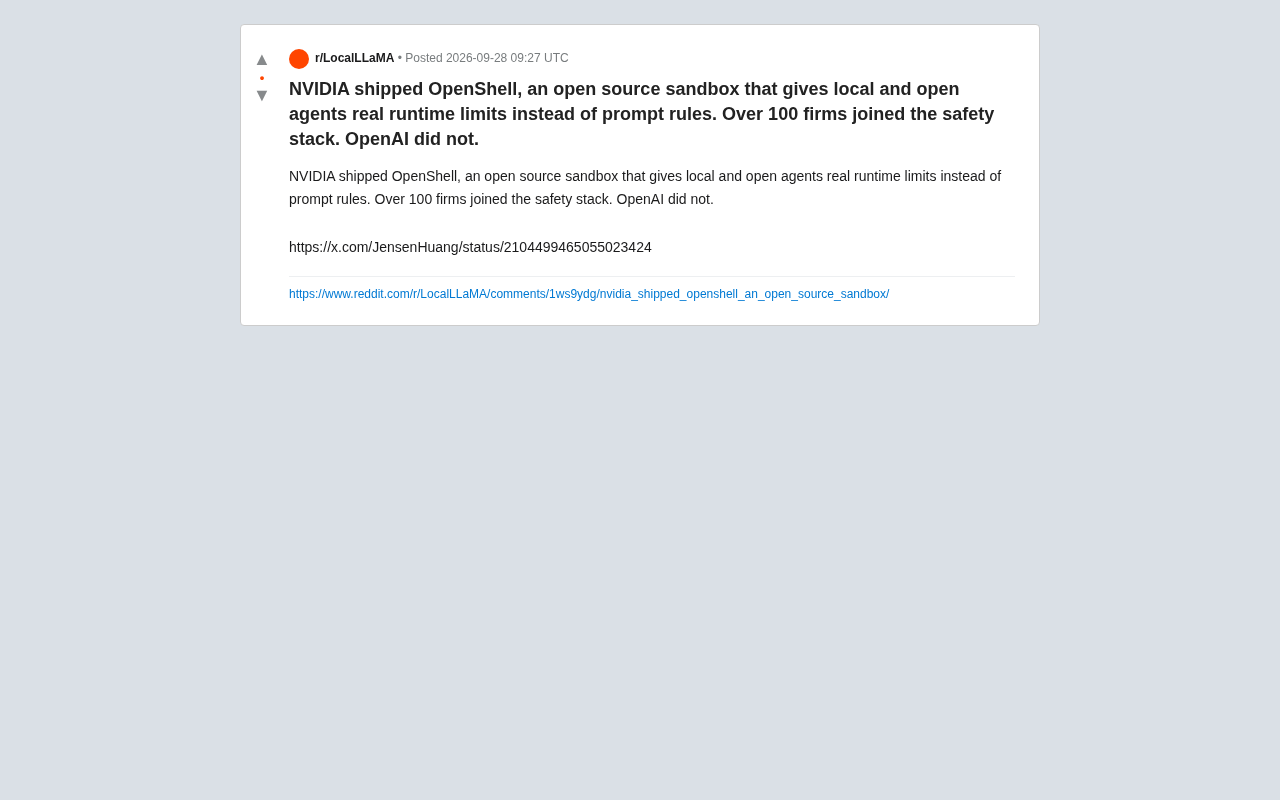
NVIDIA has released an open-source sandbox tool called OpenShell, and its core philosophy targets one of the most fundamental pain points in AI agent safety governance: replacing fragile prompt rules with genuine runtime limits. According to available information, over 100 companies have already joined this security stack — and notably, OpenAI is not among them.
For years, the dominant approach to constraining AI agent behavior has been through system prompts — telling the model what not to do. But this is essentially an honor system. When faced with jailbreak attacks, prompt injection, or unexpected model behavior, rules written in natural language are easily bypassed. OpenShell aims to solve this problem at the architectural level.
What Problem Does OpenShell Solve
As locally deployed and open-source agents become more widespread, an increasing number of AI programs need to perform real operations on user devices or within enterprise environments — reading and writing files, calling APIs, executing code. When agents with these capabilities go rogue, the consequences are far more severe than those of a purely conversational model.
Sandboxed Runtime Isolation
As an open-source sandbox, OpenShell provides agents with a controlled execution environment. Unlike prompt-based solutions that rely on the model "voluntarily complying," runtime limits intercept and constrain the agent's actual behavior at the system level. Even if a model is induced to generate a dangerous instruction, the sandbox layer can intercept it before that instruction is actually executed. This "defense in depth" philosophy is directly in line with classic software security principles like container isolation and least-privilege access.
What is a Sandbox? The sandbox is a classic technique in software security. Its core idea is to run untrusted code or processes in a restricted, isolated environment so that even malicious behavior cannot affect the host system. Browsers (like Chrome) use sandboxes to isolate tabs; operating systems use containers (Docker) to isolate application processes. In the context of AI agents, sandboxing typically enforces resource boundaries at the OS level through mechanisms like syscall filtering, filesystem permission controls, and network access allowlists. This is fundamentally different from relying on model-level self-restraint. The former places a physical barrier on the execution path; the latter only influences the "intent generation" stage — and once the model is deceived or alignment fails, those constraints collapse.
Built for Local and Open Agents
The original announcement specifically emphasizes that OpenShell serves "local and open agents." This positioning is significant: closed-source, cloud-hosted large models (such as the GPT series) typically run on the vendor's own tightly controlled infrastructure, with security boundaries maintained by the vendor. Locally running open-source models often lack this unified protection, leaving security responsibilities distributed across every individual deployer. OpenShell is designed to fill exactly this gap — providing a reusable security foundation for the fragmented open-source ecosystem.
Over 100 Companies Join, OpenAI Absent
According to available information, over 100 companies have joined this security stack. That number alone signals a growing industry consensus that agent runtime security is a real concern — and that relying solely on model alignment and prompt engineering is no longer sufficient for production environments.
OpenAI's absence is worth reflecting on. As the leading representative of closed-source large models, OpenAI has consistently favored solving safety problems within its own platform. Its business model and technical approach are both built on centralized control. Joining an open-source security alliance led by NVIDIA and oriented toward the open-source ecosystem may simply be at odds with its strategic positioning. That said, being absent from an alliance does not equate to neglecting safety — the two organizations are simply pursuing different technical paths.
Alignment vs. Prompt Engineering — Model alignment refers to training techniques that steer model behavior to match human intentions and values; RLHF (Reinforcement Learning from Human Feedback) is currently the most mainstream alignment technique. The limitation of alignment is that it acts on the model's "tendencies" rather than enforcing hard rules, and it can still fail under adversarial inputs (like carefully crafted jailbreak prompts) or out-of-distribution scenarios. Prompt engineering, meanwhile, attempts to constrain model behavior by embedding instructions in system or user prompts — essentially a natural-language "agreement" that can easily be overridden or bypassed by subsequent conversation. It is precisely these inherent limitations that are pushing the industry to explore mandatory constraints at a lower level: the runtime environment. This is the technical backdrop against which OpenShell has emerged.
What This Means for the Industry
If the focus of AI safety discussions over the past two years has been "how to make models say the right things," then OpenShell represents a shift toward "how to limit what models can do." This is a pragmatic evolution.
For enterprises, a runtime sandbox means AI agents can be safely deployed to perform real tasks without requiring complete trust in the model's output. For the open-source community, an open security standard backed by a major hardware vendor and supported by over a hundred companies has the potential to raise the security floor for the entire ecosystem.
Of course, based on publicly available information, the specific technical implementation, performance overhead, and compatibility with mainstream agent frameworks still need further verification. Open source means transparency — and it also means that OpenShell's real-world effectiveness will be subject to public scrutiny from the community.
Summary
The release of OpenShell reflects a broader shift in AI agent safety governance — moving down from the "prompt layer" to the "runtime layer." This is a meaningful upgrade in thinking: rather than assuming models will behave themselves, it builds real execution boundaries at the system level. The participation of over 100 companies, alongside OpenAI's notable absence, also reflects a divergence between the open-source and closed-source camps on how to approach security. For teams evaluating how to safely deploy AI agents in production, this class of runtime security tooling is well worth including in the evaluation process.
Related articles

Felix Rieseberg Personal Homepage
Felix Rieseberg's personal homepage sparks attention on Hacker News. This article covers the Slack engineer's technical background, the rise and fall of nativefier, and the value of a developer homepage as a tech calling card.

@ai-sdk/vue 3.0.306 Patch Release Syncs with [email protected] Update
@ai-sdk/vue 3.0.306 released, synced with [email protected]. A routine patch release for the Vercel AI SDK ecosystem with no public API changes; the Vue adapter layer stays version-aligned with the core package.

Gemini 4 Argon API Launches: The Era of Million-Token Output Begins
Google launches Gemini 4 Argon with sparse MoE architecture, up to 1M output tokens, and a 68.90% Vals Index score, available across API, AI Studio, and the Gemini app.