NVIDIA Nemotron 3.5 Super VL Powers Multimodal Agents

NVIDIA Nemotron 3.5 Super VL brings multimodal reasoning to always-on specialized agents, replacing traditional pipelines.
The article covers NVIDIA Nemotron 3.5 Super VL, a vision-language model for specialized agents. It consolidates document reading, chart parsing, cross-source verification, and video analysis into a unified reasoning chain, replacing OCR-plus-rules-plus-human pipelines. Built for always-on agents, it demands auditability and stability since visual misreads compound across long task chains. Developers should assess it on task coverage, explainability, and integration cost.
NVIDIA Nemotron 3.5 Super VL Powers Multimodal Agents
Always-on AI agents are taking on longer, more complex enterprise workflows. A single request may involve reading documents, cross-checking information across sources, parsing charts, and even processing video clips. This multimodal, multi-step task paradigm places demands on underlying models that go beyond pure text reasoning. Nemotron 3.5 Super VL, introduced by NVIDIA in a developer blog post, is a vision-language model built for exactly these scenarios.
From Single-Turn Q&A to Multimodal Workflows
In enterprise settings, traditional language models are often split into several independent stages: OCR extracts text, rule engines validate fields, and humans review anomalies. This pipeline works well enough when document formats are stable, but once layouts change, handwritten annotations appear, or embedded charts show up, maintenance costs quickly escalate.
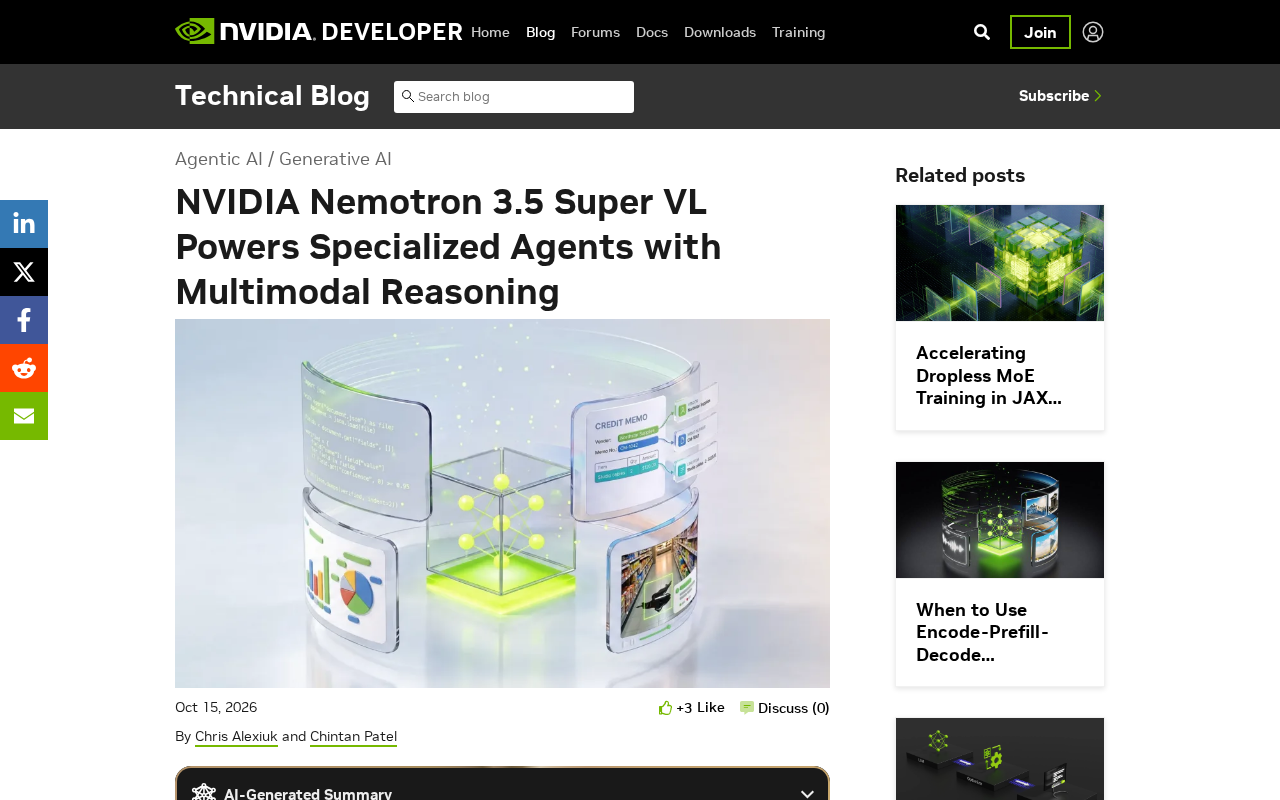
Nemotron 3.5 Super VL's approach is to consolidate these stages into a single model with visual understanding capabilities. The official illustration shows the model simultaneously connecting four types of tasks—code, charts, credit memo data extraction, and video analysis—suggesting its design goal is to serve as the reasoning hub for multimodal agents rather than a single-function recognition tool.
For developers, this means a unified interface can handle the "understand—reason—invoke tools" chain, reducing the context loss that comes from stitching together multiple models.
VLM (Vision-Language Model) is a class of models that accepts both image and text inputs and reasons within a shared representation space. Early approaches typically used a "dual-tower" architecture: a vision encoder (such as ViT) extracts image features, a text encoder processes language, and contrastive learning aligns the embedding vectors of both—CLIP being the classic example. This architecture excels at image classification and image-text retrieval, but struggles with fine-grained reasoning, such as "compare the amounts on two invoices."
Newer VLMs mostly adopt a "vision encoder + projection layer + large language model" architecture: visual features are projected and concatenated into the text sequence as "visual tokens," with the LLM performing unified autoregressive generation. This design lets the model alternately attend to image regions and text within a single forward pass, enabling document QA, chart interpretation, screen understanding, and similar tasks. The trade-off is that higher resolution and more images mean greater token consumption, placing higher demands on context windows and inference costs. Nemotron 3.5 Super VL is a product of this technical lineage.
Aimed at Specialized Agents, Not General Assistants
The "Specialized Agents" in the blog title is worth noting. NVIDIA does not position Nemotron 3.5 Super VL as a consumer-facing general-purpose chat model, but rather emphasizes its role in providing multimodal reasoning capabilities for specialized agents.
This positioning difference shows up in task granularity. Specialized agents typically operate within business systems with clearly defined boundaries—for example, reading credit memos in loan approval, parsing design blueprints for engineering teams, or analyzing surveillance video for operations systems. What these scenarios share is that inputs are primarily unstructured documents and images, and outputs need to be structured, auditable, and traceable.
If a model can chain visual elements with textual logic in a single inference, agents can reduce round-trip calls to external tools, thereby lowering latency and error rates.
AI Agent refers to a system capable of autonomously planning steps, invoking external tools, and adjusting behavior based on feedback, typically driven by a "perceive—plan—act—reflect" loop. Unlike one-shot Q&A, an agent needs to maintain task state, decompose sub-goals, and preserve context consistency across multiple rounds of interaction.
In an agent architecture, the model serves as the "reasoning core," deciding which tool to call next (such as retrieval, a calculator, or a database query) and interpreting the results returned by tools. The additional challenge for multimodal agents is that tool returns may be charts, screenshots, or scanned documents—the model must first convert these unstructured inputs into semantic representations usable for decision-making. If the model itself has visual understanding, it can eliminate external OCR or multimodal parsing services, reducing the information loss and latency of an extra cross-system conversion. This is precisely why specialized agents place differentiated demands on the underlying model.
Why "Always-On" Changes Model Requirements
The blog opens by emphasizing that always-on agents are taking on longer task chains. This trend directly changes the evaluation criteria for model selection.
In single-turn Q&A, a wrong answer once has limited impact; but when an agent processes enterprise workflows unattended for extended periods, any single visual misread can be amplified along subsequent steps. Cross-source information verification is especially sensitive—the model must judge whether the same entity in two documents is consistent, rather than relying only on surface-level text matching.
This also explains why multimodal capability becomes critical in the agent context: real business data rarely exists as clean plain text—charts, scans, and interface screenshots are the norm.
Always-on agent refers to automated workflows that run continuously over long periods, triggered by events or schedules—for example, monitoring a ticketing system around the clock, periodically auditing a contract repository, or analyzing surveillance streams in real time. It differs from the interactive "human asks—model answers" mode: without step-by-step human confirmation, errors flow directly into downstream systems.
This has two engineering consequences. The first is error accumulation: in a multi-step chain, a misread in an earlier step becomes an input premise for the next, and if a given step has 95% accuracy, ten steps in series could drop the overall success rate to roughly 60%. The second is lack of human fallback: the system must come with built-in confidence assessment, anomaly reporting, and rollback mechanisms. As a result, always-on scenarios demand far more from a model's stability, consistency, and auditability than single-turn Q&A. The multimodal stage is particularly fragile—skewed documents, uneven lighting, or rare fonts can all trigger misreads, which is the fundamental reason visual capability has shifted from a "nice-to-have" to a "must-have" in the agent context.
What Developers Should Pay Attention To
For teams building agent applications, the value of Nemotron 3.5 Super VL needs to be evaluated within specific pipelines. Here are three angles to consider:
First, task coverage. Confirm whether the model can handle the document layouts in your domain, especially materials with dense tables or mixed text-and-image content.
Second, reasoning explainability. Enterprise workflows typically require audit trails, so whether the model provides justification when extracting key fields directly affects whether it can be deployed.
Third, integration cost. If you already have an agent orchestration framework, assess whether integrating this model can genuinely reduce the number of external tool calls, rather than adding another layer of complexity.
Competition in multimodal agents will ultimately not be decided by benchmark scores alone, but by who can reliably complete long, messy tasks in real workflows. Nemotron 3.5 Super VL is a step in that direction.
One-line Summary
NVIDIA Nemotron 3.5 Super VL brings multimodal reasoning to always-on specialized agents, replacing traditional pipelines.
Paragraph Summary
The article introduces NVIDIA Nemotron 3.5 Super VL, a vision-language model for specialized agents, as presented in NVIDIA's developer blog. It aims to consolidate document reading, chart parsing, cross-source verification, and video analysis into a unified reasoning chain, replacing traditional pipelines stitched together from OCR, rule engines, and manual review—thereby reducing context loss caused by multi-model stitching. The article emphasizes that the model is positioned as a reasoning hub for specialized agents rather than a general chat assistant, with well-defined task granularity and outputs that must be auditable and traceable. Because always-on agents process long task chains unattended, a single visual misread can be amplified along subsequent steps, making multimodal capability essential. The article recommends developers evaluate deployment value from three perspectives: task coverage, reasoning explainability, and integration cost, and notes that competition in multimodal agents ultimately depends on reliably completing complex tasks in real workflows.
Related articles

Chain of Thought Isn't Just for AI: How Humans Can Use CoT to Improve Thinking Quality
Chain of Thought isn't just a prompt trick for large models. Starting from a Hacker News discussion, this article analyzes why CoT works for human thinking too, breaks down actionable ways to transfer it, and highlights the key differences between human CoT and machine CoT.
Cloudflare Teams Up with OpenAI: Closi…
Cloudflare Teams Up with OpenAI: Closing the Loop from Vulnerability Discovery to Defense with AI
Cloudflare uses OpenAI Daybreak to investigate security vulnerabilities and generate reviewable remediation plans, while developers use Codex to boost coding efficiency and quality.

Orca Multi-Agent Orchestration in Practice: A Guide to Parallel Collaboration with Claude and Codex
Orca is Stable AI's free open-source agent workbench supporting 34 agents like Claude Code and Codex in parallel. Learn its Git worktree isolation, multi-model orchestration, and mobile management.