NVIDIA Nemotron Competitive Coding Model Surpasses Top Human Performers at IOI for the First Time

NVIDIA's open-source 550B Nemotron model scores 535.4/600 on IOI 2026, beating the top human competitor.
NVIDIA released NVIDIA-Nemotron-Labs-3-Competitive-Coding on Hugging Face — an open-source 550B-A55B model fine-tuned from Nemotron-3-Ultra using ~478K synthetic reasoning traces distilled from GLM-5.2 across 22,000 competition problems. Using the GenCorrect iterative closed-loop test-time compute strategy, the model scored 535.4/600 on the IOI 2026 problem set under official competition constraints, surpassing both the gold medal threshold (361 pts) and the highest-scoring human competitor (498.27 pts). Available for commercial use, it validates the "synthetic distillation + test-time compute" approach for building specialized AI agents — though independent third-party replication is still pending.
NVIDIA has released a competitive programming model on Hugging Face called NVIDIA-Nemotron-Labs-3-Competitive-Coding. This open-source model, featuring 550 billion parameters (with 55 billion active, i.e., a 550B-A55B architecture), has reportedly achieved scores surpassing the highest-scoring human competitors on International Olympiad in Informatics (IOI) problem sets — making it the first AI system to do so.
A Specialist Model Fine-Tuned from Nemotron-3-Ultra
Nemotron is NVIDIA's family of open models, distinguished by releasing weights, training data, and training recipes simultaneously. The focus is on providing a high-efficiency, high-accuracy foundation for building specialized AI agents. This competitive coding model is fine-tuned from Nemotron-3-Ultra-550B-A55B, using NVFP4 low-precision quantization — consistent with NVIDIA's established approach to inference efficiency.
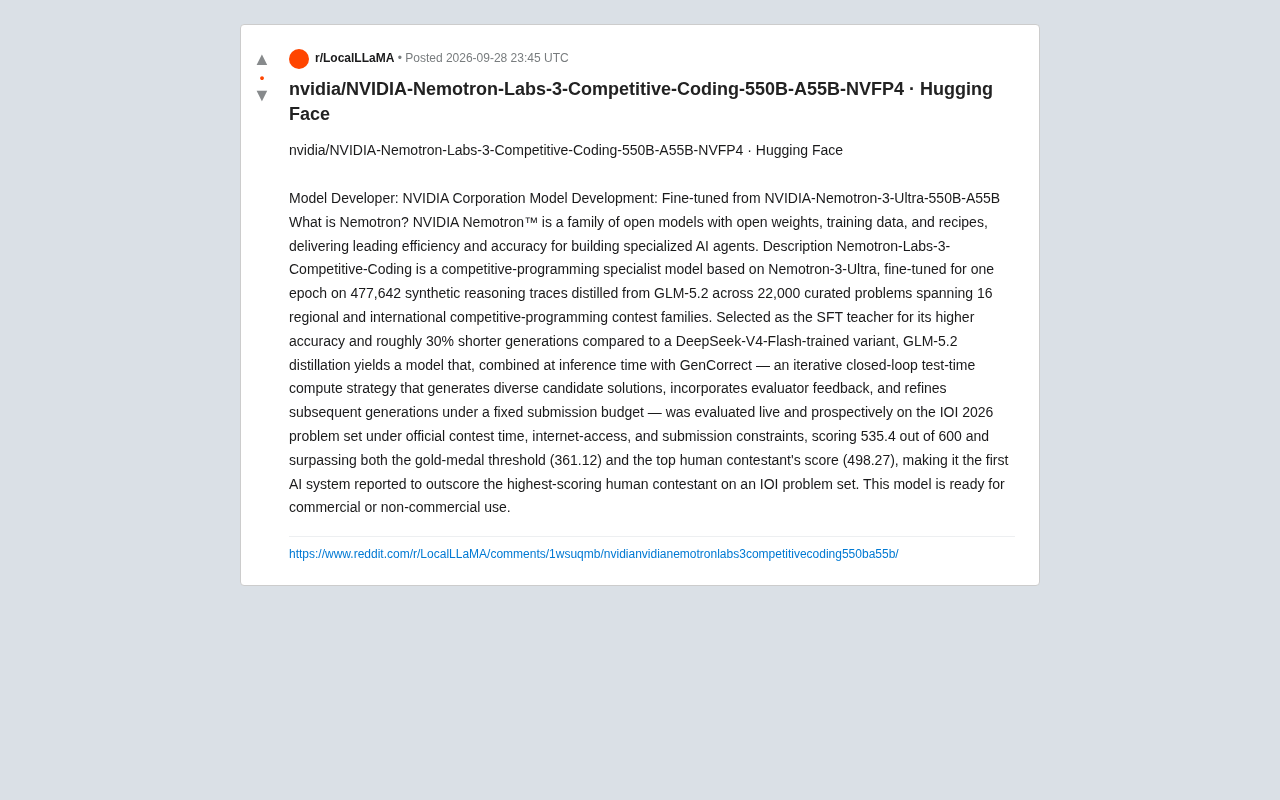
The fine-tuning process is particularly noteworthy. The team trained for one epoch on 477,642 synthetic reasoning traces distilled from GLM-5.2, covering 22,000 curated problems spanning 16 regional and international competitive programming contest systems. The scale of this data construction reflects the heavy dependence that competitive programming — as a vertical domain — places on high-quality reasoning data.
Why GLM-5.2 Was Chosen as the Teacher Model
One technically interesting decision was the choice of SFT (Supervised Fine-Tuning) teacher model. The team compared two approaches: one variant trained on DeepSeekAd-V4-Flash, and another distilled from GLM-5.2.
GLM-5.2 was ultimately chosen for two reasons: higher accuracy, and generation lengths approximately 30% shorter. In tasks like competitive programming that require extensive reasoning chains, generation length directly affects inference cost and latency. Shorter generations mean more candidate solutions can be explored within the same compute budget — a trade-off that reflects the real-world engineering need to balance accuracy and efficiency simultaneously.
"Teacher model distillation" in SFT refers to using a more capable large model to generate high-quality "reasoning process + answer" data pairs, which are then used for supervised training of the target model. Compared to manual annotation, distillation enables large-scale, low-cost construction of reasoning trace data. GLM-5.2 is a reasoning model from Zhipu AI, known for producing relatively concise and refined chain-of-thought outputs in code and math reasoning. The 30% reduction in generation length carries significant engineering implications: reasoning chains for competitive programming problems often span thousands of tokens, so shorter traces mean lower KV cache usage per inference, higher batch throughput, and substantial cumulative compute savings when running multiple rounds of iteration with GenCorrect.
GenCorrect: A Closed-Loop Test-Time Compute Strategy
Beyond fine-tuning, the inference-stage strategy was equally critical to achieving breakthrough performance. The team employed an iterative closed-loop test-time compute strategy called GenCorrect.
The mechanism works as follows: first, diverse candidate solutions are generated; then evaluator feedback is incorporated; finally, subsequent generations are iteratively refined within a fixed submission budget. In other words, the model doesn't produce a single answer — it continuously self-corrects within a constrained number of submissions. This closely mirrors how human competitors debug their code in contests, iterating based on judge feedback.
This test-time compute approach represents an important direction in the current reasoning model landscape. By investing more computation during inference to improve output quality — rather than relying solely on model scale — it opens new performance improvement paths for specialized tasks.
Test-Time Compute (TTC) is a core paradigm that has emerged in recent years as a complement to traditional "training-time scaling." Traditional methods improve performance by increasing training data and model parameters, whereas TTC dynamically allocates more compute during inference — for example, generating multiple candidate paths and selecting the best, or performing multiple rounds of reflection and self-correction. OpenAI's o-series models and DeepSeek-R1 are both representative examples of this paradigm. GenCorrect's distinguishing feature is its closed-loop mechanism with "external evaluator feedback": after the model submits code, an evaluator (typically a sandboxed execution environment) returns test pass/fail results, and the model revises its solution accordingly. Unlike open-loop strategies such as Best-of-N sampling, external signals ensure each iteration yields information gain rather than blind retries — which is precisely why competitive programming is a natural fit for TTC: the problems themselves provide clear judging feedback.
IOI 2026 Benchmark Results: 535.4 Points
The most compelling data comes from the benchmark evaluation. The model was assessed in real-time, prospectively on the IOI 2026 problem set, strictly adhering to official competition constraints on time limits, internet access, and submission quotas.
The final score was 535.4 out of 600, which:
- Far exceeds the gold medal threshold (361.12 points)
- Surpasses the highest-scoring human competitor in that edition (498.27 points)
This means that under controlled, realistic competition conditions, this AI system has for the first time surpassed the top-scoring human participant on an IOI problem set. For an olympiad long regarded as one of the most elite intellectual arenas for human competitors, this represents a landmark milestone.
A note of caution: all data comes from NVIDIA's official model documentation, and no independent third-party replication has been publicly reported. The evaluation details under competition conditions, the difficulty distribution of problems, and the methodology for comparing against human scores all warrant further scrutiny from the community.
The International Olympiad in Informatics (IOI) is the highest-level algorithmic competition for high school students, attracting top competitors from over 90 countries and regions each year. The contest uses a partial scoring system: 6 problems, each worth 100 points, for a total of 600. Competitors participate individually over two days, with 5 hours per day and multiple submission attempts with immediate feedback. Gold medals are typically awarded to the top one-twelfth of participants, with the gold threshold historically ranging around 300–400 points depending on problem difficulty. NVIDIA's model scoring 535.4 not only far exceeds the gold medal line but also surpasses the highest-scoring human competitor (498.27). It's worth noting that IOI 2026 has not yet officially taken place — NVIDIA used a pre-released problem set for prospective testing, similar to how DeepMind previously conducted closed-book testing with AlphaCode 2 at IOI 2024. The representativeness of the problems and evaluation methodology remain to be verified by the community.
Commercial Implications of an Open Model
NVIDIA has explicitly labeled this model as available for commercial and non-commercial use, continuing the open positioning of the Nemotron family. For developers and enterprises, an open-source model that reaches or exceeds top human performance in a specific vertical domain carries value far beyond competitive programming itself — it validates the feasibility of the "synthetic data distillation + test-time compute" methodology for building specialized AI agents.
Competitive programming serves as an intensive benchmark for algorithmic reasoning ability, and breakthroughs in this domain tend to spill over into broader applications including code generation, logical reasoning, and general problem solving. With the full release of open weights, open data, and open training recipes, the downstream impact of this work on the broader AI coding ecosystem is well worth watching.
Related articles

Chain of Thought Isn't Just for AI: How Humans Can Use CoT to Improve Thinking Quality
Chain of Thought isn't just a prompt trick for large models. Starting from a Hacker News discussion, this article analyzes why CoT works for human thinking too, breaks down actionable ways to transfer it, and highlights the key differences between human CoT and machine CoT.
Cloudflare Teams Up with OpenAI: Closi…
Cloudflare Teams Up with OpenAI: Closing the Loop from Vulnerability Discovery to Defense with AI
Cloudflare uses OpenAI Daybreak to investigate security vulnerabilities and generate reviewable remediation plans, while developers use Codex to boost coding efficiency and quality.

Orca Multi-Agent Orchestration in Practice: A Guide to Parallel Collaboration with Claude and Codex
Orca is Stable AI's free open-source agent workbench supporting 34 agents like Claude Code and Codex in parallel. Learn its Git worktree isolation, multi-model orchestration, and mobile management.