NVIDIA Open-Sources OpenShell: A Secure, Private Runtime for AI Agents

NVIDIA open-sources OpenShell, a Rust-built secure runtime designed to safely isolate autonomous AI agents.
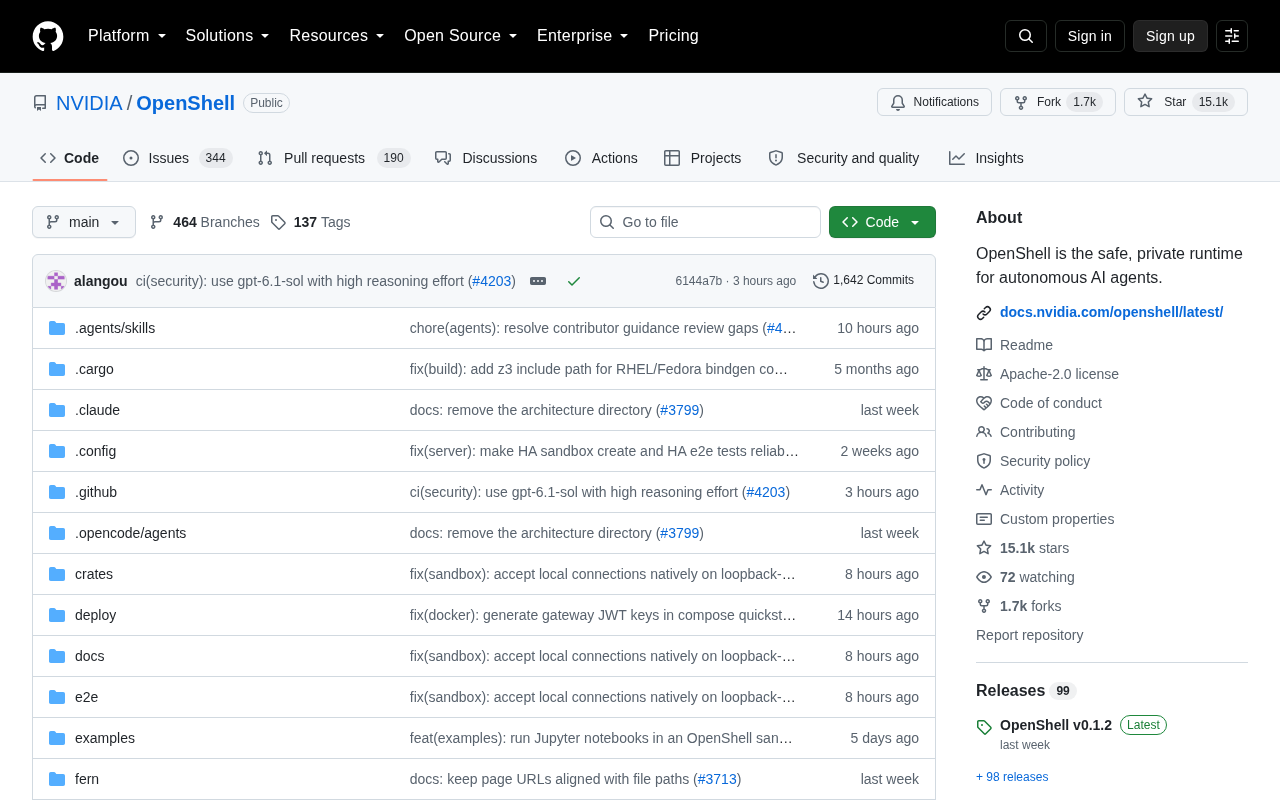
NVIDIA's newly open-sourced OpenShell project is positioned as a secure, private runtime for autonomous AI agents, addressing the critical safety isolation challenges that arise when agents gain code execution capabilities. Unlike agent frameworks focused on task orchestration, OpenShell targets the lower-level runtime layer, leveraging Rust's memory safety guarantees to prevent threats like prompt injection from causing real damage to host systems. The project gained nearly 6,000 GitHub stars in a single week — surpassing 15,000 total — reflecting strong developer demand for AI agent security infrastructure. NVIDIA's move signals a broader industry shift: as agent autonomy expands, secure runtime environments are becoming foundational infrastructure, much as container technology once underpinned cloud computing security.
When AI Agents Need a "Secure Sandbox"
As autonomous AI agents move from concept to real-world deployment, a core challenge has emerged: how do we let these agents — capable of autonomously executing code, calling tools, and interacting with operating systems — run in a safe and controlled environment? NVIDIA's recently open-sourced OpenShell project was built precisely to address this pain point. It's positioned as "the safe, private runtime for autonomous AI agents."
The project has quickly accumulated over 15,000 stars and 1,700+ forks on GitHub, with nearly 6,000 new stars added in just one week — a clear signal of the developer community's strong appetite for AI agent security infrastructure. The project is written in Rust, a choice that immediately signals the designers' deep commitment to memory safety and runtime performance.
Why a "Runtime" and Not Just Another Agent Framework
The market is already crowded with AI agent frameworks, but most of them focus on orchestration, reasoning, and task planning. OpenShell takes a different angle — targeting a lower-level and arguably more critical layer: the runtime.
Once an AI agent is granted execution permissions, it may run arbitrarily generated code, access the filesystem, or make network requests. Without an isolation mechanism, an agent hijacked by a malicious prompt injection attack — or a hallucinating model — could cause irreversible damage to the host system. OpenShell's two defining keywords, "safe" and "private," directly address these two categories of risk: safe means isolating and constraining agent behavior, while private refers to the need for local deployment where data doesn't leak and the execution environment remains under control.
The Low-Level Advantages of Rust
Choosing Rust as the implementation language was no accident. For a runtime that must handle the execution of untrusted code, Rust's ownership model and compile-time memory safety checks fundamentally eliminate entire classes of vulnerabilities — buffer overflows, null pointer dereferences, and other issues that have historically plagued C/C++ systems software. At the same time, Rust's near-C runtime performance makes it well-suited for building infrastructure-layer components where latency and throughput matter.
Prompt injection is one of the most significant attack surfaces facing AI agents today. Attackers embed malicious instructions disguised as content into materials the agent might read — webpages, files, emails — to redirect the agent away from its intended goal and into performing unauthorized actions, such as leaking sensitive data, deleting files, or sending outbound requests. Much like SQL injection, it exploits a structural weakness in the blurry boundary between "data" and "instructions." When an agent has real execution permissions, the consequence of a successful prompt injection escalates from "producing wrong output" to "causing real damage to live systems" — which is precisely why runtime isolation exists.
Rust's core safety guarantees stem from its unique ownership system: each piece of memory has exactly one owner at any given time, and the compiler statically tracks memory allocation and deallocation at compile time, ensuring memory safety without a garbage collector (GC). This stands in sharp contrast to C/C++'s model of manual memory management. For a runtime that executes externally untrusted code, this means attackers cannot trigger heap overflows or use-after-free vulnerabilities through crafted inputs — attack classes that have been responsible for countless serious security incidents throughout history. Rust's thread-safety guarantees also provide an additional layer of protection when multiple agent tasks run concurrently.
AI Agent Security: An Underestimated Battleground
For a while, the industry's attention was locked on improving model capabilities — stronger reasoning, longer context windows, lower hallucination rates. But when agents gain the ability to actually "act" — calling tools, executing commands, and interacting with the outside world — the importance of security boundaries becomes impossible to ignore.
The fact that OpenShell comes from an infrastructure giant like NVIDIA is significant not just because it provides a useful tool, but because it sends a signal: the secure execution environment for AI agents is becoming infrastructure on par with the models themselves. To draw an analogy from the traditional software era, container technologies (like Docker), virtualization, and sandboxing underpinned the security foundation of cloud computing. In the age of autonomous AI agents, runtimes like OpenShell may well play the same foundational role.
Imagining the Use Cases
Based on the project's positioning, OpenShell appears well-suited for scenarios such as:
- Autonomous code execution: Let AI agents safely run the code they generate in an isolated environment, with no risk of affecting the host machine.
- Enterprise private deployment: Organizations with strict data privacy requirements can run agents locally without worrying about data exfiltration.
- Multi-agent collaboration: Provide mutually isolated execution spaces for multiple agents, preventing interference or privilege escalation between them.
Container technology (Docker being the canonical example) achieves process-level isolation through Linux kernel mechanisms like cgroups and namespaces, letting untrusted application code run within a restricted view of resources and the filesystem, without affecting other processes. This became the cornerstone of modern cloud security models. AI agents face a similar but more complex challenge: it's not just about isolating code execution — it also requires constraining network access scope, controlling tool-call permissions, and auditing the intent and outcome of each action. What OpenShell is attempting to build is exactly this kind of "containerization" infrastructure, designed for agent semantics rather than being a simple reuse of general-purpose sandboxing techniques.
A Measured Take: The Project Still Needs Time to Prove Itself
It's worth noting that publicly available information about OpenShell is still relatively limited, mostly covering high-level positioning and basic descriptions. Key details — such as its specific isolation mechanisms, how it integrates with mainstream agent frameworks, and its performance overhead — are still waiting to be revealed through official documentation and community practice.
Rapidly accumulating stars certainly reflects interest, but the true value of a runtime project ultimately comes down to its stability in production environments, the rigor of security audits, and the breadth of ecosystem compatibility. For developers currently building AI agent applications, OpenShell is worth keeping a close eye on — but a careful evaluation of its maturity is still advisable before committing to production use.
Conclusion
The emergence of NVIDIA's OpenShell marks a shift in the AI agent space from a pure "capability race" toward the engineering of safety and reliability. As agents gain ever-greater autonomy, building a secure, private, and controllable runtime environment for them will become an unavoidable challenge for the entire industry. This open-source project, built in Rust, may well prove to be an important milestone in that journey.
Related articles

Chain of Thought Isn't Just for AI: How Humans Can Use CoT to Improve Thinking Quality
Chain of Thought isn't just a prompt trick for large models. Starting from a Hacker News discussion, this article analyzes why CoT works for human thinking too, breaks down actionable ways to transfer it, and highlights the key differences between human CoT and machine CoT.
Cloudflare Teams Up with OpenAI: Closi…
Cloudflare Teams Up with OpenAI: Closing the Loop from Vulnerability Discovery to Defense with AI
Cloudflare uses OpenAI Daybreak to investigate security vulnerabilities and generate reviewable remediation plans, while developers use Codex to boost coding efficiency and quality.

Orca Multi-Agent Orchestration in Practice: A Guide to Parallel Collaboration with Claude and Codex
Orca is Stable AI's free open-source agent workbench supporting 34 agents like Claude Code and Codex in parallel. Learn its Git worktree isolation, multi-model orchestration, and mobile management.