NVIDIA's $12.9B Hugging Face Acquisition: The Ultimate Power Play Over Open-Source AI

NVIDIA acquires Hugging Face for $12.9B, gaining control of open-source AI's default distribution layer.
NVIDIA's reported $12.9 billion acquisition of Hugging Face — including llama.cpp — isn't about the models or datasets. It's about owning the default entry point for all of open-source AI: the library stack, the Hub, and the domain every developer's script points to by default. Drawing on the GitHub precedent, the article argues that the platform will stay open but lose its neutrality over time, and outlines concrete steps developers can take today to hedge their risk.
A Deal That Rewrites the Open-Source AI Landscape
Reports indicate that NVIDIA has agreed to acquire Hugging Face — the open-source model hosting platform often called the "Switzerland of AI" — for $12.9 billion. The deal also includes llama.cpp, the inference engine that lets AI models run on hardware NVIDIA doesn't sell: Macs, AMD GPUs, and plain CPUs.
llama.cpp was released in March 2023 by Bulgarian engineer Georgi Gerganov. It started as just a few hundred lines of C/C++ that reproduced the inference logic of Meta's LLaMA model. Its breakthrough was the GGUF quantization format, which compresses models that normally require tens of gigabytes of VRAM down to 4–8-bit precision, making them runnable on consumer hardware. The Metal backend was adapted for Apple's M-series chip unified memory architecture, letting Mac users run 7-billion-parameter models at near-GPU speeds. The Vulkan backend extended support to AMD, Intel, and various mobile GPUs. The project shattered the assumption that local AI required an NVIDIA GPU, and spawned an entire ecosystem of local AI tools like Ollama and LM Studio.
The irony is hard to miss. Just this past February, Georgi Gerganov and the llama.cpp team joined Hugging Face to find a "stable home" for local AI. Joining gave the team steady salaries and infrastructure resources — but also introduced a new dependency: their employer's strategic priorities. Barely six months later, that home is about to be sold to NVIDIA. Does this spell the end of open source, or is it the opening move in a deeper game?
One detail stands out. Back in January, the Financial Times reported that Hugging Face had turned down a $500 million investment from NVIDIA, citing a desire not to have any single large investor influence its decisions. Now it's selling the entire company to that same investor — at 26 times the amount it once refused. Founder Clément Delangue spent years calling Hugging Face the "Switzerland of AI." Switzerland was never supposed to be for sale.
What NVIDIA Is Actually Buying
Hugging Face was founded in 2016 as a chatbot company before pivoting to an open-source AI platform in 2019. Many assume its core value lies in the 3 million models and 1 million datasets it hosts. But those files are actually the least valuable part. What makes developers truly dependent on Hugging Face is its library stack:
- Transformers: The starting point for half of all AI tutorials worldwide, installed over 3 million times a day. Released in 2019, it standardized the API for calling Transformer-architecture models like BERT and GPT, becoming the de facto standard in both academia and industry.
- SafeTensors: The standard publishing format for modern model weights. It addresses the arbitrary code execution vulnerability in the traditional pickle format and has been adopted by virtually every major model.
- Hugging Face Hub: A client embedded in nearly every AI tool and CI pipeline
- Gradio: The framework behind the vast majority of model demos. It lets researchers build shareable model demo interfaces with a dozen lines of Python, dramatically lowering the barrier to AI showcasing.
- A robotics team that plugs directly into NVIDIA's robotics ambitions
The key insight: every from_pretrained call in your code defaults to pointing at huggingface.co. That single line of code triggers hundreds of millions of HTTP requests per day. 13 million registered users, each with scripts that — out of the box — all point to the same domain. That's the real target of this deal: control over the distribution layer and the default entry point.
Hugging Face's annual revenue is around $150 million. The acquisition price is roughly 86 times that revenue. For context, when Microsoft acquired GitHub for $7.5 billion, GitHub was generating more revenue than Hugging Face is today. A multiple this high can't be justified by cash flow alone — what's being bought is control of the platform.
Why NVIDIA Is Actually Open Source's Biggest Winner
On the surface, open-source models should be a counterweight to NVIDIA's dominance — this deal looks like NVIDIA body-checking open source. But follow the money and the direction reverses.
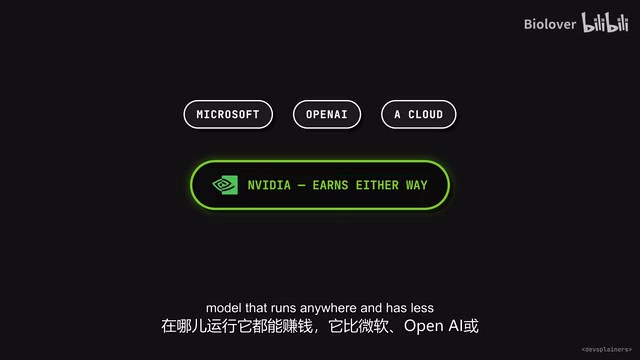
DeepSeek, Qwen, Kimi, Llama — these open-source models run overwhelmingly on NVIDIA GPUs. Every open-weight release effectively sells more NVIDIA hardware. Morgan Stanley said it plainly in their August scenario analysis: whether closed-source labs win, open-source models win, or the market fragments, NVIDIA comes out as the "biggest beneficiary." Jensen Huang said it himself in July: "Free AI is good for chips."
What's more, NVIDIA is already the largest publisher of open weights on Hugging Face, with its Nemotron model series downloaded over 45 million times.
NVIDIA's real threat is alternative chips. CUDA — the Compute Unified Device Architecture NVIDIA launched in 2006 — has spent nearly two decades building an ecosystem so deep that mainstream frameworks like PyTorch and TensorFlow depend on it at the hardware acceleration layer. Once developers invest in CUDA — learning its APIs, tuning tricks, and debugging tools — switching costs become enormous. AMD's ROCm platform and Intel's oneAPI are the main alternatives, but they lag significantly behind CUDA in software maturity and community size.
Earlier this year, a Chinese lab released a frontier-scale open-source model trained end-to-end on Huawei Ascend processors. Huawei's CANN platform has been growing rapidly in the Chinese market, and DeepSeek-R1's training on Ascend clusters directly challenged the narrative that frontier models could only be trained on CUDA. If a default model is optimized for someone else's hardware and the software stack requires no CUDA, every company that adopts it is chipping away at NVIDIA's moat. And Chinese labs accounted for roughly 41% of Hugging Face's downloads last year.
NVIDIA's true threat was never a single competitor — it's the trend of decoupling software stacks from hardware. And llama.cpp and Hugging Face's library stack are precisely the infrastructure enabling that decoupling. Owning the Hub gives NVIDIA two levers against that future:
Lever One: Data Intelligence
A real-time feed showing what every developer is downloading and what hardware they're running on — before any competitor can spot the trend.
Lever Two: Default Control
The Hub is where adoption decisions happen. Whoever owns it decides which build appears at the top of search results. And both levers work equally well on an open platform — so keeping it open costs NVIDIA almost nothing.
The GitHub Precedent
When Microsoft acquired GitHub for $7.5 billion in June 2018, the developer community's panic triggered a wave of migration to GitLab — but the actual migration numbers were far smaller than feared. Microsoft kept the platform open, kept investing in it, and let it operate independently for years. Core features like Actions, Packages, and Pages stayed free; private repos were opened to individual users.
But Microsoft also wove its own strategic product, Copilot, into every corner of the site. Copilot launched in 2021, trained on GitHub's codebase, and has become one of Microsoft's most important AI products, generating over $1 billion in annual revenue. After GitHub's CEO departed in 2024, GitHub's product roadmap visibly accelerated its integration with Microsoft Azure AI services. Seven years later, the platform stayed open, but its neutrality had an expiration date.
The core lesson from that history isn't "open platforms get closed" — it's that "a platform's neutrality erodes much more slowly than users expect, but much faster than promised."
There's one major difference this time: the 2018 Microsoft was just one of many software giants, while today's NVIDIA is the dominant force in AI, and it's acquiring the one piece of the AI distribution layer it didn't yet control. Hugging Face grew to its current scale precisely because it "belonged to no one, yet served everyone" — and that kind of trust doesn't transfer with the servers.
llama.cpp: Where You'll Feel the Change First
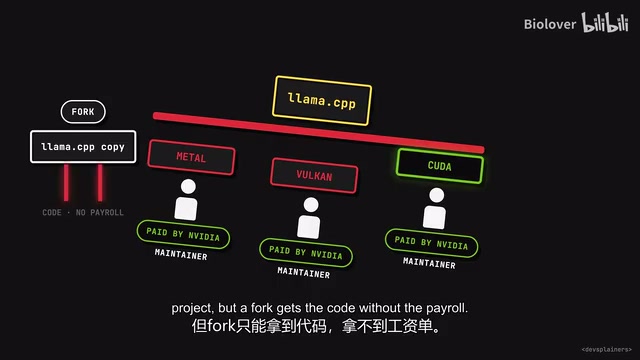
The changes will show up in llama.cpp first. Its value lies in letting models run efficiently on Macs, AMD GPUs, and ordinary CPUs, and that depends on sustained maintenance of its Metal and Vulkan backends. The open-source sustainability crisis isn't new — the Log4Shell vulnerability exposed just how fragile critical infrastructure can be when it depends on single-maintainer projects. llama.cpp faces a textbook version of this problem: hundreds of millions of downloads, hundreds of new issues flooding in with every major model release, but only a handful of core maintainers. What happens if maintainers on NVIDIA's payroll quietly let the Metal and Vulkan backends fall behind the CUDA backend? That kind of asymmetric maintenance pace is far harder for the community to detect than any license change.
The community can always fork the project, but a fork gets the code, not the payroll. That's the core dilemma of open-source sustainability.
Can you just torrent everything? A mirror called Hugging Bay was already circulating before the acquisition news broke, but it doesn't scale — 3 million models means a long tail no one can see, and files are the easiest part to copy anyway. What's hard to replicate is: search rankings, model cards, and every script around the world that defaults to pointing at the same domain.
What Developers Should Do Now
The real "escape hatch" only takes one environment variable. The Hugging Face client libraries were designed with a redirect mechanism: the HF_ENDPOINT environment variable lets you point all model download requests at a custom server, and HF_HUB_URL can override the Hub's base URL. Run a self-hosted mirror using an open-source tool like Ollama on your own machine, then point HF_ENDPOINT at it, and the entire client stack — including Transformers — follows. One line of config, redirect everything. This mechanism was originally built to support Chinese mirror sites and enterprise intranet deployments, but in the context of a platform ownership change, it's also a key risk-hedging tool.
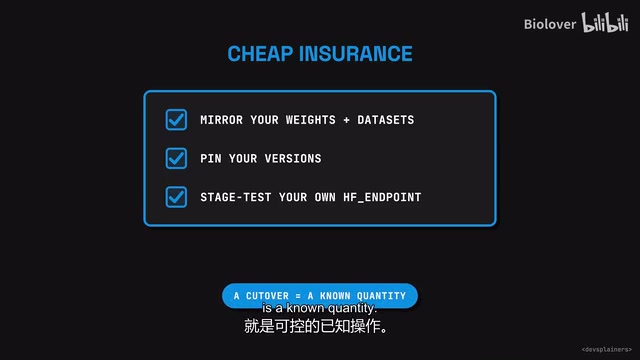
The good news is that your workflow won't change at all today. These libraries carry open-source licenses that can't be revoked, and old versions will keep working. But cheap "insurance" is still worth buying:
- Mirror the weights and datasets your production and CI pipelines depend on
- Pin your library versions
- Run a dry-run test against your own HF endpoint mirror so a switchover is a known quantity
Then watch for four signals, in order of likely appearance:
- Access barriers: Anonymous downloads start hitting account walls or stricter rate limits
- Format bias: Support for non-CUDA formats like GGUF, MLX, and ROCm starts lagging
- Default shifts: Search results and default builds start favoring the NVIDIA ecosystem
- Key departures: Gerganov or core Transformers maintainers leave
Closing Thoughts
Whether this deal ultimately closes or not, "mirror your models" is a low-cost action with a certain payoff. What NVIDIA is buying isn't a collection of files — it's the default entry point to an entire ecosystem. History already told us through GitHub: a platform can stay open indefinitely, but neutrality doesn't come with a lifetime guarantee. For every developer who depends on Hugging Face, the agency is still yours — as long as you prepare before you need it.
Key Takeaways
Related articles
OpenAI's Chief Scientist: Using Stronger AI to Defend Against AI Threats Is the Strongest Argument for Accelerating Training
OpenAI Chief Scientist Jakub Pachocki argues that building AI defense systems is the core driver for accelerating model training, exploring the logic, tensions, and regulatory implications of defensive accelerationism.

LTX 2.5 Open-Source Audio-Video Model Deep Dive: A Comprehensive Comparison with MiniMax H3
LTX 2.5 is a 22B-parameter open-source audio-video model. This deep dive compares it with MiniMax H3 across image-to-video, IC LoRA ecosystem, legacy fixes, and more.

Climate Resilience Assessment of Global Megacities: Who Stands Strongest Against Disaster?
An in-depth look at climate resilience across global megacities, comparing how developed and developing cities handle extreme weather, sea-level rise, and other climate disasters.