LTX 2.5 Open-Source Audio-Video Model Deep Dive: A Comprehensive Comparison with MiniMax H3

Deep comparison of open-source LTX 2.5 vs MiniMax H3 for AI video generation workflows.
LTX 2.5, a 22-billion-parameter open-source audio-video model by Lightricks, upgrades its architecture with a diffusion-based decoder and Gemma 4 text encoder. This article compares it with MiniMax H3 across image-to-video quality, multi-stage sampling, legacy issue fixes, audio generation, and the thriving IC LoRA ecosystem—LTX's key differentiator for asset reuse and community-driven workflows.
A Steadfast Champion of Open-Source Video Generation
In the AI video generation space, open-source models have long been at a disadvantage. There are deep technical and economic reasons behind this: training large-scale video diffusion models requires hundreds of thousands of GPU hours and massive video datasets, giving closed-source commercial teams a natural edge. During the long gap before MiniMax H3 went open source, the Wan series from Alibaba's Tongyi team was briefly the mainstream choice, while the LTX family—especially LTX 2.3—was virtually the only option holding down the open-source front in video generation. LTX is developed by Lightricks, an Israeli startup known for professional creative tools, whose CEO has repeatedly emphasized the company's commitment to the open-source community and has poured considerable enthusiasm into it.
Despite obvious shortcomings in the LTX base model itself, the community has leveraged its rich fine-tuning tools, IC LoRA, and plugin ecosystem to play to its strengths and work around its weaknesses, building practical applications like director consoles and long-video generation pipelines. IC LoRA (Image-Conditioned LoRA) is a lightweight fine-tuning technique that uses reference images for conditional injection—LoRA's trainable parameters are only 0.1–1% of full fine-tuning, enabling individual developers to train custom adapters on consumer-grade GPUs. It allows users to lock down character appearance, scene style, and other visual attributes without retraining the entire model. ComfyUI, currently the most popular node-based AI workflow framework, features a plugin ecosystem that lets users freely combine different models, samplers, and post-processing nodes, serving as the community's primary platform for secondary development. This vibrant ecosystem is what sets LTX apart from other models.
LTX 2.5 is the latest version in this family, featuring a 22-billion-parameter open-source joint audio-video architecture. Compared to the previous LTX 2.3, the parameter count remains unchanged, with upgrades focused on architectural optimization and expanded capabilities.
Core Upgrades in LTX 2.5
A Comprehensive Evolution in Architecture and Capabilities
LTX 2.5 introduces an entirely new diffusion-based video decoder. Unlike traditional VAE decoders that perform deterministic decoding, the diffusion decoder models the decoding process itself as denoising diffusion—essentially running another "super-resolution diffusion" pass during the decoding stage. This preserves overall motion trajectories while repairing local texture details, significantly reducing visual artifacts in high-dynamic scenes. The upgraded text encoder uses Google DeepMind's 12-billion-parameter Gemma 4 model, whose multilingual pretraining corpus is more balanced. It can more accurately understand complex multi-subject prompts (such as spatial relationship descriptions like "A standing to the left of B, C walking in through the door") and supports generating multiple shots in a single run while maintaining character, scene, and audio consistency across cuts—ideal for narrative videos and high-fidelity rendering.
The model constructs motion and structure in a latent space with 8× temporal compression—downsampling the time axis by 8× means that for 30fps video, only 1 latent vector is retained per 8 frames. This dramatically reduces sequence length and computational cost but requires the model to have stronger temporal reasoning capabilities. The model can also intelligently determine the number of keyframes needed for a scene. Notably, the distilled version has seen significant improvements, and the official team strongly recommends using it as the primary model—a recommendation backed up by hands-on testing.
More User-Friendly Local Deployment
LTX 2.5 offers more complete NVIDIA GPU support, lowering the VRAM threshold required for local deployment in ComfyUI. This time the team has split files into separate folders, making the directory structure much cleaner.
The most notable change is with the main model. Earlier versions shipped as a single monolithic file bundling the diffusion model, audio VAE, and video VAE. Users who wanted to use GGUF (GPT-Generated Unified Format, a quantized model format introduced by the llama.cpp project) or other quantized models had to manually extract the VAE—an extremely tedious process. LTX 2.5 splits each component into independent files and directly provides INT8 and NVFP4 quantization formats. INT8 quantization compresses weights from FP16 to 8-bit integers, reducing VRAM by roughly 50% with inference accuracy loss typically within 1–2%, making it currently the most cost-effective general-purpose quantization scheme. NVFP4 is a 4-bit floating-point format designed by NVIDIA specifically for the Blackwell architecture (RTX 50 series), leveraging hardware-level FP4 Tensor Core acceleration for further throughput gains, but it's incompatible with older architectures.
Recommended hardware configuration: INT8 distilled main model + text encoder + two BF16 (Brain Float 16, preferred for precision-sensitive VAE components due to its larger numerical range) VAEs, running comfortably on 12GB of VRAM. RTX 50 series GPU owners seeking smaller VRAM footprint and faster speeds can opt for the NVFP4 format; otherwise, INT8 works just fine.
Image-to-Video in Practice: The Cost-Effectiveness of Multi-Stage Sampling
A Three-Step Sampling Pipeline
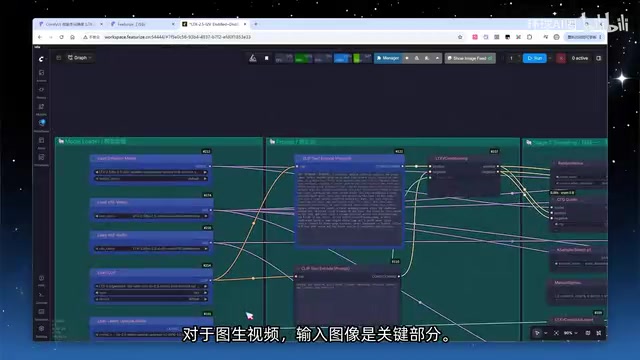
Multi-stage sampling isn't necessary because the model can't generate in one pass—it's simply more cost-effective. Diffusion model inference cost scales with the square of the resolution—doubling resolution means roughly 4× the computation—so the core idea of multi-stage sampling is to decouple "confirming motion intent" from "recovering high-frequency details" into two independent steps. Taking a 704×1280, 5-second portrait video as an example:
- Step 1: Draft generation. Using the distilled model with only 8 steps, generate the same duration at half resolution. Sampling cost is roughly one-quarter of the target resolution, allowing quick verification that motion and framing meet expectations.
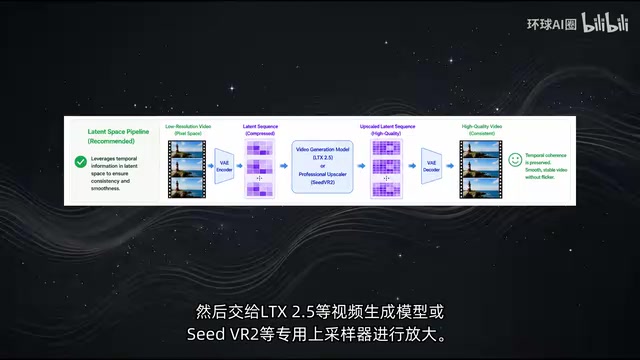
- Step 2: Latent space upsampling. Use the LTX 2.5 spatial upsampler to scale the video to target resolution directly in latent space, avoiding the quality degradation and extra time from the "decode to pixels → upscale → re-encode" pipeline with its two lossy conversions.
- Step 3: Refinement. Run a short sampling pass with a sigma schedule (a parameter sequence for the diffusion model's noise scheduling that controls denoising magnitude at each step), injecting a moderate amount of noise and then denoising. This is essentially "inpainting" while preserving overall composition and motion, restoring texture details and sharpening the image.
On an RTX 5090, the complete two-stage sampling plus decoding takes only about 20 seconds. Test results show quite good character consistency, with clear audio and well-matched lip sync.
Initial Comparison with MiniMax H3
Feeding the same image and prompt into MiniMax H3 formatted in H3 style and running the full pipeline, it's hard to say one is clearly superior—H3 looks more like a beauty close-up, LTX more like a casual everyday shot, but LTX finished faster at around 24 seconds.
Interestingly, LTX 2.5 adds support for directly outputting 20-second videos, but prompts need to include sufficient action descriptions; otherwise, the video tends to stall, idle, or drift meaninglessly. Testing revealed that forcing 20-second output leads to sluggish pacing—the key action doesn't appear until the 7th second, and the latter portion can only be filled with camera zooms, with noticeable quality degradation.

Fixes for Three Legacy Issues
Garbled Subtitles: Improved but Not Fully Resolved
In LTX 2.3, garbled subtitles frequently appeared on screen when characters spoke non-English languages (such as Chinese). The root cause was that early LTX used T5-XXL as its text encoder, which had a low proportion of Chinese in its pretraining corpus. When receiving Chinese character input, the model couldn't accurately extract semantics and instead searched for nearest neighbors in its "glyph-visual associations" from training data, resulting in garbled on-screen text. After switching to the Gemma 4 text encoder, Chinese characters are correctly parsed as semantic units rather than unknown tokens, and LTX 2.5's Chinese performance has noticeably improved—Chinese speech runs in testing produced no garbled text. However, the issue isn't fully fixed—LTX 2.5 still produces garbled subtitles far more frequently than H3, especially in text-to-video scenarios. Recommendation: if using AI to write prompts, English remains the safer choice.
End-Frame Degradation: No Improvement
The issue of the last few frames going soft persists in LTX 2.5, and the team hasn't listed it as a fix target. Users still need to manually trim trailing frames.
Motion Blur: Slight Improvement
The new VAE (Variational Autoencoder, responsible for compressing pixel space into latent space) and decoder have made some effort on this front—portrait and subtle motion scenes look cleaner. However, motion blur in fast-action scenarios is fundamentally constrained by the 8× temporal compression rate—detail displacement information between adjacent frames gets averaged out. This is a structural constraint of the current architecture rather than an engineering defect; a complete fix would require higher temporal resolution or dedicated motion compensation modules. Compared to H3's fast-motion performance, LTX still exhibits noticeable blur during vigorous movement.
Audio Generation and Multi-Shot Capabilities
As a joint audio-video generation model, LTX 2.5 simultaneously models video frames and audio spectrograms within the same diffusion process, using cross-modal attention mechanisms to create physically causal bindings between sound and lip movements/actions. This makes lip-sync quality significantly better than the traditional post-processing approach of generating silent video first and then overlaying TTS. The model can generate a 5-second audio clip in roughly 2.9 seconds on an RTX 5090 and can produce basic dialogue. However, for extremely clear dialogue, traditional TTS models specifically optimized for Chinese pronunciation accuracy and polyphonic character handling (such as QwenTTS) still perform better—especially since LTX tends to produce mispronunciations when generating Chinese.
Multi-shot is a new highlight of LTX 2.5, maintaining consistency across cuts by preserving character appearance, lighting direction, and scene layout at the global semantic level. But as a production tool it still has limitations: computational complexity grows super-linearly with the number of segments, which is the fundamental reason the team recommends no more than 4 segments; additionally, total duration is capped at 20 seconds and cuts cannot be pinned to exact timestamps. Therefore, using the Director Console plugin for shot choreography is still recommended.
The Thriving IC LoRA Ecosystem: LTX's Winning Edge
The thriving IC LoRA ecosystem is where LTX currently holds a key advantage over H3. IC LoRA builds on low-rank adaptation by introducing reference images as conditional inputs—during training, reference image features are injected into cross-attention layers, teaching the model to "preserve the visual characteristics of characters/scenes from reference images when generating new videos." This achieves identity-locking effects similar to DreamBooth but with lower inference overhead. The core competitive advantage of this ecosystem lies in its transferability—most LoRAs trained on LTX 2.3 work directly with 2.5, covering ControlNets, inpainting, outpainting, lip-sync replacement, video editing, and more. This means months of community-accumulated assets don't get wiped out with version upgrades.
A typical application is using LTX 2.5 to refine H3 videos. Since LTX 2.5 can easily generate at 2K or higher resolution while H3 typically runs at 768p, the official "Video H3 Recipe" involves generating a low-resolution draft with H3 first, then upsampling and refining with LTX 2.5.
MSR (Multi-Subject Reference) and similar IC LoRAs support inputting multiple reference images simultaneously (character front view, side view, clothing details), fusing multi-view features via weighted attention layers. This solves the generalization limitations of single reference images under complex poses—it can lock down both characters and scenes simultaneously, similar to H3's all-purpose reference. In testing, room furnishings and character clothing matched accurately; facial matching was limited by the small face regions in the three-view images, but overall performance was quite practical. For projects that emphasize digital asset accumulation, the LTX route offers a clear advantage.
Conclusion: A Pragmatic Path of Open-Source Validation + Closed-Source Production
Evaluating both models as production tools, here's a clear multi-dimensional comparison:
- Complex prompt understanding: H3 is currently stronger, especially when reproducing existing video styles.
- Cross-shot consistency: H3 relies on all-purpose references for quick validation; LTX's IC LoRA system excels at asset reuse.
- Camera language and motion continuity: Both have their own solutions; the challenge for both lies in shot choreography rather than single-shot generation.
- Iterability: H3's structured prompts have a clear advantage for precise modifications; LTX is prone to cascading changes where touching one thing affects everything else.
- Speed vs. quality: H3 tends to blur wide-angle faces and runs slower; LTX is faster but still suffers from motion blur and end-frame degradation.
Overall, closed-source commercial models are currently more mature. But as long as the open-source camp continues to deliver on its promises and absorb community contributions, the gap between LTX 3.0 and MiniMax H4 could very well narrow further.
The ultimate pragmatic recommendation: validate locally with open-source models first, then deploy with closed-source models for production—this itself is an extremely cost-effective workflow.
Related articles

OpenAI's Chief Scientist: Using Stronger AI to Defend Against AI Threats Is the Strongest Argument for Accelerating Training
OpenAI Chief Scientist Jakub Pachocki argues that building AI defense systems is the core driver for accelerating model training, exploring the logic, tensions, and regulatory implications of defensive accelerationism.

NVIDIA's $12.9B Hugging Face Acquisition: The Ultimate Power Play Over Open-Source AI
NVIDIA's $12.9B Hugging Face acquisition buys control of open-source AI's default distribution layer. Analysis of the real logic, the GitHub parallel, and what developers should do now.

Climate Resilience Assessment of Global Megacities: Who Stands Strongest Against Disaster?
An in-depth look at climate resilience across global megacities, comparing how developed and developing cities handle extreme weather, sea-level rise, and other climate disasters.