NVIDIA's Automated Workload Recovery: Making Distributed Training Uninterruptible

NVIDIA proposes automated workload recovery for fast, reliable automatic recovery of distributed training after failures.
The article introduces NVIDIA's automated workload recovery approach, aimed at solving the problem of frequent hardware and software dependency failures in distributed AI training as it scales, where manual recovery becomes unsustainable. It analyzes why failures amplify with scale and notes that the traditional path of manual monitoring plus manual restart is slow and experience-dependent. The core capabilities of automated recovery center on two dimensions—"fast" and "reliable": quickly sensing failures and triggering recovery, and reliably completing checkpoint loading, communication group rebuilding, and resource reallocation. The article also raises key planning points from an engineering practice perspective—checkpoint strategy, failure detection coverage, and recovery process testing—and notes that training reliability is shifting from an operations problem to a system design problem, deserving to be built as a foundational capability of the training platform.
NVIDIA's Automated Workload Recovery: Making Distributed Training Uninterruptible
As distributed AI training continues to scale up, failures along hardware and software dependency chains are increasingly interrupting the training process. A single GPU memory error, a dropped node, or even a hiccup in some dependent service can wipe out hours or even days of training progress. In a developer blog post, NVIDIA proposes Automated Workload Recovery to tackle this challenge, with the core goal of enabling training jobs to recover quickly and reliably after failures rather than relying on manual intervention.
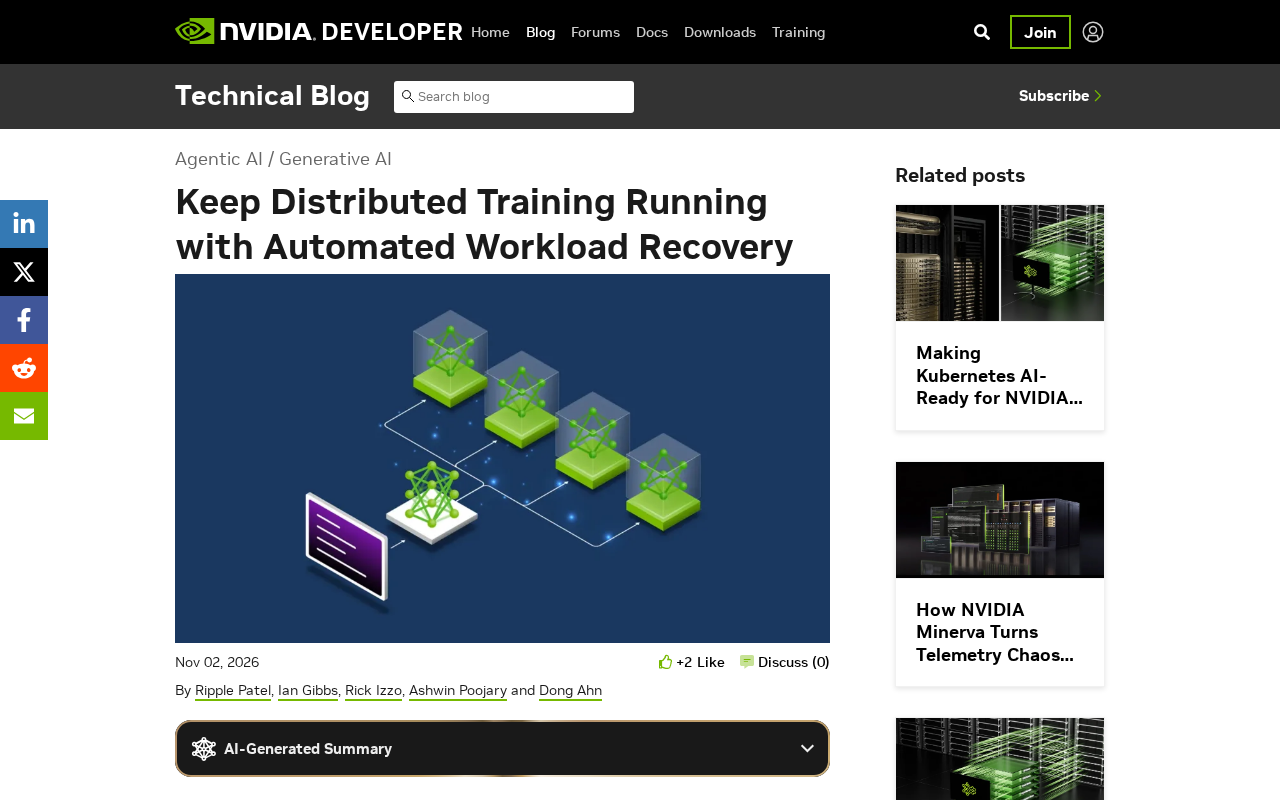
Why Failures in Distributed Training Are Getting Harder to Handle
The essence of distributed training is splitting a massive computational task across hundreds or thousands of accelerators working in concert. The more nodes there are, the more the probability of any single component failing is amplified, and the mean time between failures for the overall system shrinks accordingly. NVIDIA points out in the original article that as scale increases, failures spanning hardware and software dependencies will continue to disrupt training progress.
The traditional approach is for operations staff to monitor logs, manually restart jobs after detecting anomalies, and resume from the most recent checkpoint. The problem with this path is slow response, reliance on experience, and the fact that on large-scale clusters, fault localization itself is time-consuming. Every minute a training job sits idle is wasted compute.
Automated recovery is precisely about addressing this "detect—localize—restart—recover" loop, turning it from a manual process into a system capability.
Checkpoint is the foundational mechanism for fault recovery in distributed training. During training, the system periodically persists the complete training state—model parameters, optimizer states (such as momentum and variance), learning rate scheduler state, and data loader position—to storage. When a failure occurs, the job can reload from the most recent checkpoint rather than starting training from scratch. Checkpoint frequency requires a trade-off between failure loss and I/O overhead: too infrequent and a large amount of computation is lost on failure; too frequent and the repeated synchronous disk writes slow down training throughput—especially for large models where a single checkpoint can reach hundreds of GB or even TB scale, making the write time itself non-negligible.
Mean Time Between Failures (MTBF) is a classic metric for measuring system reliability, referring to the average uptime between two failures. In distributed training, the relationship between overall MTBF and single-node MTBF is approximately: overall MTBF ≈ single-node MTBF / number of nodes. This means that when a cluster scales from dozens of GPUs to thousands, even if individual node reliability stays the same, the overall system's uptime shrinks proportionally. This is the quantitative basis for the article's emphasis that "the larger the scale, the more frequent the failures," and the fundamental reason why automated recovery becomes essential at large scale.
Key Capabilities of Automated Recovery
Based on NVIDIA's description, the focus of automated workload recovery lies in two dimensions: "fast" and "reliable."
Fast means the system can automatically sense a failure and trigger recovery actions, shortening the job downtime window. Reliable requires the recovery process itself to be robust enough not to introduce new problems through recovery actions—such as duplicate launches, state inconsistency, or corrupted checkpoints.
These two points are especially critical for large-scale training. Training job checkpoints are often enormous, and the recovery process requires reloading model state, rebuilding communication groups, and reallocating resources. If these steps aren't properly orchestrated automatically, recovery time can approach or even exceed the loss from the failure itself.
Communication Group is the underlying structure for multi-GPU, multi-node coordination in distributed training. Collective communication libraries like NCCL establish communication groups at training startup, determining each process's rank number, topology relationships, and communication paths. When a node goes down or a process crashes, the existing communication group becomes invalid, and recovery cannot simply restart the training script—it requires rebuilding the communication group, reassigning ranks, and ensuring all participating processes agree on the new topology. Improper communication group reconstruction can lead to hidden failures such as process hangs, collective communication timeouts, or data misalignment. Therefore, automated recovery systems must incorporate communication group rebuilding into the orchestration flow, which is one of the technical reasons why "reliable recovery" is harder to achieve than "fast restart."
Implications for Training Engineering Practice
The value of NVIDIA's article isn't in providing a specific tool's API, but in highlighting an engineering trend: the reliability of distributed training is shifting from an "operations problem" to a "system design problem."
For training teams, this means several things need to be planned in advance. Checkpoint strategy must be designed in tandem with the recovery mechanism—too low a checkpoint frequency amplifies failure losses, while too high increases I/O overhead. Failure detection must cover both hardware and software dependency layers; watching only GPU status easily misses anomalies in upstream services. The recovery process itself needs to be tested, otherwise you'll only discover your recovery scripts don't work when a real failure occurs.
Building recovery capabilities into the training platform is more aligned with the cost structure of large-scale training than after-the-fact remediation. The cost of a single long training interruption is often far higher than the investment in building an automated recovery system in advance.
Elastic Training is an advanced capability closely related to automated recovery. Traditional recovery requires jobs to restart with a fixed amount of resources, whereas elastic training allows jobs to continue running as the number of resources changes—for example, resuming training with slightly fewer or more workers after failed nodes are replaced. This requires the training framework to support dynamic adjustment of parallelism and global batch size, along with corresponding scaling of optimizer states. NVIDIA's automated recovery approach aligns with elastic training in its goals—both aim to reduce manual intervention and shorten downtime—but elastic training demands more extensive framework modifications. Teams planning a recovery system can start with automated restart at fixed scale as a first step, then gradually evolve toward elastic capabilities.
Summary
NVIDIA's proposed automated workload recovery points to an essential step in distributed AI training's evolution from "getting it to run" to "getting it to run to completion reliably." The larger the scale, the less sustainable manual operations become, and making failure recovery a system capability is a key step toward ensuring expensive compute continuously produces models. For teams scaling up their training clusters, this deserves to be treated as a foundational capability in platform building.
One-line Summary
NVIDIA proposes automated workload recovery to enable fast, reliable automatic recovery of distributed training after failures.
Related articles
 Tech Frontiers
How Do You Stop AI Agent Emails From Sounding Like AI? One Developer's Solution
AI agent emails always sound like AI? A developer shares reright: a rewrite step that validates numbers, names, and links, preventing humanizers from tampering with key info. Test data and integration details inside.
 Tech Frontiers
Starlink Mobile: SpaceX's Carrier Ambitions and the 5G Deployment Challenge
SpaceX plans to make Starlink Mobile a mainstream carrier, deploying thousands of direct-to-cell satellites and building a terrestrial 5G network to challenge AT&T, Verizon, and T-Mobile. This article analyzes its dual-track strategy, 5G deployment challenges, and the competitive landscape.
 Tech Frontiers
OpenAI Raises Another $11 Billion, Valuation Hits $1.25 Trillion
OpenAI has raised an additional $11 billion in a new funding round at a valuation of $1.25 trillion. The deal is not yet closed and is expected to be completed in the coming weeks, further consolidating its leading position in AI.