Nvidia's New Laptops: Borrowing Network Compute to Run AI, Three Unusual Tricks

Nvidia uses distributed inference, MCP hardware control, and local small models to push AI agents onto laptops.
Nvidia is shifting the AI PC concept from "cramming in a stronger GPU" to "teaching laptops to borrow power." The upcoming RTX Spark series supports NVIDIA pair, which automatically discovers other computers on the LAN and splits AI inference tasks across multiple machines—free, open-source, and cross-platform. NVIDIA Broadcast 2.3 adds an MCP server, letting AI agents control camera and microphone effects. The SkyrimNet mod gives each NPC in Skyrim independent memory and autonomous behavior, running locally on 4GB VRAM. Clear positioning, but latency, stability, and the $2,600 price need real-world testing.
Nvidia is pushing the "AI PC" concept in a new direction—not by cramming the most powerful GPU into a laptop, but by teaching laptops to "borrow" power. According to a short video from a YouTube tech channel, the upcoming RTX Spark series laptops support a feature called "NVIDIA pair": it automatically discovers other computers on your local network and splits AI tasks across multiple machines for collaborative completion. This feature is free, open-source, and runs across Windows, Linux, and Mac platforms.
This news is worth paying attention to because it touches on an industry-wide contradiction: local AI inference demands increasingly more VRAM, but laptops have inherent limits on cooling and power consumption. Nvidia's solution isn't to brute-force it, but to network.
Core Mechanism: Splitting AI Tasks Across Every Computer on the Network

RTX Spark laptops come with up to 128GB of memory, with entry models featuring 24GB of VRAM and a starting price of around $2,600. The top-tier Surface Laptop Ultra approaches $5,900 (data from PC World). But price isn't the whole selling point—what's truly interesting is how NVIDIA pair works.
When you need to run an AI model that exceeds a single machine's capability, NVIDIA pair automatically scans other devices on the local network, determines which machines have spare capacity to contribute to computation, then splits and distributes the inference task. The entire process is transparent to the user—no manual cluster configuration required. The essence of this mechanism is turning "one computer running one model" into "one network running one model."
Open-source and cross-platform are two attributes worth mentioning separately. Windows, Linux, and Mac can all participate, meaning that old Mac Mini or Linux workstation gathering dust at home could become a contributor to AI compute. This lowers the barrier for multi-machine AI collaboration and pushes "compute sharing" from an enterprise-level concept down to consumer scenarios.
Why does local AI inference demand for VRAM remain so high? The root cause is that large models' parameter scale and activation values must reside in VRAM. Take a 7-billion-parameter model as an example: at FP16 precision, weights alone require about 14GB of VRAM, and adding KV Cache and intermediate activations, actual usage often approaches 20GB. Once model scale reaches the 70B level, single-machine VRAM requirements jump directly into the hundreds of GB, far exceeding the physical limits of consumer laptops. When VRAM is insufficient, the system can only offload some layers to memory or disk, causing inference speed to plummet. This is where distributed inference comes in: splitting the model by layers (pipeline parallelism) or by tensors (tensor parallelism), letting multiple machines each carry a portion of weights and computation, then exchanging intermediate results over the network. The cost is introducing network communication overhead, so LAN bandwidth and latency directly determine whether collaborative inference is viable—this is also the key technical variable for whether NVIDIA pair can be deployed.
From Camera to MCP: AI Agents Begin Taking Over Hardware

The second notable feature is the newly added MCP server in NVIDIA Broadcast 2.3. MCP (Model Context Protocol) is a protocol standard proposed by Anthropic for enabling AI models to interact with external tools and services. Nvidia brought it into its live-streaming enhancement software, with the direct effect that your AI agent can control camera and microphone effects processing.
This means AI no longer just "sees" and "hears"—it can actively adjust hardware-level parameters. For example, automatically switching background blur intensity based on the scene, dynamically adjusting noise reduction levels, or even triggering visual effects when specific actions are detected. From the perspective of the MCP protocol, this is a signal of AI agents extending from pure software operations to hardware control.
For content creators and remote workers, the practical value of this feature is fairly direct: hand over tedious live-streaming settings to AI agents to manage. But its significance goes beyond that—once MCP servers become a universal interface for hardware control, AI agents will be able to take over more and more.
MCP (Model Context Protocol) is an open protocol launched by Anthropic in late 2024, with the core goal of providing a unified interface for AI models to call external tools, data sources, and services. Before MCP, each AI application connecting to a tool often required writing specialized integration code, leading to ecosystem fragmentation. MCP's approach abstracts tool capabilities into standardized "servers"; the model side only needs to implement client logic once to connect to any protocol-compliant server—similar to how USB-C unified peripheral interfaces. An MCP server typically exposes several "tools" (executable operations), "resources" (readable data), and "prompt templates." Nvidia putting an MCP server into Broadcast essentially packages hardware capabilities like cameras and microphones into standard tools, allowing AI agents to schedule them using the same protocol without writing dedicated driver logic for each piece of hardware.
Running Skyrim Smart NPCs on 4GB
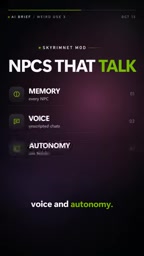
The third "unusual trick" may be what gamers find most interesting. A mod called SkyrimNet gives every NPC in The Elder Scrolls V: Skyrim independent memory, voice, and autonomous behavior. Each NPC no longer just loops preset lines, but can respond differently based on their interaction history with the player.
More critically, the hardware requirement: starting October 23, this mod can run locally on an Nvidia device with 4GB of VRAM. In current AI inference scenarios, 4GB is almost "micro"—being able to run smart NPC dialogue locally shows that small models have reached a usable stage in vertical scenarios.
This case's value lies in demonstrating a path: no cloud-based large model needed, no high-end GPU needed—a lightweight local model can breathe new life into old games. If this model is adopted by more mod developers, the game AI ecosystem will undergo structural change.
Running smart NPC dialogue on 4GB VRAM depends on the model used not being a general-purpose large model, but a quantized and compressed small-parameter model. Quantization is the process of reducing model weights from FP16 or FP32 to INT8, INT4, or even lower bit widths, which can compress VRAM usage several times over with almost no loss in vertical scenario performance. A 3-billion-parameter model quantized to 4-bit can have weight usage compressed to under 2GB, leaving enough VRAM for dialogue context and speech synthesis. Additionally, NPC dialogue is a short-text, strongly constrained scenario that doesn't require the model to have broad general knowledge—a fine-tuned small model actually fits character settings better. Skyrim itself has a mature mod ecosystem and scripting interface (Papyrus); SkyrimNet precisely converts model output into NPC behavior through the script layer, bypassing deep modification of the game itself—this is also an important reason it can quickly be deployed on an old game.
Controversy and Wait-and-See

RTX Spark's positioning is clear—a laptop built around AI agents. From NVIDIA pair's distributed inference, to Broadcast's MCP hardware control, to SkyrimNet's local NPC intelligence, all three lines point in the same direction: AI agents are no longer chatbots in a chat window, but executors deeply embedded in hardware scheduling, content creation, and game interaction.
But the short video author's judgment is also worth considering: "Wait for real reviews to come out." The actual latency of distributed AI inference, stability of cross-platform pairing, and security boundaries of MCP servers are hard to discern from official demos. The $2,600 starting price also means it's not targeting the mass market, but developers and small studios with hard requirements for local AI inference.
A question worth pondering further: if laptops can borrow compute from other computers on the network, will the logic of "buying a stronger computer" be replaced by "building a better network"? Nvidia's answer is already laid out there.
One-line Summary
Nvidia uses distributed inference, MCP hardware control, and local small models to push AI agents onto laptops.
Paragraph Summary
Nvidia is shifting the AI PC concept from "cramming in a stronger GPU" to "teaching laptops to borrow power." The upcoming RTX Spark series supports NVIDIA pair, which automatically discovers other computers on the LAN and splits AI inference tasks across multiple machines for collaborative completion—free, open-source, and cross-platform across Windows/Linux/Mac, pushing "compute sharing" from an enterprise concept to consumer scenarios. NVIDIA Broadcast 2.3 adds an MCP server, letting AI agents control camera and microphone effects, marking AI's extension from software operations to hardware control. The SkyrimNet mod gives each NPC in Skyrim independent memory and autonomous behavior, and can run locally on 4GB VRAM devices. Product positioning is clear, but distributed inference latency, cross-platform stability, and the $2,600 starting price still need real-world review verification.
Related articles

Chain of Thought Isn't Just for AI: How Humans Can Use CoT to Improve Thinking Quality
Chain of Thought isn't just a prompt trick for large models. Starting from a Hacker News discussion, this article analyzes why CoT works for human thinking too, breaks down actionable ways to transfer it, and highlights the key differences between human CoT and machine CoT.
Cloudflare Teams Up with OpenAI: Closi…
Cloudflare Teams Up with OpenAI: Closing the Loop from Vulnerability Discovery to Defense with AI
Cloudflare uses OpenAI Daybreak to investigate security vulnerabilities and generate reviewable remediation plans, while developers use Codex to boost coding efficiency and quality.

Orca Multi-Agent Orchestration in Practice: A Guide to Parallel Collaboration with Claude and Codex
Orca is Stable AI's free open-source agent workbench supporting 34 agents like Claude Code and Codex in parallel. Learn its Git worktree isolation, multi-model orchestration, and mobile management.