Nvidia Scandal Continues to Simmer: AI Chip Leader Faces Trust Crisis

Nvidia's controversy over supply-demand imbalance and ecosystem monopoly continues to simmer; its dominance is hard to shake short-term, but cracks in trust have appeared.
Nvidia has become the building block of America's advanced AI technology thanks to its GPUs and CUDA ecosystem, and demand consistently exceeding supply gives it rare pricing power and ecosystem influence. However, this absolute dominance is being eroded by controversies over supply allocation fairness, market position sustainability, and asymmetric power with major customers. The controversy is transmitting along the supply chain, creating R&D uncertainty for AI startups, accelerating cloud providers' in-house chips, and drawing regulatory scrutiny.
Why Nvidia's "Scandal" Won't Go Away
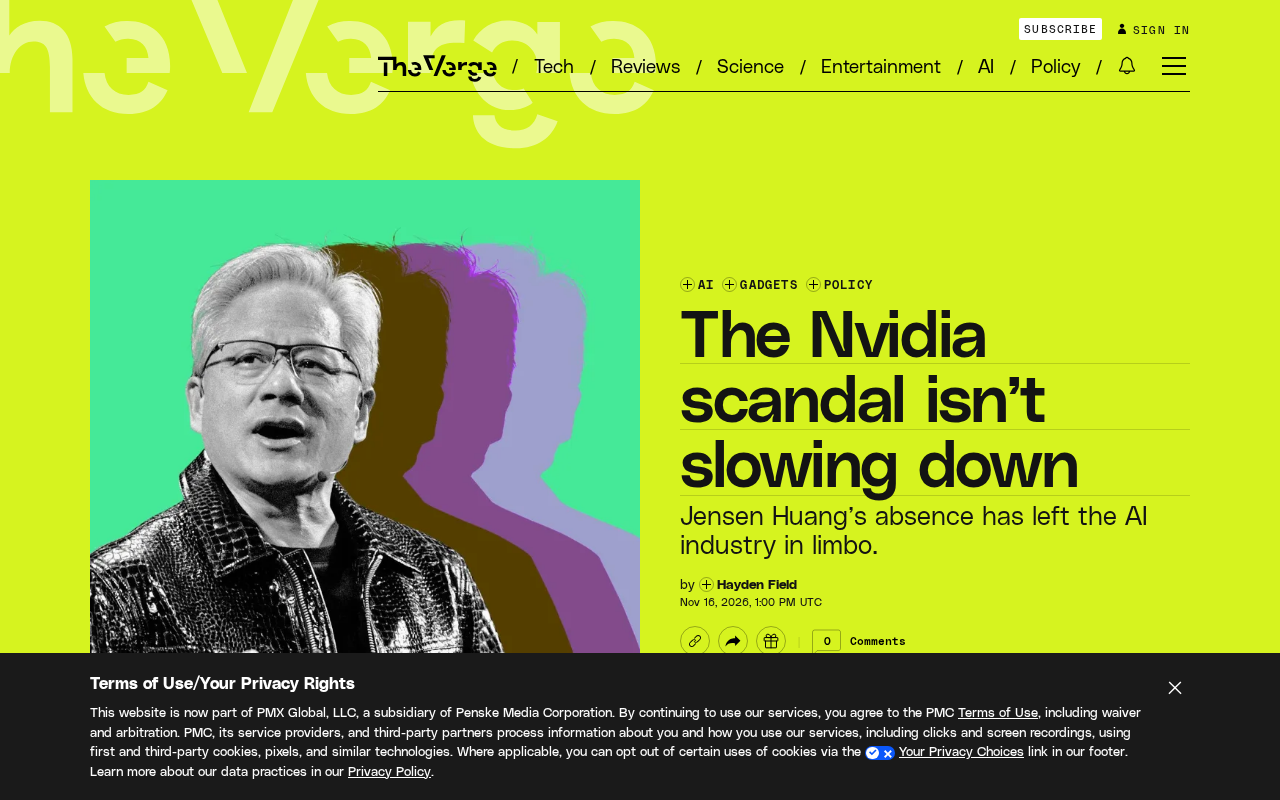
Over the past few years, Jensen Huang, as Nvidia's CEO, co-founder, and president, has had an almost unprecedented influence in shaping the trajectory of AI development. According to The Verge, Nvidia's chips are "the building blocks on which America's advanced AI technology depends." Demand has consistently outpaced supply to the point where AI company CEOs are practically "making pilgrimages" to Nvidia. Yet this absolute dominance is being eroded by a series of controversies—the "scandal" surrounding Nvidia has not subsided but is instead continuing to simmer.
Supply-Demand Imbalance: Two Sides of the Same Coin of Power and Risk
The reason Nvidia's chips have become the hard currency of the AI race lies in the long-term mismatch between supply and demand. On the demand side, virtually all cutting-edge AI workloads—from large model training to inference deployment—depend on its GPUs; on the supply side, capacity ramp-up and supply chain constraints have stretched delivery timelines. This structural scarcity gives Nvidia rare pricing power and ecosystem influence, while leaving customers at a disadvantage at the negotiating table.
The Verge's report highlights a key fact: Nvidia's hardware is "the building blocks on which America's advanced AI technology depends." This statement is both praise and a risk warning—when the entire AI industry's infrastructure is highly concentrated in a single company, any controversy over its business practices, supply allocation, or competitive tactics gets amplified into an industry-level issue.
GPUs (graphics processing units) were originally designed specifically for graphics rendering. Because of their massively parallel computing architecture, they are far more efficient than CPUs at executing core AI workloads such as matrix operations. Large model training requires tens of thousands of GPUs working in concert for weeks or even months, while inference deployment demands continuous compute supply with low latency and high throughput. Nvidia's GPUs (such as the A100 and H100 series), with their dual advantages of performance and software ecosystem, have become the de facto standard for AI infrastructure. This technological dependence means that the AI industry's compute supply is highly concentrated in a handful of chip products—once capacity or allocation runs into problems, the entire supply chain is affected. This is the underlying reason why the supply-demand imbalance gets amplified into an industry-level risk.
The Focus of Controversy: What the Scandal Is Really About
Based on available information, the "scandal" discussions surrounding Nvidia center on several dimensions. The first is the fairness of supply allocation: amid an extreme chip shortage, who gets priority access to inventory and under what terms directly affects the life or death of AI companies. The second is questions about the sustainability of its market position: when a single company simultaneously controls hardware, software ecosystem (such as CUDA), and developer relationships, where are the boundaries of competition? The third is the power relationship with customers—the description of AI CEOs "making pilgrimages" to Nvidia itself implies an asymmetric dependency structure.
It should be noted that the original report did not elaborate on the specific details of the scandal, but rather sketched the public opinion environment surrounding Nvidia from a macro perspective. This also means that the controversy surrounding Nvidia remains in a phase of "continuing to simmer" rather than "settled."
CUDA (Compute Unified Device Architecture) is a parallel computing platform and programming model that Nvidia has offered since 2006. It allows developers to use languages such as C/C++ to directly invoke GPUs for general-purpose computing, not just graphics rendering. After more than a decade of accumulation, CUDA has developed a vast library ecosystem (such as cuDNN and TensorRT) and developer community, and the vast majority of deep learning frameworks (PyTorch, TensorFlow) are optimized for CUDA first or even exclusively. This ecosystem lock-in effect means that even if competitors' chips approach Nvidia in peak compute performance, customers still bear high costs for code rewriting, performance tuning, and talent training when migrating. Therefore, CUDA is not just a technical tool but the core moat Nvidia relies on to maintain its market position—and an unavoidable topic when outsiders question the boundaries of its competition.
Knock-On Effects on the AI Industry
Nvidia's controversy is not just a company-level PR problem; it transmits along the supply chain. For AI startups, uncertainty in chip procurement directly affects R&D pace and fundraising narratives; for cloud providers, the urgency of developing in-house chips is further amplified; for regulators, a single company's monopolistic position over "the building blocks of America's advanced AI technology" naturally invites scrutiny from a competition policy perspective.
The industry influence Jensen Huang has accumulated rests on the certainty of "continuously delivering the most powerful compute." Once that certainty is shaken by controversy, customer behavior may shift from "queuing for supply" to "hedging across multiple bets," even if alternative solutions still lag in performance or ecosystem in the short term.
In-house chips (ASICs/custom accelerators) are a strategy adopted by cloud providers and large tech companies to reduce dependence on Nvidia. Google's TPU, Amazon's Trainium/Inferentia, and Microsoft's Maia are all custom-designed for specific AI workloads and can achieve better energy efficiency and cost control in scenarios such as inference. However, in-house chips face challenges including immature software stacks, low developer willingness to migrate, and long tape-out cycles, making it difficult to fully replace general-purpose GPUs in the short term. The uncertainty of Nvidia's supply allocation has objectively accelerated the pace of these in-house projects and elevated "hedging across multiple bets" from a fallback option to a strategic necessity.
Conclusion: Hegemony Won't Collapse Overnight, But Cracks Have Appeared
Nvidia's dominance in AI chips will be difficult to shake in the short term, and its hardware remains the building block on which advanced AI technology is constructed. But the phenomenon of "the scandal that won't go away" is itself worth heeding: when a company becomes the infrastructure of an entire industry, every controversy it faces becomes an industry controversy. For Nvidia, the real test may not be whether it can keep selling more chips, but whether it can find a new balance between power and trust.
One-line Summary
Nvidia's controversy continues to simmer over supply-demand imbalance and ecosystem monopoly; its dominance is hard to shake in the short term, but cracks in trust have appeared.
Paragraph Summary
With its GPUs and CUDA ecosystem, Nvidia has become the building block on which America's advanced AI technology depends, and demand consistently exceeding supply gives it rare pricing power and ecosystem influence. Yet this absolute dominance is being eroded by a series of controversies: the fairness of supply allocation, the sustainability of its market position, and the asymmetric power relationship with major customers have all become focal points of public debate. The controversy transmits along the supply chain, forcing AI startups to face R&D uncertainty, accelerating cloud providers' in-house chip efforts, and prompting regulators to scrutinize its monopolistic position. Jensen Huang's industry influence rests on the certainty of continuously delivering the most powerful compute; once that certainty is shaken, customers may shift from queuing for supply to hedging across multiple bets. Nvidia's short-term dominance is hard to shake, but "the scandal that won't go away" has itself exposed an imbalance between power and trust.
Related articles

Nightmare Mode: Engineering Practices for Simulating Disk Failures
Starting from the Hacker News Nightmare mode discussion, this article analyzes typical forms of simulated disk failures, fault injection implementation approaches, and how to integrate fault drills into the development process to improve distributed system fault tolerance.

Datasette-charts-pie Plugin Released: New Options for Pie and Sunburst Charts
Datasette-charts-pie 0.1a0 is released, adding pie, donut, sunburst, and rose charts to Datasette. The author dislikes pie charts but built the plugin to test the plugin architecture.

Diablo II: A Classic Retrospective That Changed Gaming History
From game history writing and tech community discussion, a retrospective on Diablo II's random drops, numerical systems, and multiplayer design—analyzing why this classic ARPG is still discussed by developers today.