NVIDIA Vera Rubin NVL72 Tops MLPerf Agentic Inference Benchmark

NVIDIA Vera Rubin NVL72 leads MLPerf Endpoints v1.0 agentic inference benchmark, highlighting system-level design value.
In MLPerf Endpoints v1.0, NVIDIA's Vera Rubin NVL72 delivered a result for agentic inference. The benchmark shifts from single-turn Q&A to multi-turn workloads with tool calling and reasoning chains, measuring endpoint-level performance under long contexts and chained calls. NVIDIA's lead is attributed to rack-scale design—interconnect bandwidth, KV cache management, and tool-call scheduling—matching the new workload profile. The article notes agentic inference is changing hardware selection from token throughput to end-to-end task efficiency, while cautioning the benchmark is new and needs cross-vendor validation.
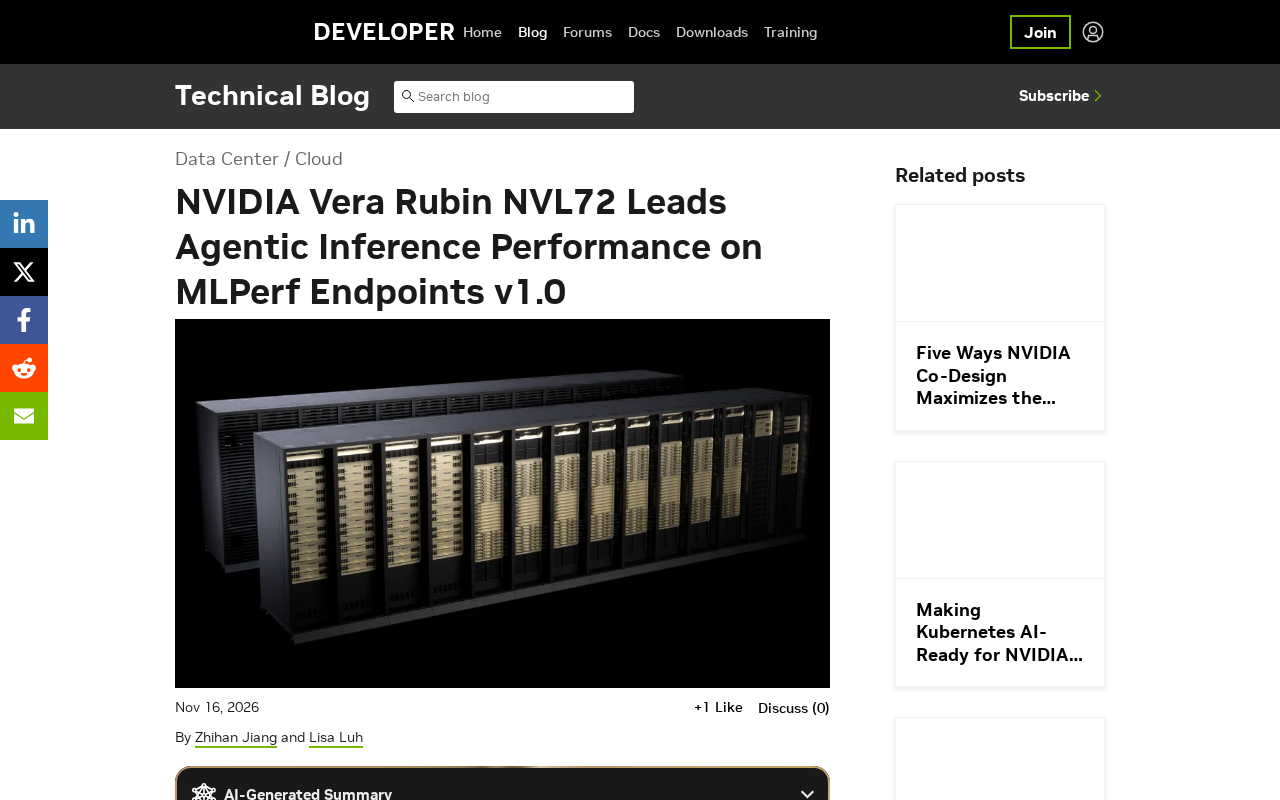
NVIDIA has delivered an answer for agentic inference with Vera Rubin NVL72 in the MLPerf Endpoints v1.0 benchmark. The emergence of this new benchmark is itself more noteworthy than the ranking: it shifts the evaluation target from single-turn Q&A to multi-turn agentic workloads with tool calling and reasoning chains.
What MLPerf Endpoints v1.0 Measures
Most traditional inference benchmarks measure single-turn requests: given a prompt, generate a response, and observe latency and throughput. Agents work in a completely different way—they carry a growing conversation history across turns and, within a single task, mix generating reasoning content, calling tools, reading returned results, and continuing to reason.
According to NVIDIA's technical blog, this type of workload places higher demands on inference systems: contexts grow longer, and request patterns are no longer neatly batched inference but chained calls with dependencies. MLPerf Endpoints v1.0 is an endpoint-level evaluation established precisely for this scenario, measuring system performance under real agentic interactions.
MLPerf is a machine learning benchmark suite led by the MLCommons consortium. It became known early on for its two major suites, Training and Inference, with the latter long centered on single-request latency and throughput. Endpoints is a newer branch positioned as "endpoint-level" evaluation—placing model serving closer to the real application entry point and emphasizing request arrival patterns, multi-turn interaction, and end-to-end response rather than isolated single inference. Compared with the data center suite, Endpoints focuses more on scheduling, caching, and session state management in service-oriented deployments, which explains why it is well suited to evaluating agentic workloads.
Why Vera Rubin NVL72 Leads on This Benchmark
NVIDIA's answer is system-level design. Vera Rubin NVL72 optimizes accelerators, networking, and the software stack as a whole, targeting inference workloads with long contexts and multi-turn interaction. In agentic scenarios, per-GPU compute is no longer the only bottleneck; in-rack interconnect bandwidth, KV cache management efficiency, and scheduling overhead during tool-call round trips all directly affect end-to-end experience.
From this perspective, NVL72's lead is not merely a chip-level victory but the result of a rack-scale architecture matching the workload characteristics of the new benchmark. The endpoint performance measured by the benchmark happens to amplify the value of this system-level coordination.
KV cache is the structure in autoregressive inference that stores the key-value pairs of generated tokens, avoiding recomputation of the entire context for each new token. In agentic scenarios, conversation history grows across turns and tool-returned results are continuously appended, so the KV cache expands rapidly; its memory footprint and management strategy directly determine how long a context can be supported and how many concurrent sessions can be handled. Efficient KV cache reuse allows multi-turn requests to share prefix computation results and reduces redundant computation; meanwhile, the overhead of cache eviction, paging, and cross-device migration affects end-to-end latency. Therefore, KV cache management efficiency is one of the bottlenecks in long-session inference systems that is as critical as compute.
Agentic Inference Is Changing Hardware Selection Logic
In the past, choosing inference hardware meant looking at how many tokens per unit time it could run. Agentic workloads break this metric down further: a single task may include multiple rounds of model calls and multiple tool round trips, and what users perceive is the time to complete the entire task, not the speed of a single generation.
This means the weight of cache hit rate, cross-turn context reuse efficiency, and request queuing strategy is rising. NVIDIA's emphasis on Vera Rubin NVL72's performance in agentic inference is essentially promoting a system design approach for long-session, tool-intensive scenarios. For teams planning to deploy agentic applications, the benchmark results provide a reference point, but real gains still depend on the specific workload shape.
Tool calling refers to the model outputting structured instructions during generation, requesting external functions, APIs, or retrieval systems to perform operations, and then splicing the returned results back into the context to continue reasoning. It splits a user task into multiple rounds of "model—tool—model" round trips, each accompanied by request queuing, network round trips, and context stitching. Compared with pure text generation, tool-calling latency is no longer determined solely by token generation speed; it also depends on whether the scheduler can yield compute resources while waiting for tool returns and process other sessions in parallel. This is exactly the chained-dependency overhead that endpoint-level benchmarks aim to measure, and the reason the value of system-level design is amplified under agentic workloads.
How to Read This Result
MLPerf Endpoints v1.0 is still a relatively new benchmark, and the diversity of participating vendors and submitted results remains to be seen. NVIDIA, as one of the benchmark's drivers, leads on evaluation dimensions it helped shape, so cross-checking with subsequent submissions from other vendors is needed.
The more practical takeaway is that when deploying agentic applications, the evaluation criteria for inference infrastructure should be updated accordingly. Good single-turn throughput numbers do not mean a smooth experience in multi-turn tool-calling scenarios. Vera Rubin NVL72 topping this benchmark at least shows that the system-level optimization path is a proven effective direction under agentic workloads.
One-line Summary
NVIDIA Vera Rubin NVL72 leads the MLPerf Endpoints v1.0 agentic inference benchmark, highlighting the value of system-level design.
Paragraph Summary
In the MLPerf Endpoints v1.0 benchmark, NVIDIA delivered a result for agentic inference with Vera Rubin NVL72. The benchmark shifts evaluation from single-turn Q&A to multi-turn agentic workloads with tool calling and reasoning chains, measuring endpoint-level system performance under long contexts and chained calls. NVIDIA's lead is attributed to rack-scale system design: coordinated optimization of interconnect bandwidth, KV cache management, and tool-call scheduling overhead matches the new benchmark's workload characteristics. The article notes that agentic inference is changing hardware selection logic, from single-turn token throughput to end-to-end task completion efficiency, with rising weight on cache hit rate and context reuse. It also cautions that the benchmark is new and should be cross-checked against future submissions from other vendors.
Related articles

From 0 to 1: Vibe Coding an AI Knowledge Base — A Practical Retrospective and Tech Stack Breakdown
A retrospective on building the AI knowledge base OilBook from scratch with Vibe Coding: Next.js+Neon stack, Oil Dev Skill workflow, Stripe paywall security, interview-style writing, AI-flavor control, and Vercel deployment.

GLM-5.4 Hands-On: Native Vision Meets a New Vibe Coding Workflow
Hands-on with Zhipu GLM-5.4: native vision tested across a 3D product demo, pure-code video generation, and remote-control Vibe Coding, compared with GPT-6.2 and Gemini Neon.

AI and Humans Claim to Prove the Riemann Hypothesis: Machine-Verified, Yet Nobody Can Understand It
Anthropic mathematician and AI Claude claim to prove the Riemann Hypothesis with 17 million lines of Lean code, machine-verified but unreadable by humans. This article analyzes the event, the zero proportion record from 41.6% to 67.2%, and the gap between machine verification and human understanding.