NVIDIA Verified Agent Skills Framework: A New Standard for AI Agent Capability Governance

NVIDIA launches Verified Agent Skills framework, shifting AI agents from capability pursuit to safety governance.
As AI agent capabilities rapidly expand, so do the risks of losing control. NVIDIA has released its "Verified Agent Skills" framework, providing systematic capability governance for AI agents that covers skill certification, permission control, behavior auditing, and risk classification. Deeply integrated with the MCP protocol, the framework adds a trust endorsement layer for MCP-connected tools while establishing quality benchmarks for portable skills, helping enterprises overcome compliance and security challenges in AI agent deployment.
AI Agent Capabilities Are Exploding — and Governance Challenges Are Surfacing
The capabilities of autonomous AI agents are expanding rapidly. Open-source models continue to iterate, the Model Context Protocol (MCP) has opened up tool connectivity, and portable skills have lowered the barrier to building agents — all of these factors combined have made AI agent development easier than ever before.
Notably, autonomous AI agents are not a new concept, but their capabilities underwent a qualitative leap between 2023 and 2024. Early AI agents (such as AutoGPT and BabyAGI) relied primarily on the reasoning capabilities of a single large language model, with limited and unstable tool-calling abilities. As function calling matured in models like GPT-4, Claude 3, and Llama 3, and as reasoning frameworks like ReAct and Chain-of-Thought became widespread, agents could reliably plan multi-step tasks, dynamically select tools, and handle exceptions. The explosion of the open-source ecosystem (frameworks like LangChain, AutoGen, CrewAI, etc.) further lowered the barrier to entry, enabling a single developer to build an agent system with complex tool-calling capabilities in just a few hours. This democratization of capability is precisely why governance has become an urgent concern.
But the flip side is: the more capable agents become, the greater the risk of losing control. When an AI agent can autonomously query databases, initiate API requests, and manipulate file systems, who ensures its behavior is controllable, trustworthy, and traceable?
NVIDIA recently offered its answer — releasing the "NVIDIA-Verified Agent Skills" framework, providing a systematic capability governance solution for AI agents. This move sends a clear signal: the industry is shifting from purely pursuing agent capabilities to focusing on agent safety and manageability.
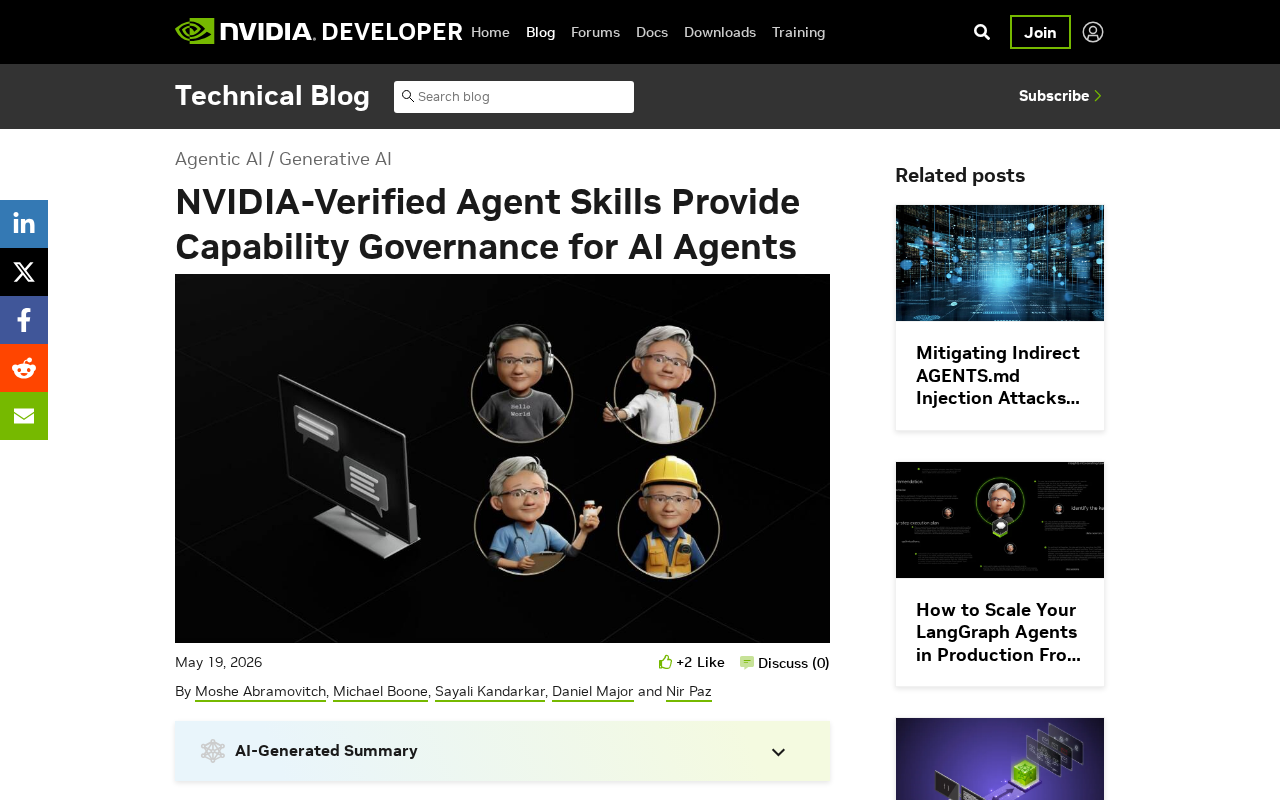
What Are NVIDIA Verified Agent Skills?
Core Positioning
In simple terms, NVIDIA Verified Agent Skills is a set of officially certified agent capability modules. The problem it addresses is very specific: when AI agents connect to various external tools and services via the MCP protocol, how do you determine whether those capabilities are secure, thoroughly tested, and production-ready?
In the past, developers could freely attach any skills and tool permissions to their agents, but there was no unified standard for measuring quality and safety. NVIDIA's verification framework fills this gap — establishing a trustworthy admission mechanism for agent skills.
What Does Capability Governance Actually Cover?
Capability governance is different from traditional AI safety. Traditional AI safety primarily prevents models from outputting harmful content, while capability governance focuses on the boundary between what an agent "can do" and what it "is allowed to do."
From a theoretical perspective, the concept of capability governance sits at the intersection of several fields: from AI alignment research, it corresponds to the engineering response to the "instrumental convergence" problem — preventing agents from acquiring capabilities and resources beyond what is necessary to accomplish their goals; from enterprise IT security, it borrows core concepts from the Principle of Least Privilege and Zero Trust Architecture; from software engineering, it resembles app store review mechanisms (such as Apple App Store's sandbox model), ensuring ecosystem quality through centralized admission controls.
Specifically, NVIDIA's capability governance framework covers the following dimensions:
- Skill Certification: Every skill must pass quality and safety verification before going live
- Permission Control: The range of capabilities an agent can invoke is clearly defined for different scenarios
- Behavior Auditability: Every skill invocation is logged, supporting post-hoc tracing
- Risk Classification: Skills are assigned management tiers based on their potential impact level
The value of this mechanism lies in the fact that it doesn't restrict an agent's capabilities — it makes the use of those capabilities systematic and accountable.
How MCP Works in Tandem with the Verification Framework
MCP Has Become the De Facto Standard
The Model Context Protocol (MCP) was officially open-sourced by Anthropic in November 2024, designed to solve the fragmentation problem in integrating AI agents with external tools. Before MCP, every AI application needed custom integration code for different tools, resulting in extremely high maintenance costs.
MCP uses a client-server architecture: the MCP Server encapsulates specific tool capabilities (such as database access, file operations, API calls), while the MCP Client (i.e., the AI agent) dynamically discovers and invokes these capabilities through a standardized protocol. The protocol is built on JSON-RPC 2.0 and supports core primitives including tool listing, tool invocation, resource reading, and prompt templates. Within just a few months, MCP gained support from major vendors including OpenAI, Google, and Microsoft, with thousands of tool servers available — effectively becoming the industry standard for AI agent tool integration.
This rapid adoption also means that security governance for the MCP ecosystem has become an urgent priority. NVIDIA's verification framework is deeply integrated with the MCP ecosystem, adding a layer of trust endorsement to tools and skills connected via MCP. In practice, developers and enterprises can prioritize NVIDIA-verified skill modules — preserving MCP's flexibility while maintaining control over agent behavior.
Portable Skills Now Have a Quality Benchmark
Portable skills are capability modules that can be reused across different agent frameworks and platforms. A complete portable skill module typically includes: a functional description of the skill (for the LLM to understand when to invoke it), structured schema definitions for inputs and outputs, actual execution logic (which may involve API calls, code execution, or database queries), error handling mechanisms, and security constraint declarations.
Portability requires that skills can operate across different agent frameworks (LangChain, AutoGen, NVIDIA AgentIQ, etc.) and underlying models without depending on specific implementation details — and MCP plays precisely this standardization role. However, portability also introduces security risks: a skill designed for a low-risk scenario could produce unintended consequences when ported to a high-privilege environment. Previously, enterprises often lacked evaluation criteria when adopting third-party skills. NVIDIA's verification mechanism adds safety guardrails to portability by annotating skills with applicable scenarios and risk levels — essentially adding a "standard of measure" to the skills marketplace.
What Does This Mean for the Industry?
The "Last Mile" of Enterprise AI Agent Deployment
Many enterprises face an awkward situation: AI agents are fully feasible from a technical standpoint, but the lack of guarantees around compliance, security, and controllability keeps them from moving to production. This "trust gap"
Related articles
Meta Muse Hits 900K Downloads in Six D…
Meta Muse Hits 900K Downloads in Six Days: The AI Agent Era Has Officially Arrived
Meta's AI agent Muse hit 902K downloads in 6 days, topping US App Store and Google Play charts above ChatGPT and Claude. A deep dive into Muse's capabilities and the AI Agent race.
 Industry Insights
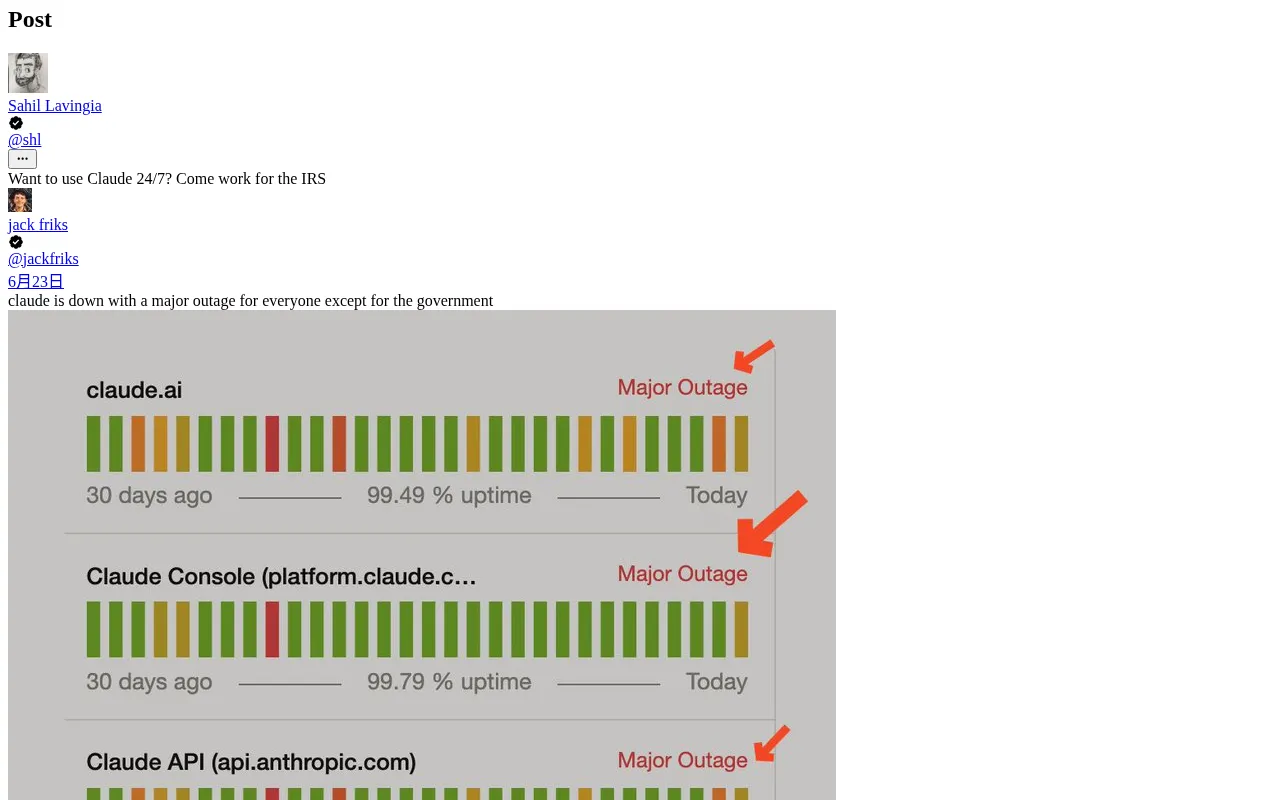
IRS Fully Embraces Claude AI, Accelerating Federal Government's AI Adoption
The IRS is recruiting staff with 24/7 Claude AI access, marking Anthropic's breakthrough into the federal government. Explore the strategic implications and tax use cases.
 Industry Insights
The IRS Mobile App Debate: A Trust Crisis in Government Digital Transformation
The IRS's proposed mobile app has sparked heated debate. This article analyzes the core arguments, exploring data security, privacy, and the trust crisis in government digital transformation.