NYC Subscriber Meetups: A New Signal for AI Creator Community Building

Subscriber-exclusive offline meetups reflect creators shifting from traffic logic to relationship logic, with community as the most stable asset.
Starting from a minimal RSS announcement about a NYC subscriber-exclusive meetup, this article analyzes its implications for the AI and tech content ecosystem. The author notes that creators' focus is shifting from traffic metrics to deep relationships via paid subscriptions, email lists, private communities, and offline meetups. When AI makes content abundant, genuine connection and community belonging become scarce. Offline events serve as a moat against platform uncertainty, and for vertical-niche creators, 100 core readers outweigh 100,000 passersby.
Behind a "Subscriber-Exclusive" Offline Meetup
Recently, a brief announcement from an RSS feed drew attention: a content creator announced they would host NYC Subscriber Meetups "tomorrow and Tuesday," adding a lighthearted line — "If you're seeing this, you're on the guest list."
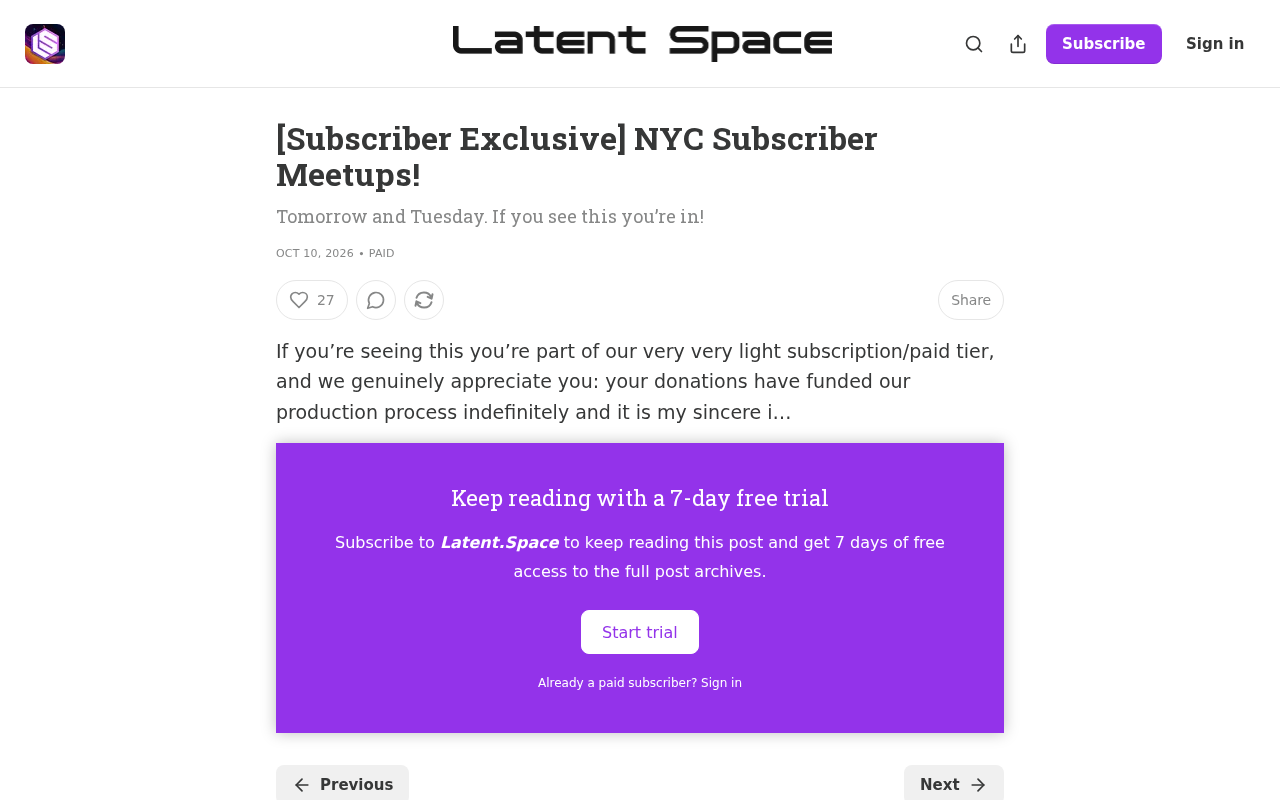
The message itself is minimal, but placed within today's AI and tech content ecosystem, the signal it sends is anything but simple.
Why "Subscriber-Exclusive" Deserves Attention
From Traffic Logic to Relationship Logic
For the past several years, the core metrics for content creators have been views, click-through rates, and follower counts. Platform algorithms determine how many people content reaches, and a recommendation mechanism always stands between creators and their audiences.
The "Subscriber Exclusive" label signals that the operational focus is shifting from "getting as many people as possible to see it" to "getting the people who truly care to stay." Offline meetups turn this relationship from digital signals into face-to-face interaction — a form of trust-building that recommendation algorithms simply cannot replace.
RSS (Really Simple Syndication) is an XML-based content distribution format that emerged around 1999. It allows publishers to output website updates in a standardized structure, and users who subscribe via an RSS reader automatically receive new content without relying on any platform algorithm's recommendations.
RSS's core value lies in "disintermediation": the connection between creator and subscriber is direct and open. The subscription list is controlled by users themselves and won't be lost due to platform throttling, algorithm changes, or account bans. This is why RSS has long been regarded as the underlying infrastructure for independent creators to counter platform risk. The announcement mentioned in this article was published via an RSS feed, meaning it naturally reaches only readers who actively subscribed — this itself is a layer of precise filtering, which also explains why the announcement could use such minimal wording as "if you're seeing this, you're on the guest list."
Offline Events as a Creator's Moat
When AI-generated content makes information supply extremely abundant, what's scarce is no longer the content itself, but genuine human connection and a sense of community belonging. Paid subscriptions, email lists, private communities, and offline meetups — this entire combination is becoming the standard configuration for independent creators to counter platform uncertainty.
Private Domain refers to user assets that creators can autonomously reach, repeatedly engage, and that don't depend on platform distribution. Typical forms include email lists, paid communities, Discord channels, and offline event networks. In contrast, the "public domain" consists of exposure resources in platform recommendation feeds, where distribution rules are determined by algorithms and creators cannot control reach rates.
The core characteristic of the private domain is "migratability": even if a platform declines, creators can still bring users to new territory via email or communities. For AI/tech creators, the private domain offers additional value — while vertical-niche readers may be fewer in number, they have high professional alignment, strong willingness to pay, and good interaction quality, with per-user value far exceeding that of generic traffic. This is why the combination of "paid subscription + email list + offline meetups" is seen as the standard configuration.
Implications for AI Content Creators
Small-Scale High-Density Beats Large-Scale Low-Stickiness
A local NYC meetup might draw only a few dozen attendees, but the loyalty, word-of-mouth, and subsequent paid conversions it generates often exceed tens of thousands of generic content impressions. For AI/tech creators in vertical niches, 100 precisely targeted core readers are far more valuable than 100,000 passersby.
Vertical Niche refers to a creative positioning focused on a specific professional direction — for example, specializing in large model inference optimization, AI art workflows, or a particular type of development tool, rather than general tech news. Vertical creators naturally face a smaller audience pool, but their reader profiles are highly concentrated with clear needs.
Precisely because the audience size is limited, vertical creators rely more on "deep relationships" than "broad exposure" to sustain income. 100 genuinely active core readers may bring stable subscription revenue, high-quality feedback and collaboration opportunities, and become the starting point for word-of-mouth diffusion; while the vast majority of 100,000 generic readers are merely passing through. This structural difference is exactly why vertical-niche creators turn to subscription models and community operations earlier.
Community Operations Need "Product Thinking"
Designing a subscriber meetup as a product — clear access mechanism (subscriber-exclusive), clear scheduling (tomorrow and Tuesday), low-friction participation (saw it, so you're invited) — these details together constitute a good community experience. This approach also applies to the operational design of online communities.
Observations and Judgments
The minimal style of this announcement is itself a filtering mechanism: only those who genuinely follow the creator and have subscribed to the content will see and understand the information at first glance. It doesn't pursue broad reach, but deliberately creates an "insider feel."
For AI creators building personal brands, this offers a path worth referencing: content builds awareness, subscriptions precipitate relationships, and offline events complete the trust loop. In an environment of increasingly fragmented attention, deeply connected communities are becoming the most stable asset.
One-line Summary
Subscriber-exclusive offline meetups reflect content creators shifting from traffic logic to relationship logic, with community becoming the most stable asset.
Paragraph Summary
The article starts from a minimal RSS announcement — a creator announcing a subscriber-exclusive NYC meetup, filtering participants with "if you're seeing this, you're on the guest list" — and analyzes its implications for the AI and tech content ecosystem. The author points out that creators' operational focus is shifting from traffic metrics like views and follower counts to deep relationships built through paid subscriptions, email lists, private communities, and offline meetups. When AI makes content supply extremely abundant, what's scarce is genuine connection and a sense of community belonging. Offline events thus become a moat against platform uncertainty. For vertical-niche creators, 100 core readers are far more valuable than 100,000 passersby, and community operations also require product thinking: clear access, scheduling, and participation methods.
Related articles

Felix Rieseberg Personal Homepage
Felix Rieseberg's personal homepage sparks attention on Hacker News. This article covers the Slack engineer's technical background, the rise and fall of nativefier, and the value of a developer homepage as a tech calling card.

@ai-sdk/vue 3.0.306 Patch Release Syncs with [email protected] Update
@ai-sdk/vue 3.0.306 released, synced with [email protected]. A routine patch release for the Vercel AI SDK ecosystem with no public API changes; the Vue adapter layer stays version-aligned with the core package.

Gemini 4 Argon API Launches: The Era of Million-Token Output Begins
Google launches Gemini 4 Argon with sparse MoE architecture, up to 1M output tokens, and a 68.90% Vals Index score, available across API, AI Studio, and the Gemini app.