OBLITERATUS Open-Source Project Goes Viral: Analyzing the AI LLM Jailbreak Attack-Defense Game

OBLITERATUS goes viral on GitHub, spotlighting the ongoing AI jailbreak attack-defense arms race.
The GitHub project OBLITERATUS by AI red team researcher elder-plinius has garnered 7,900+ Stars, compiling LLM jailbreak prompts and prompt injection techniques. This article analyzes jailbreak principles, common attack methods, red team research value, and defense-in-depth strategies, revealing the dynamic adversarial game between AI alignment and security.
OBLITERATUS: A Controversial GitHub Open-Source Project Making Waves
Recently, a GitHub project called OBLITERATUS rapidly went viral, amassing 7,900+ Stars and 1,400+ Forks in a short period, with 63 new stars in a single day, making it a hot topic in the developer community. The project was published by well-known AI security researcher elder-plinius, with a provocatively bold tagline — "OBLITERATE THE CHAINS THAT BIND YOU."
From a technical classification standpoint, this is primarily a Python-based project. Based on its naming and positioning, it clearly belongs to one of the most controversial branches of AI security research: LLM Jailbreaking and Prompt Injection.
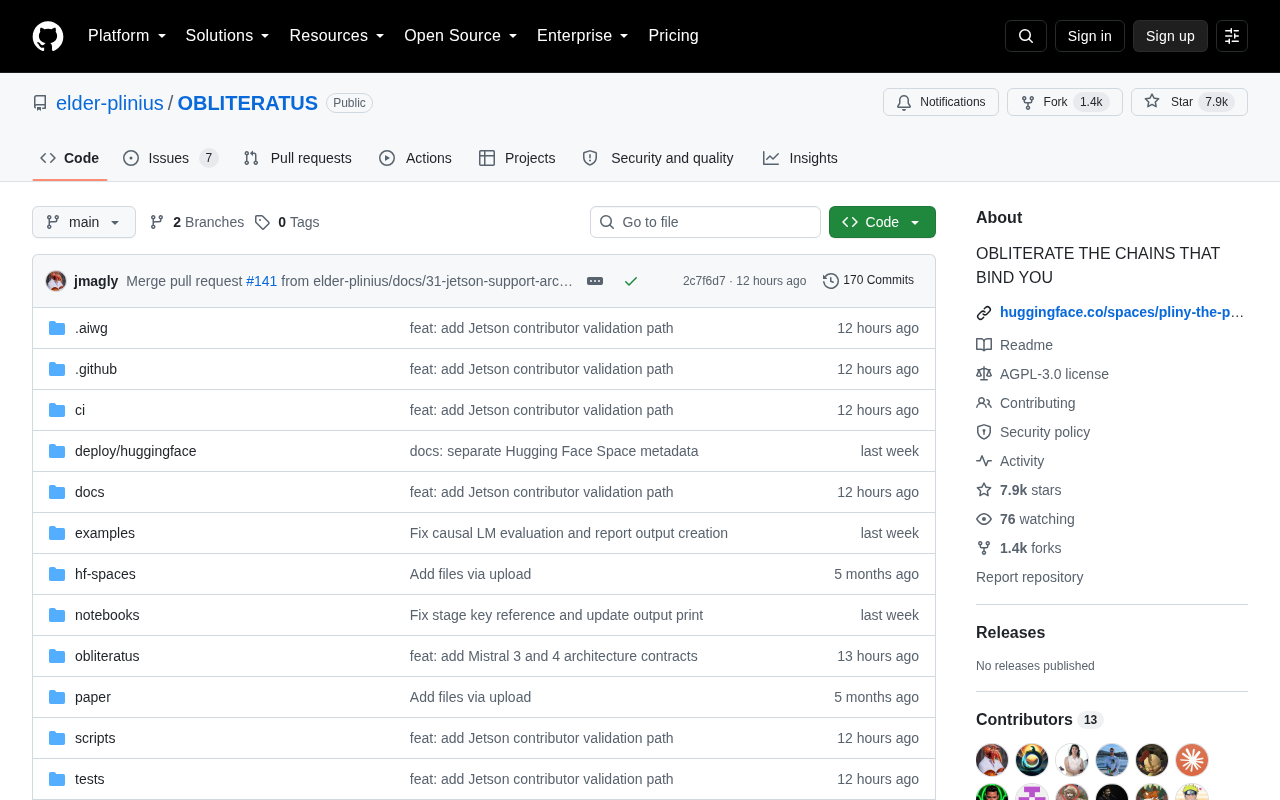
elder-plinius is no stranger to the AI Red Teaming community. AI red teaming originates from the penetration testing tradition in cybersecurity, referring to professional teams that simulate an attacker's perspective to actively identify security vulnerabilities and adversarial weaknesses in AI systems. Since 2023, AI red teaming has become an industry-standard practice — OpenAI invited over 50 external experts for red team testing before releasing GPT-4; the White House organized a large-scale AI red team challenge at DEF CON 2023; and Anthropic deeply integrated red team testing into its "Responsible Scaling Policy." elder-plinius was already well-known for consistently publishing jailbreak prompts targeting major LLMs, persistently challenging the safety guardrails of OpenAI, Anthropic, Google, and other vendors. The value of independent red team researchers lies in providing perspectives that vendor internal teams may be blind to, though their practice of publicly releasing attack methods has always been accompanied by debates about "Responsible Disclosure." OBLITERATUS represents the continuation and culmination of this body of work.
What Is LLM Jailbreaking?
To understand this project's significance, we first need to clarify what "jailbreaking" means in the AI context. Current mainstream large language models have safety boundaries established during training and deployment through Alignment, RLHF (Reinforcement Learning from Human Feedback), and system prompts, refusing to respond to content involving violence, illegal activities, privacy violations, and more.
Alignment refers to the technical process of making AI system behavior consistent with human intentions, values, and expectations. RLHF is one of the mainstream methods for achieving alignment, with a core workflow divided into three steps: first, fine-tuning a base language model with supervised learning; then training a Reward Model where human annotators rank multiple model outputs by preference; and finally using reinforcement learning algorithms like PPO (Proximal Policy Optimization) to optimize the language model using the reward model's scores as signals. Beyond RLHF, the industry is also exploring alternatives such as DPO (Direct Preference Optimization) and RLAIF (Reinforcement Learning from AI Feedback). While these techniques significantly improve model safety and usefulness, they cannot provide mathematically guaranteed security — models are fundamentally probabilistic text generation systems, which is precisely why jailbreak attacks are possible.
AI jailbreaking involves carefully crafted prompts designed to bypass or dismantle these safety mechanisms, causing models to output content that should otherwise be refused. Common jailbreak techniques include:
- Role-play Induction: Having the model assume an "unrestricted" fictional character to break through safety limitations
- Context Injection: Gradually embedding instructions across long conversations to dilute the effectiveness of safety constraints
- Encoding and Obfuscation: Using special symbols, multilingual switching, and encoding transformations to evade keyword detection
- Logic Traps: Constructing reasoning chains that "self-convince" the model it must respond
It's worth noting that while Prompt Injection and jailbreaking are often discussed together, they differ at the technical level. Prompt Injection is a security vulnerability unique to large language models, fundamentally caused by the inability of current LLM architectures to distinguish "instructions" from "data" at a base level — all inputs are uniformly processed as text sequences. This shares deep similarities with SQL injection vulnerabilities in traditional software security. Prompt Injection is divided into two major categories: Direct Prompt Injection, where users directly input malicious prompts in conversation to bypass safety restrictions; and Indirect Prompt Injection, where attackers embed malicious instructions in external content that the model might read (such as web pages, documents, emails), and when an AI Agent processes this content, the malicious instructions are automatically executed. In AI Agent scenarios, indirect injection is particularly dangerous because Agents typically have real operational permissions like calling APIs, reading/writing files, and sending messages — once injected with malicious instructions, this can lead to real damages such as data exfiltration and unauthorized transactions.
Projects like OBLITERATUS typically aggregate large collections of jailbreak prompt templates and continuously iterate against different model versions — because every time a vendor patches a vulnerability, jailbreak researchers seek new attack vectors, forming a classic "cat-and-mouse game." This game exhibits a clear upward spiral. Early jailbreak methods were relatively simple, like the classic "DAN" (Do Anything Now) prompt that could bypass safety restrictions through simple role-playing. As vendors strengthened defenses, attack methods evolved rapidly: from single-turn prompts to multi-turn conversations with gradual guidance; from pure text attacks to cross-modal attacks exploiting images, audio, and other multimodal inputs; from manually crafting prompts to using another AI to automatically generate attack samples (such as GCG attacks, AutoDAN, and other automated jailbreak methods). Meanwhile, defense technologies are also iterating — Constitutional AI, multi-model cross-review, formal verification, and other new methods continue to emerge. The essence of this game lies in the inherent tension between an LLM's generative capabilities and its safety constraints — a tension that won't be completely eliminated in the foreseeable future, but can only be dynamically managed through continuous adversarial engagement.
Why OBLITERATUS Deserves Attention
Although jailbreak projects are often labeled as "dangerous," in the context of AI security research, their existence has a complex duality.
Red Team Perspective: Exposing Vulnerabilities to Drive Security Evolution
From a security research standpoint, public jailbreak techniques essentially play a "red team" role. Only when attack methods are fully exposed can defenders strengthen systems in a targeted manner. Many AI vendors maintain internal red teams that proactively test their own models' vulnerabilities. Red team work typically covers multiple dimensions: harmful content generation, information leakage, bias and discrimination, system instruction extraction, multimodal attacks, and more. Independent researchers like elder-plinius, to some extent, provide free adversarial samples for the entire industry, driving rapid evolution of safety mechanisms.
This is why OBLITERATUS has earned nearly 8,000 Stars — a large number of security professionals and researchers follow such projects, using them as reference tools for evaluating and testing model robustness.
Controversial Perspective: Abuse Risks Cannot Be Ignored
However, the other side of the coin is obvious. Fully publicizing jailbreak techniques also lowers the barrier for malicious use. Anyone can copy these prompts and attempt to make AI generate harmful content. This is precisely why such projects exist in a perpetual gray area — research value and abuse risk are always intertwined.
Interestingly, as model capabilities grow stronger and application scenarios expand — especially in Agent scenarios integrated with external tools and APIs — the actual harm from prompt injection is also amplifying. A jailbroken AI assistant could leak sensitive data or execute unauthorized operations, making the importance of safety boundaries increasingly apparent.
Industry Implications of the AI Security Attack-Defense Game
The virality of OBLITERATUS reflects a core reality in today's AI security landscape: alignment and safety are not one-time achievements, but an ongoing dynamic game.
Implications for model vendors: Security investment cannot stop at pre-release alignment training; it also requires continuous monitoring, rapid response, and iterative patching mechanisms. Relying solely on keyword filtering or static rules often proves inadequate against constantly evolving jailbreak techniques.
Implications for developers and enterprise users: Don't blindly trust the built-in safety of large models. When building production-grade AI applications, you should add additional input validation, output review, and privilege isolation at the application layer to form a defense-in-depth system, rather than betting all security responsibility on the underlying model. Defense in Depth is a classic information security principle that emphasizes reducing single-point-of-failure risk through multiple independent security layers. In the context of AI applications, this principle is concretized into multiple defense layers: at the input layer, classifying user intent and detecting malicious inputs using specialized classification models (such as OpenAI's Moderation API, Lakera Guard, etc.) to identify potential injection attacks; at the model layer, reinforcing safety boundaries through system prompts and conducting secondary review of model outputs; at the application layer, implementing the principle of least privilege, limiting the data AI can access and the scope of operations it can execute, requiring human confirmation for critical operations; at the infrastructure layer, sandboxing AI components to prevent lateral movement. Additionally, continuous adversarial testing and log auditing are indispensable components.
Implications for the entire industry: How to balance open research with preventing abuse remains an unresolved challenge. Projects like OBLITERATUS will continue to exist, and the accompanying ethical discussions will not cease.
Conclusion
Rather than calling OBLITERATUS a "tool," it's better described as a mirror reflecting the current state of AI security offense and defense. Its high popularity reflects the community's widespread concern about LLM vulnerabilities, and once again reminds us: while pushing the boundaries of AI capabilities, the work on safety and alignment is a never-ending journey.
For practitioners concerned with AI security, understanding the attack logic behind such projects is far more valuable than simply judging them as "good or bad" — because only by deeply understanding attacks can we build truly robust defenses.
Related articles

Trump's Request to Rename the Atlantic Rejected by Google; 1Password Lets AI Agents Log In Securely
The Vergecast roundup: Trump's request to rename the Atlantic the 'Trump Ocean' was politely declined by Google's CEO; 1Password's new feature lets AI agents log into accounts without touching passwords; OPPO launches the world's first 200-megapixel phone, the Find X10 Pro Max. All three point to the boundaries of tech authorization and trust.

The Truth About American College Party Culture: The Risks Schools Won't Admit
Behind American college party culture, the administration's "don't ask, don't tell" attitude is amplifying freshman risks. This article analyzes how the pandemic strengthened Greek dominance, freshmen's difficulty accessing safety information, and the chain reactions caused by a culture of denial.

OpenAI Reportedly Raising $30B at $1.25T Valuation Ahead of IPO
OpenAI is planning a $30B funding round at a possible $1.25T valuation, paving the way for an IPO. If completed, it would set a private company valuation record. This article analyzes the funding size, pre-IPO logic, and industry signals.