Gemini 3.7 Flash Released: An AI Model That's Faster and 50% Cheaper

Google's Gemini 3.7 Flash delivers faster speeds, 50% lower costs, and smarter responses.
Google has released Gemini 3.7 Flash, the latest in its Flash series, featuring a 50% price cut, faster response times, and notable intelligence improvements achieved through algorithmic optimization in just three weeks. Available across API, AI Studio, and Antigravity, the model targets developers and enterprises seeking cost-effective, low-latency AI inference at scale.
Gemini 3.7 Flash Officially Arrives
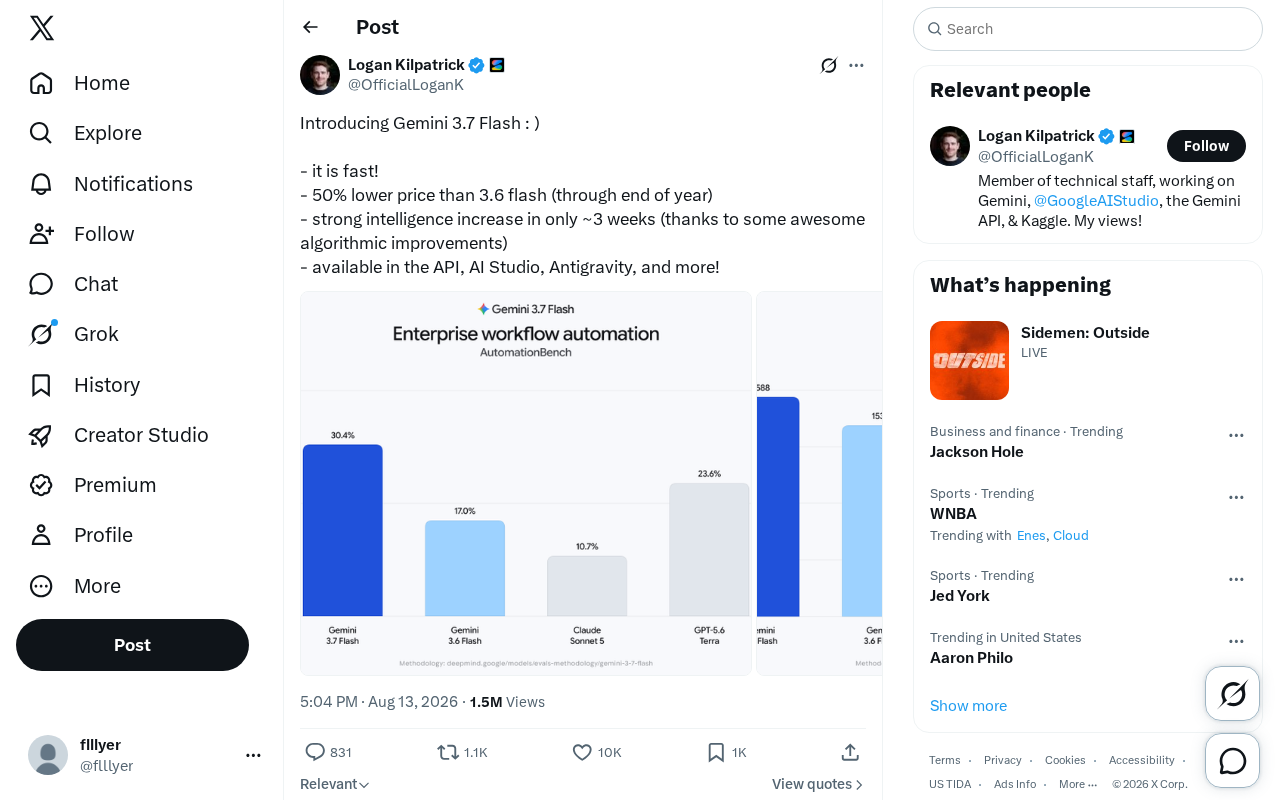
Google recently announced Gemini 3.7 Flash on social media as the latest iteration of the Flash series. Compared to its predecessor, 3.6 Flash, the core message of this update is crystal clear — faster, cheaper, and smarter. For developers and enterprise users, this means significantly lower costs without sacrificing response speed.
What you might not have noticed is that the upgrade from 3.6 to 3.7 took only about three weeks. The Google team stated that the notable leap in intelligence was primarily driven by algorithmic-level improvements, rather than simply throwing more compute at the problem. This detail reveals Google's continued investment in model efficiency optimization.
Three Core Upgrades of Gemini 3.7 Flash
Speed Boost: The Flash Series' Signature Strength
The Flash series has always been known for low latency and high throughput, targeting speed-sensitive use cases. Gemini 3.7 Flash continues and strengthens this positioning — the official team described its response performance simply as "it is fast!" For products that require real-time interaction — such as customer service bots, code completion, and real-time translation — speed is often the decisive factor in user experience.
50% Price Cut: A Major Cost Advantage
The most eye-catching change this time is that the price has been cut by 50% compared to 3.6 Flash (a limited-time offer through the end of the year). A halved price tag is hugely significant for enterprises making large-scale API calls — it means the same budget can support twice the call volume, or dramatically reduce costs while maintaining the same business scale.
In today's fiercely competitive AI inference market, pricing has become a core battleground alongside performance. Google's move is clearly aimed at capturing the developer ecosystem through pricing advantages.
Intelligence: A Significant Leap in Just Three Weeks
Google emphasized that Gemini 3.7 Flash achieved "strong growth" in intelligence, and this improvement was accomplished in just three weeks. It was powered by "algorithmic improvements." This means Google can enhance model capabilities without significantly increasing model size or inference costs — a textbook example of the "efficiency dividend" that the current wave of large model development is striving for.
Where to Access Gemini 3.7 Flash
In terms of availability, Gemini 3.7 Flash offers broad coverage:
- API: The standard integration method for developers
- AI Studio: Google's model experimentation and development platform
- Antigravity: Google's newly launched development environment
- And additional integration endpoints
This strategy of launching across multiple channels simultaneously lowers the barrier to entry for developers and reflects Google's intent to rapidly scale adoption of the new model.
Industry Perspective: The Competition Logic of Efficiency-First AI Models
Several trends emerge from the release of Gemini 3.7 Flash.
First, iteration cycles are accelerating. Completing a meaningful intelligence upgrade in just three weeks shows that model optimization cycles are being dramatically compressed, and that Google has the engineering capability to deliver improvements rapidly.
Second, "fast and affordable" is becoming the mainstream selling point. While flagship ultra-large models are certainly important, the models that truly power massive commercial applications tend to be these mid-weight models that balance speed and cost. The Flash series' positioning hits the sweet spot for the vast majority of production environments.
Finally, the AI inference price war has officially begun. A 50% price reduction is no minor adjustment — it's a clear signal from Google in the inference cost competition. For users, stronger capabilities, faster speeds, and lower prices are arriving all at once.
Summary
The launch of Gemini 3.7 Flash is another step in Google's "efficiency-first" approach. Rather than pushing for extreme parameter counts, it achieves a better balance among speed, cost, and intelligence through algorithmic optimization. For developers evaluating their options, this model — combining low latency with low pricing — deserves a spot on the shortlist. The limited-time pricing offer through the end of the year also provides extra incentive for teams looking to give it a try.
Related articles

Getting Started with Claude Code: Why It's the Most Powerful AI Coding Assistant
Deep dive into Claude Code's core advantages vs Cursor, Trae, and Copilot. Learn how its full-project context understanding and auto-debugging make it the top AI coding assistant.

OpenCode Tutorial: A Complete Guide from Installation and Configuration to Hands-On Practice
Complete guide to OpenCode AI coding tool: two installation methods, model configuration, Agent types, custom commands, MCP extensions, Agent SQL, with practical examples.

Getting Started with Claude Code: Complete Guide to Terminal AI Coding Tool Installation and Selection
Complete guide to Claude Code terminal AI coding tool: installation, setup, Terminal vs Device Agent comparison, and the practical Claude Code + DeepSeek combo.